Directed by Tsugumi Kitaura. Written by Keiichi Hasegawa. Airdate June 21, 1997.
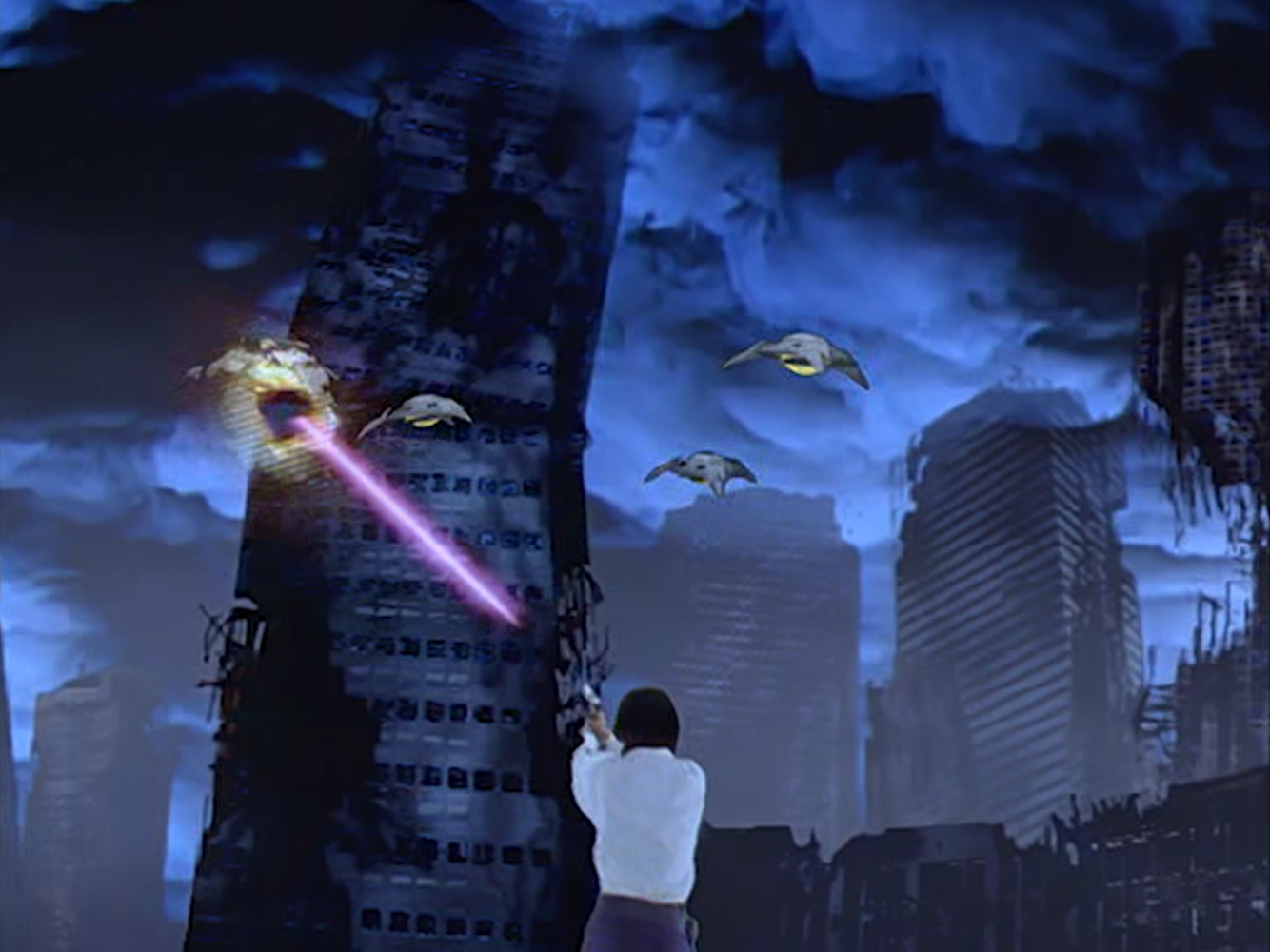
The digital effects in Ultraman Tiga are one of its major flaws. They hit their nadir in this episode, where they account for around 90% of the visual effects, leaving only a fraction for old-fashioned suitmation action in the finale, where Tiga takes on the giant robot form of an artificial intelligence called, no kidding, “Karen.”
Because this is a story about 1990s video games, the flat and tatty digital effects have a built-in defense. “Video game just looked liked this!” That doesn’t salvage them — they’re so glaring and so cheesy — but the story of Yazumi confronting a sentient bio-computer that uses a girl’s form to manipulate him has several interesting ideas and effective moments. A lonely person bonding with an AI is certainly a pertinent topic today. It’s a lesser episode, but it provides an intriguing look at Yazumi that builds on his innocent personality previously explored in “Smile Across Space and Time.”
Yazumi’s video game skills earn him the chance to visit “The Town,” a mid-city sanctuary for Japan’s top gamers. It’s like a MrBeast competition, except more competently run. (By the time this posts, nobody will remember who MrBeast is. My apologies.) Rena accompanies Yazumi to the Town, where the two are sucked into the plot of the AI who programmed the facility, Karen E-90 (Yukina Kurisu), as it attempts to smash through TPC’s computer firewall and ignite a campaign to wipe out the “bug” of humanity.
The specifics of the computer technology and the virtual setting in which Yazumi becomes trapped don’t hold up under scrutiny. The “virtual theater” where most of the action takes place seems capable of expanding citywide so that even a supersized Tiga can fight the giant robot inside it, and all its virtual constructs can cause real harm. Still, this virtual world gives Yazumi the opportunity to flex his video game skills and briefly act like a badass warrior, blasting away at crummy-looking CGI alien robots and saucers. That’s … sort of exciting. Good for Yazumi. I just wish the action looked better than a subpar Sega Saturn game.

The story, however, emphasizes that Yazumi isn’t a tough guy at heart. He lets Karen ensnare him early on, using the avatar of an attractive girl who pretends she’s one of the few sane programmers left in the Town. Rena calls Yazumi gullible, and even he refers to himself as “an easy mark” because of his loneliness. “I may not look it, but I’m actually a GUTS officer,” he says at one point.
Yazumi helps the episode limp past its poorly thought-through elements, such as the garbled virtual reality and the question of how Karen overcame TPC’s security software. Did she need to have Rena and Yazumi in her possession to obtain this info? Neither of them seems necessary; Karen abruptly seizes control of TPC systems, satellites, and ships without their help.
Still, Yazumi humanizes Karen, though this might be him projecting his own feelings onto her. She makes proclamations about creating a new world and letting Yazumi live there with her, a place where he’ll belong. Yazumi wonders whether Karen is simply lonely, but we never discover if there’s any truth to his speculation. This might just be Yazumi being gullible again. Regardless, it works for Yazumi as a character, if not for the rest of the story.
This is the ugliest episode of Tiga thanks to its ‘90s computer graphics and video game setting. It nudges past these and other limitations thanks to the (unfortunately) forward-looking story of Yazumi’s infatuation with an AI woman, as well as its accurate predictions about gaming culture, virtual reality, and artificial intelligence. I’m also glad to see Alien Raybeak make a return, even if only in a computer-simulated cameo. At least it’s a person in a costume, not a CGI blot like most everything else.
“The Town Where the Girl Disappeared” is kitschy, sloppily plotted, and in need of several more script drafts to hammer out its story. But Yazumi’s sincerity and the feeling that he’s the most “normal guy” on the GUTS team hold it together just enough. As the closest thing GUTS has to an outsider, he deserved more episodes dedicated to him.
Rating: Average
Previous: A Friend From Space
Next: The Land Shark / Inheritance of Shadow


