
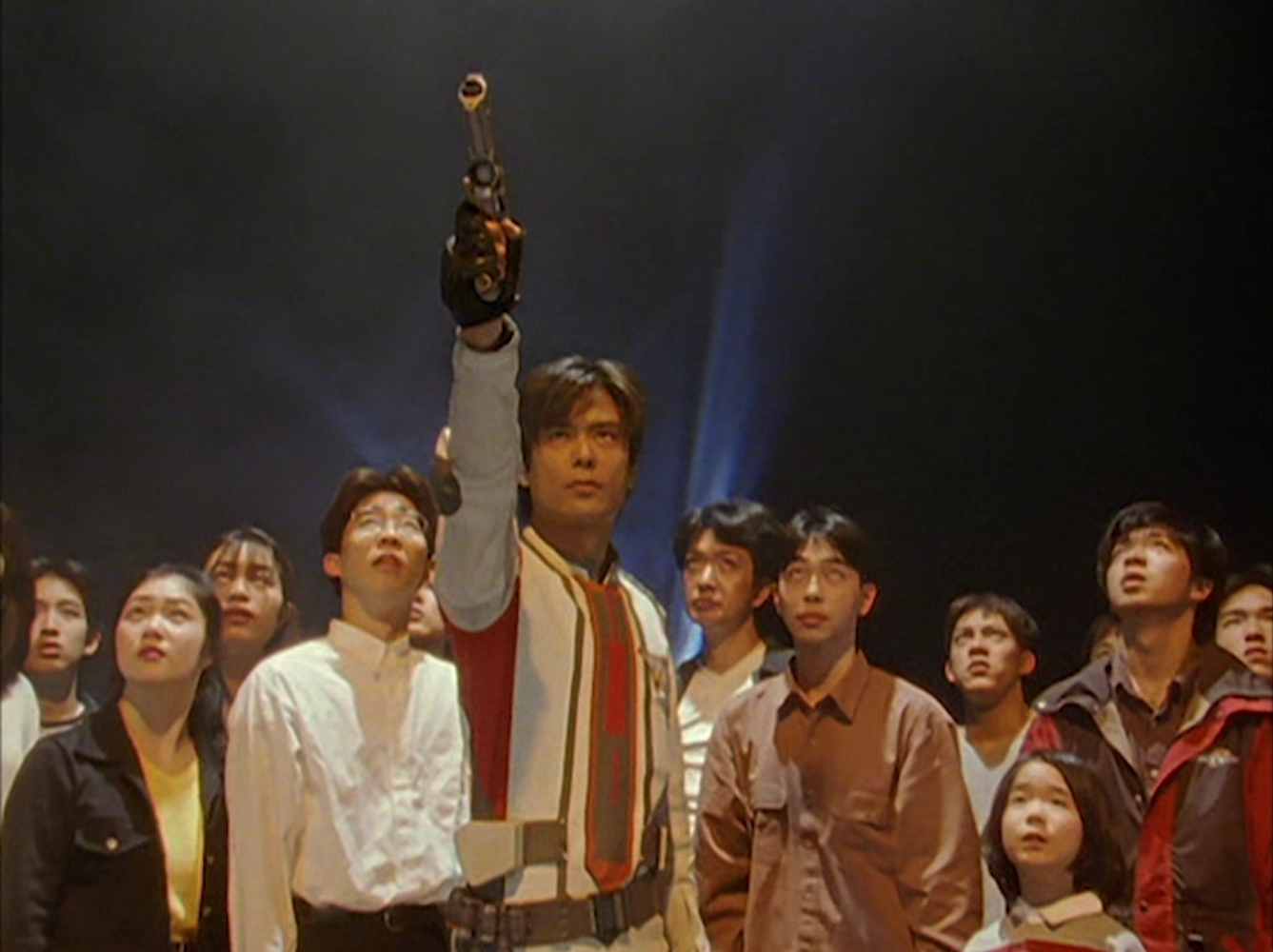
Directed by Tsugumi Kitaura. Written by Ai Ota. Airdate June 14, 1997.
The fourth and final Ultraman Tiga script from Ai Ota. Her previous episodes show her talent for stories with fairy-tale and fantasy slants, similar to Ultraman Taro but without the Showa-era crackpot absurdity. “Deban’s Turn” is a delightful children’s story, while “The Battle of Zelda Point” takes a sombrous approach to what could have been a simple girl-and-her-pet fable. Good stuff, and Ota would continue to write other enjoyable scripts for future Heisei Ultra shows.
Her last Tiga script is another solid piece of tokusatsu entertainment. It treads familiar territory: yet another Ultra take on The Quatermass Experiment, in which astronauts return to Earth after undergoing an alien transformation. Tiga already riffed on this concept in “Goodbye, Planet Earth.” Ota improves on that episode by making the affected astronauts friends of Shinjoh, which creates more personal drama.
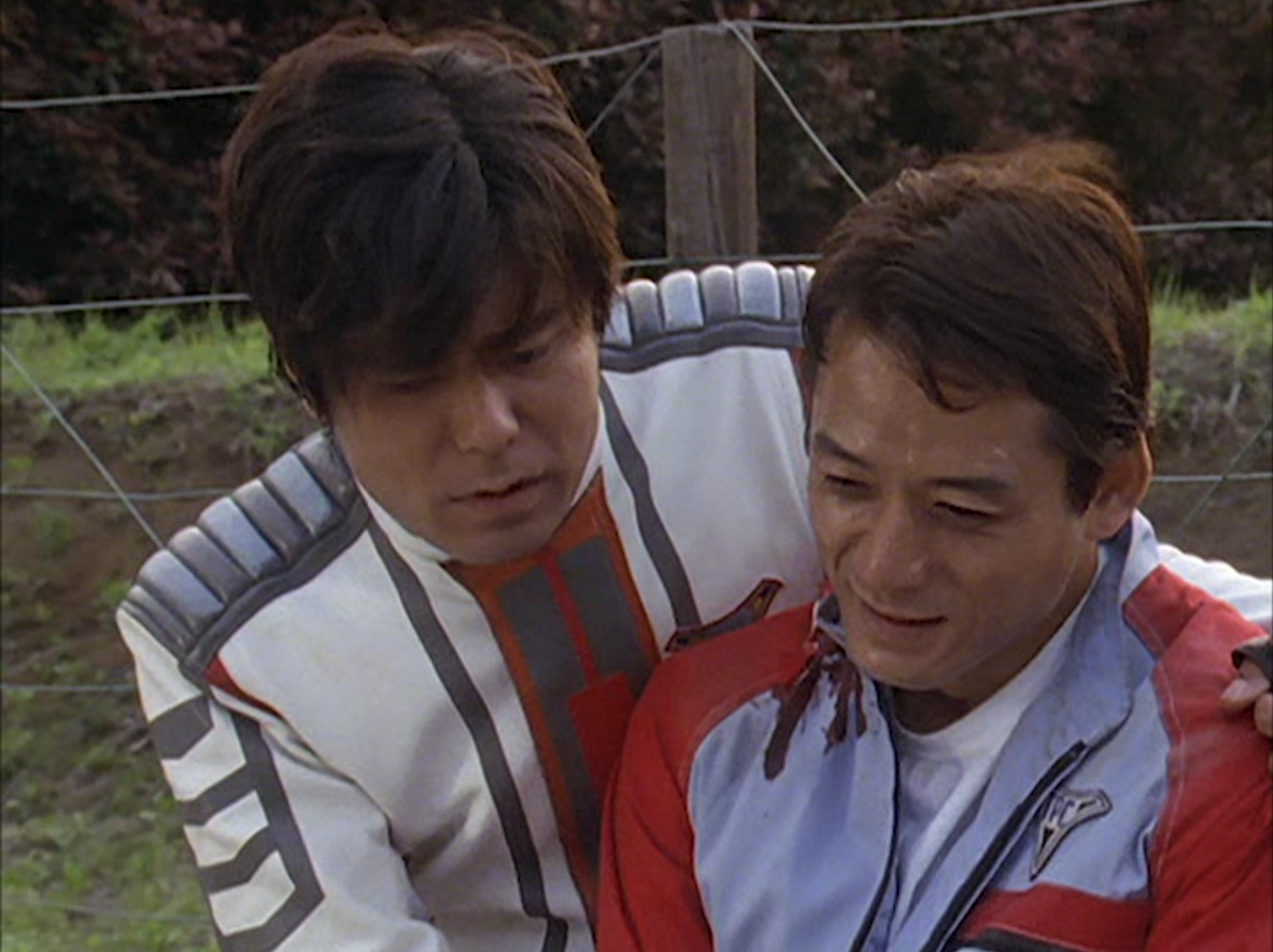
Shinjoh’s old pals from the academy, Inui (Tom Saeba) and Kinosaki (Shintaro Hayasaka), are returning to Earth after a two-year voyage aboard the vessel the Romulus. However, an extraterrestrial creature, Alien Irudo, has infiltrated the ship and infected Kinosaki, turning him into one of the aliens. When the Romulus crashes, Shinjoh accidentally shoots and kills the alien form of Kinosaki when it emerges from the wreckage. This fills Shinjoh with guilt, even though he recalls hearing Kinosaki’s voice urging him to shoot.
The episode fields several ideas that don’t pan out beyond one or two scenes. Alien Irudo has an eye-catching design that wouldn’t feel out of place in the Showa era. However, the invaders’ plot never feels especially threatening or developed. After their first emergence, Alien Irudo lands a large tower in a city and broadcasts a message that they wish to live in peace with humans. They invite people to gather at their tower at noon to experience harmony, or oneness … something like that. In reality, the extraterrestrials plan to simply transmogrify humans into more Alien Irudo, as they did to Kinosaki.
There are hints of the appeal the aliens’ offer has for young people who feel like outsiders. One youth tells Shinjoh that he’d be fine being altered into an Irudo. However, the Irudo lure only a meager pack of kids to their tower — not exactly an Earth-shattering result. They then abruptly switch tactics from subterfuge and promises of universal harmony to simply sucking people into the tower to transform them into Alien Irudo duplicates. Basically, Alien Irudo cannot compete with the Kyrieloids as existential threats who manipulate humanity’s loneliness and misplaced desires.
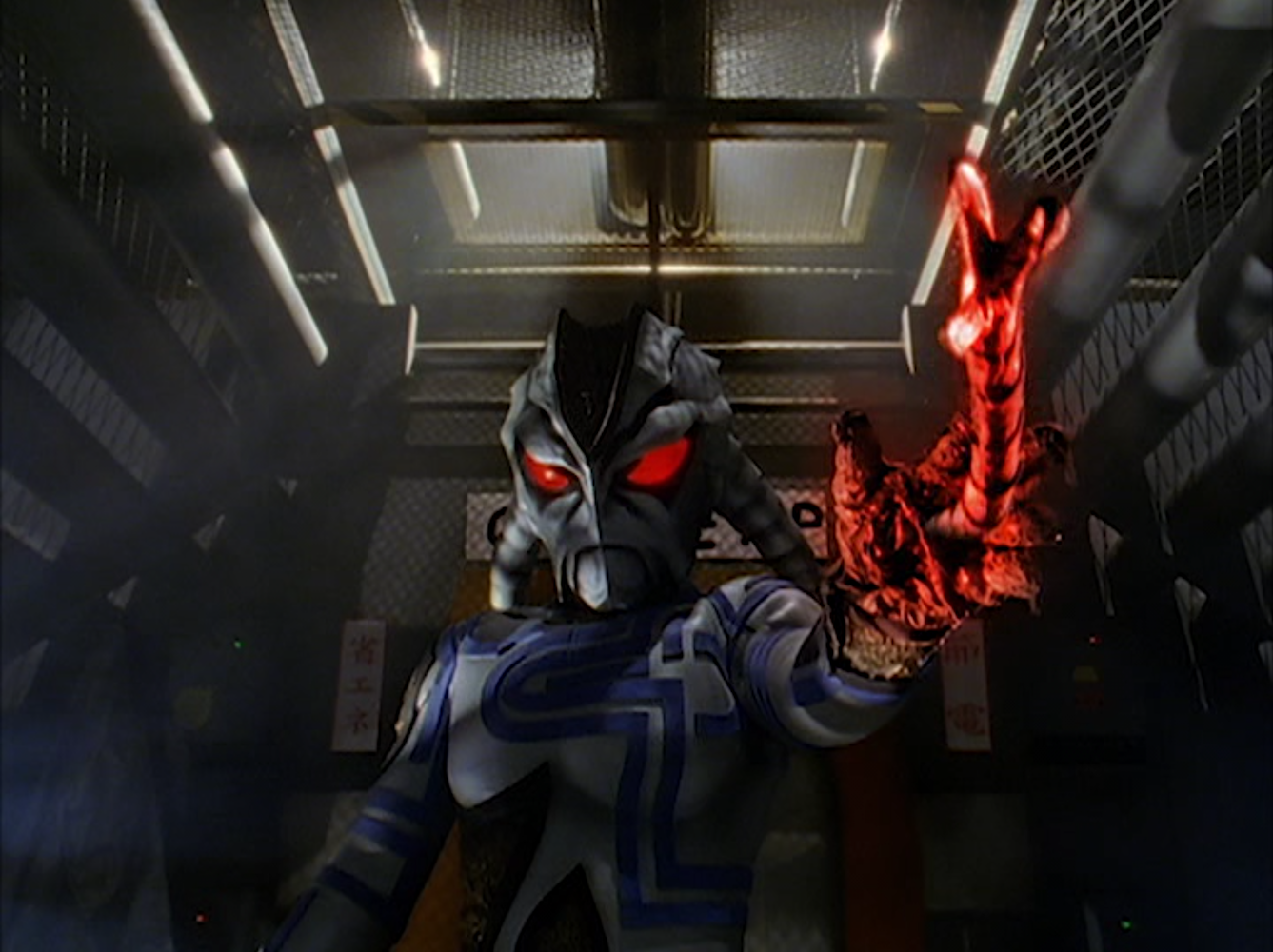
Alien Irudo’s final battle with Ultraman Tiga is one of the less interesting fights, shot almost entirely with a stroboscopic effect that makes the action jittery and unappealing to watch. The best action is when Munakata and Rena arrive in the GUTS Wings to attempt to demolish the tower, with Munakata piloting the impressive-looking GUTS Wing EX-J.
However, the story is more interested in the personal stakes for Shinjoh and Inui than in the alien’s larger scheme. On that level, the episode works.
Shinjoh again proves his flexibility as a lead. Early plans for the episode had Inui and Kinosaki as Daigo’s friends, but Shinjoh is a better choice. Daigo just isn’t interesting enough as a character, except when he’s paired with Rena, so the drama lands better with Shinjoh. Even though we’ve never met Inui before, his camaraderie with Shinjoh makes him feel like a semi-regular.
The best parts of the episode are Shinjoh’s struggle with accidentally killing Kinosaki, then working with his old friend Inui to defeat the Irudo while Inui faces the looming loss of his humanity to the aliens’ infection. There are hints of body horror as parts of Inui’s body start to transform, but the episode doesn’t need to lean on that heavily. The strong chemistry between Inui and Shinjoh does what’s necessary to carry these scenes and convey the emotion that makes them land.
The half-hour time slot doesn’t permit “A Friend From Space” much time to wrap things up, and the resolution feels a bit too easy. But Ai Ota’s characterization of the two friends at the heart of the story is effective enough to leave an impression long after the disappointments of Alien Irudo and the over-explored Quatermass Experiment storyline have faded. I remain impressed by how well Shinjoh has developed over the run of the show into one of its more complex and charismatic figures.
Rating: Good
Previous: Dream
Next: The City Where the Girl Disappeared
 The Ultra Project