Directed by Teruyoshi Ishii. Written by Masakazu Migit, Keiichi Hasegawa. Airdate May 10, 1997.
Yazumi finally gets an episode of his own. The “guy in the chair” of GUTS, the agent who didn’t even get to go into the field until episode 23, now takes the spotlight. Aside from “One Vanishing Moment,” where he flaunted a militaristic attitude, Yazumi has always come across as the quietest, most restrained member of GUTS. Perhaps that’s why Captain Iruma kept him in the operations chair most of the time rather than fighting monsters in the field.
Yazumi’s first lead story takes inspiration from the film I’d consider least likely to influence an Ultra episode: the 1980 romantic fantasy Somewhere in Time. Apparently, co-writer Hasegawa encouraged references to this time-travel love story. Yet the Ultra Series has always shown a remarkable ability to absorb influences from other media without disrupting its own setup. “Smile Across Space and Time” uses the core ideas of Somewhere in Time — and the specific symbolism of an antique photograph of a woman — to create another intriguing genre sideroad in Ultraman Tiga.
A time anomaly tears open in the middle of a city and materializes a cargo ship. GUTS identifies the vessel as an American ship that vanished in the Bermuda Triangle 70 years ago. The distortion then zaps in a teenage girl dressed in a traditional Japanese school uniform. Her name is Yuri Tezuka, and she claims to have been born in 1915.
Iruma assigns Yazumi to question Yuri and watch after her. She picks him because Yazumi is the “nicest” of the GUTS team; hopefully, he’ll put the frazzled, time-displaced Yuri at ease. Shinjoh, Horii, and Daigo disqualify themselves from the job by acting like hormonal teens over the opportunity to hang out with Yuri. This is just creepy — Yuri looks barely 15 — and I’m glad the episode quickly drops this inappropriate horniness.
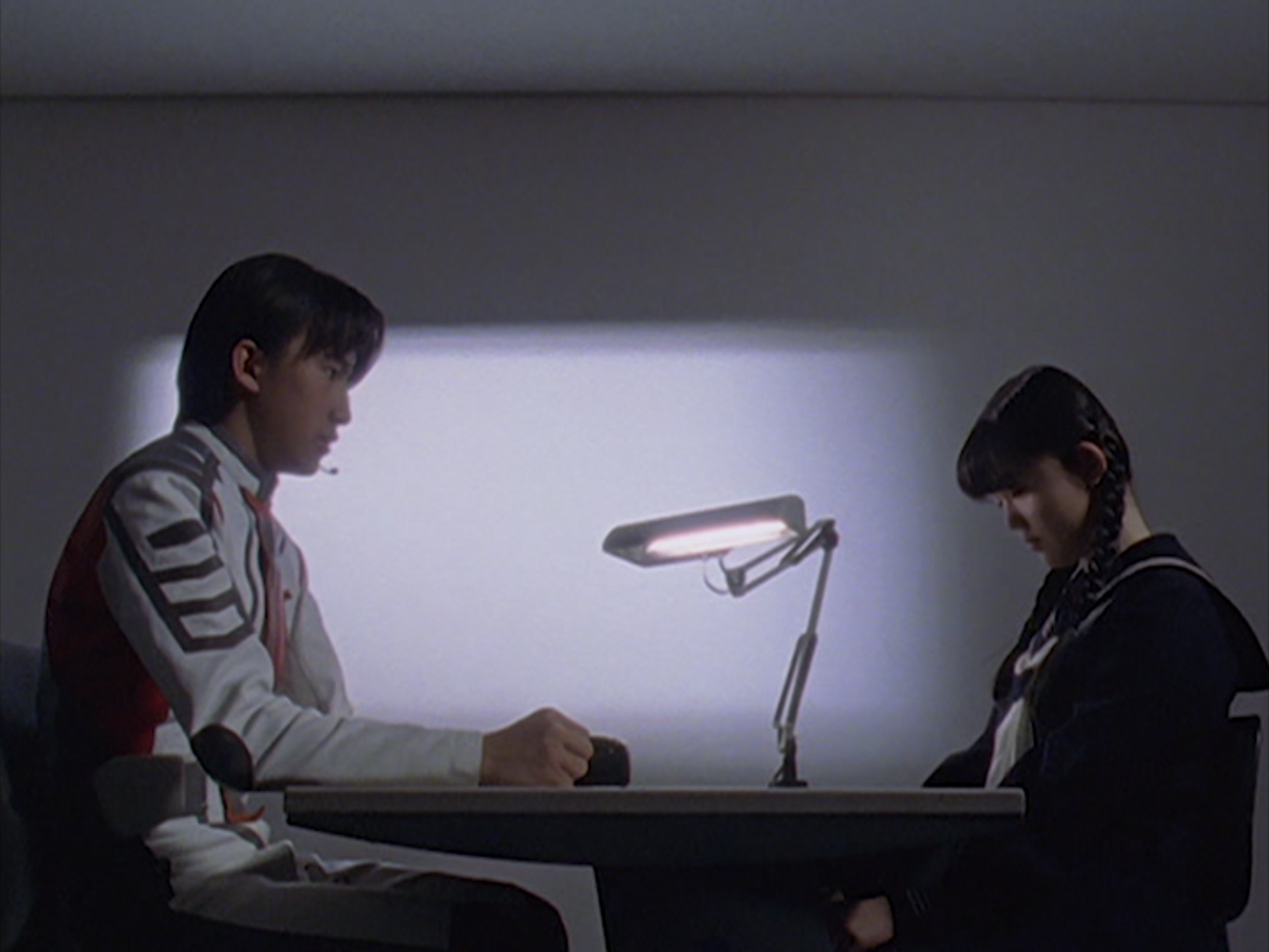
When Yazumi first sees Yuri waiting despondently in a shadowy interrogation room, it brings back a memory. When he was a child, an old woman approached him, gave him a pendant, spoke a few cryptic words, then left. Inside the pendant was a photograph of a girl — and Yuri looks exactly like her. Yazumi likely has several ideas about what this means, but he doesn’t say anything out loud. The memory sets the tone for the brief relationship he has with Yuri: there’s something important about this girl in his life, and perhaps he’s important in hers.
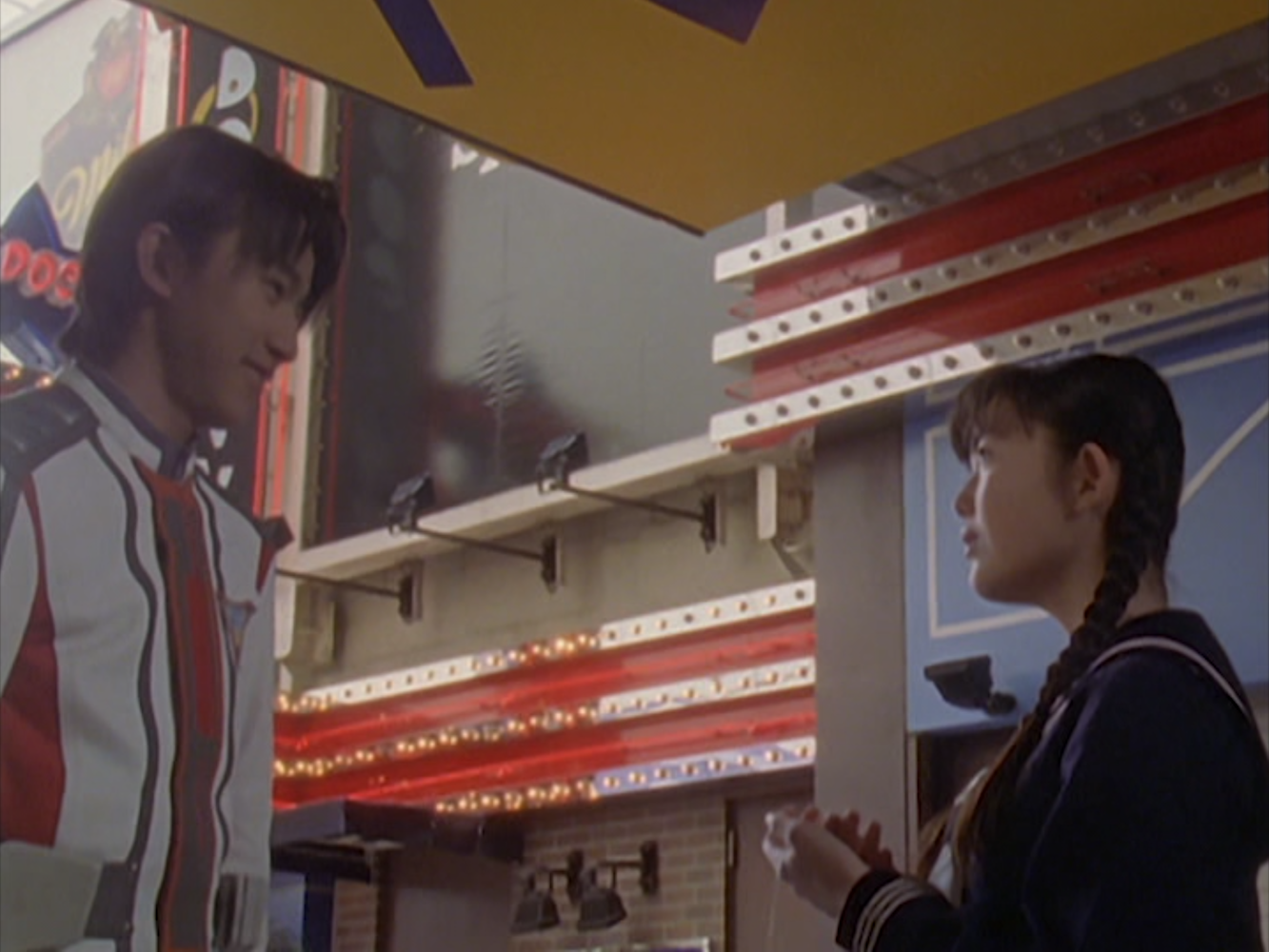
While Yazumi tries to introduce Yuri to modernity through fast food and playing Whack-a-Mole at a mall, GUTS attempts to close the anomaly before it expands. The problem has gotten trickier because a kaiju, Goldras, has teleported in through the distortion. The monster may be the reason the space–time rift occurred. But if the anomaly vanishes, what will happen to Yuri? Will time catch up with her, possibly causing her to turn into a desiccated corpse? Not quite the ending Yazumi wants for this romance, but he may have no choice.
To be clear, what happens between Yazumi and Yuri is not a traditional love story. As I said, Yuri is simply too young for that to work. But I think it’s accurate to call it a “romance” of a sort. A chaste, youthful romance between a girl who is lost and terrified and a young man who’s awkward and maybe too gentle for his own world.
Yazumi works in this soft role, which makes his aggressive turn in “One Vanishing Moment” seem more dissonant. I made it sound trivial when I wrote that he takes Yuri to a fast-food place and an arcade, but these are genuinely well-acted and written scenes with the right level of sentimentality. Yazumi understands what a teen girl may need to help her adjust.
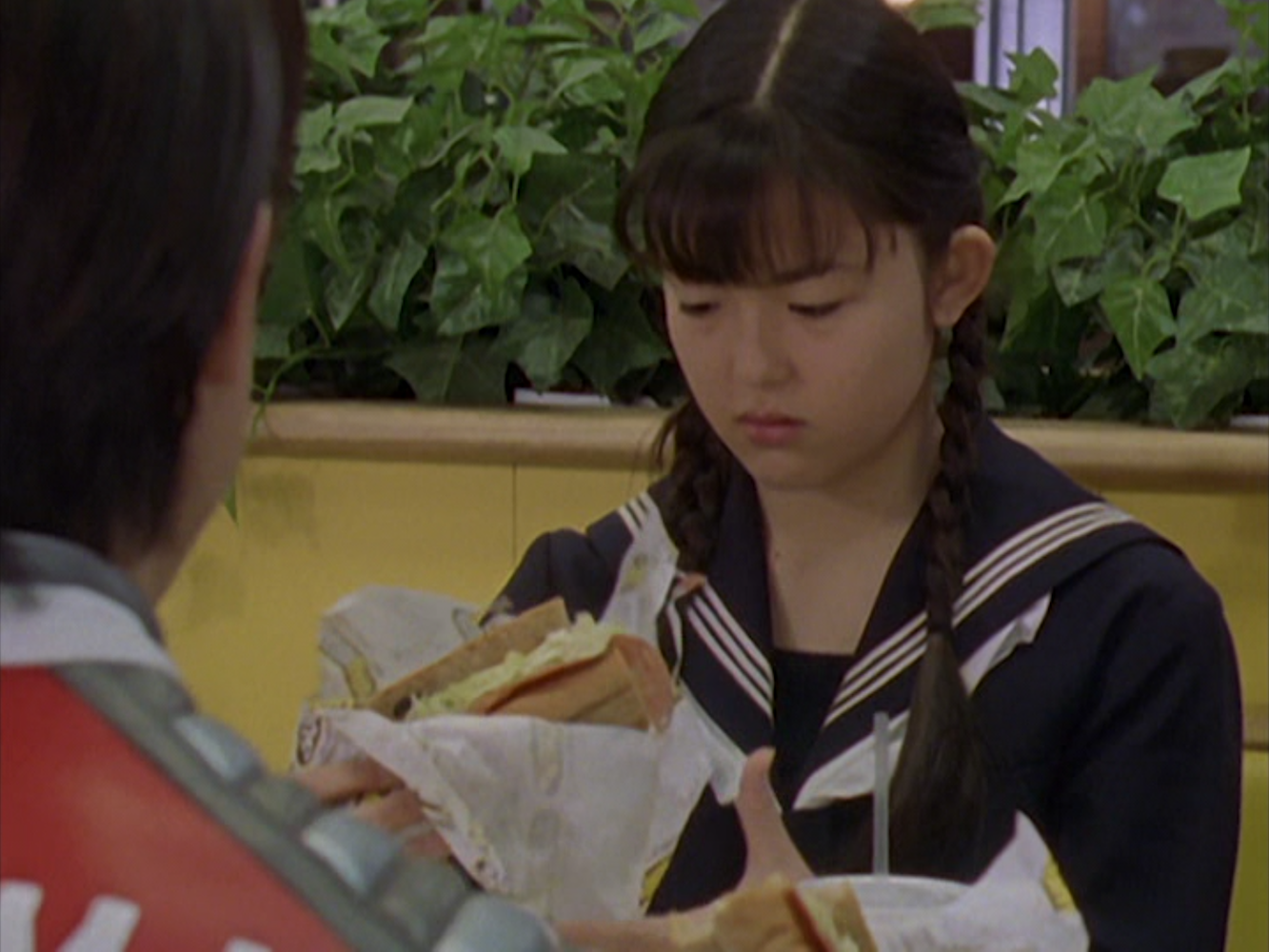
Actress Sayaka Kamiya is spot-on as Yuri. She captures the girl’s innocence and pain through facial expressions better than any amount of dialogue. She’s particularly good at subtly conveying Yuri’s confusion with the modern world, such as when she stares at a sandwich from Subway. The sense of loss around her is strong, which makes her connection to Yazumi, brief as it is, equally strong.
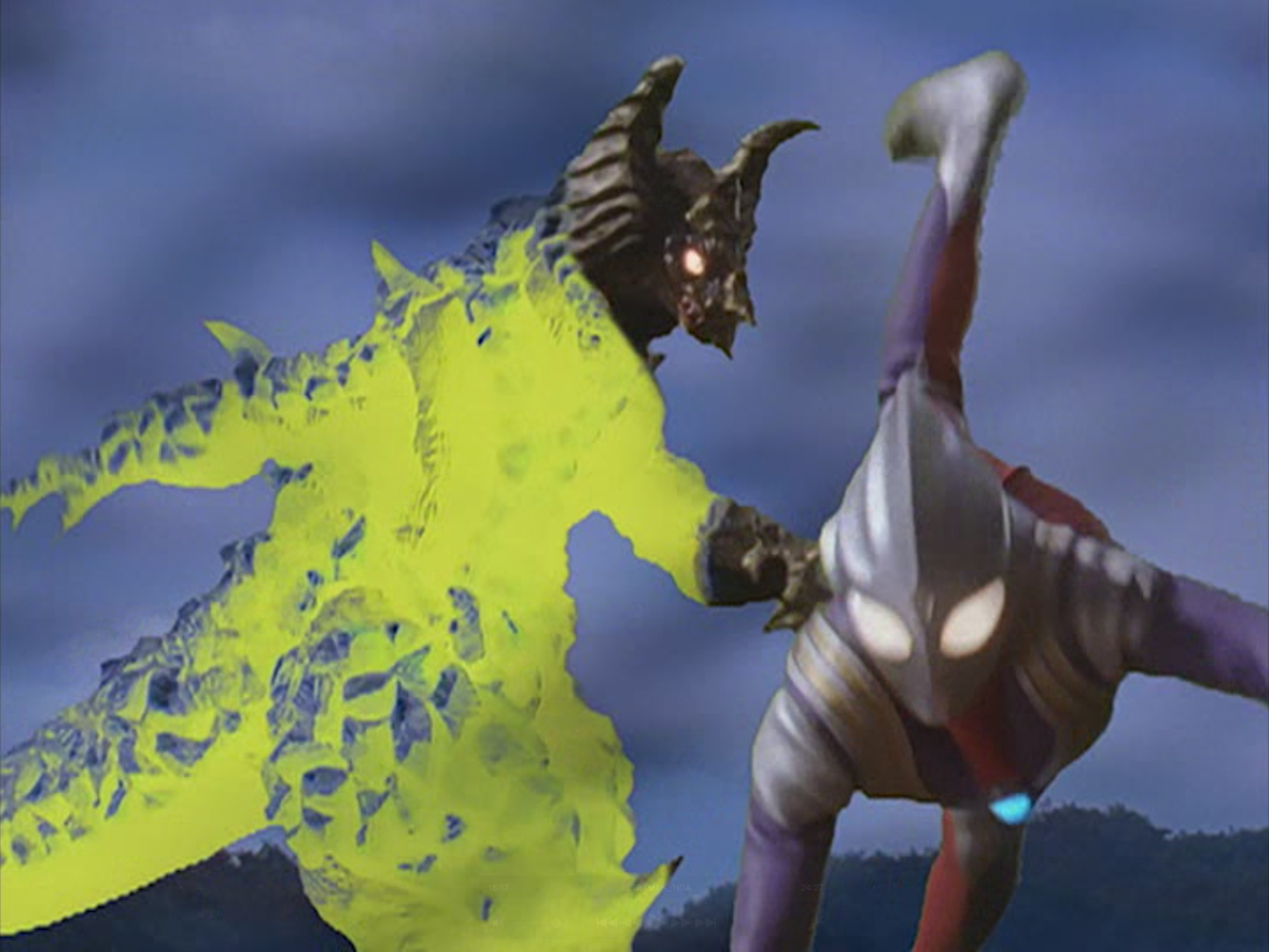
The other half of the episode — GUTS working to stop the time anomaly and destroy Goldras — merits less attention. It’s not terrible or a waste of time; it’s merely regulation Ultraman Tiga. GUTS has a techno-babble scheme to close the space-time rift. The rift never gets a proper explanation; it’s just kind of there. Goldras is a minor kaiju that resembles Silvergon (from “The Rainbow Monsterland”) with cosmetic adjustments. There are some interesting visual effects for the time travel manifestations, and the final fight with Goldras is solid, particularly the way Goldras shifts half in and out of the distortion. It’s just not the part of the episode that will grab viewers.
The conclusion that matters is what happens with Yuri and Yazumi, and this is handled with the sensitivity it deserves. Although a tragic resolution is possible (as in Somewhere in Time), no viewer will feel that the story wants to, or should, go in such a bleak direction. It’s a bittersweet ending that leans toward sweet; passionate but not romantic. How Yazumi reacts to the final revelation matches what we’ve come to know about his personality. Iruma was right to give him the job of caring for a fragile, gentle person.
Rating: Good
Previous: Sleeping Beauty
Next: Flower