
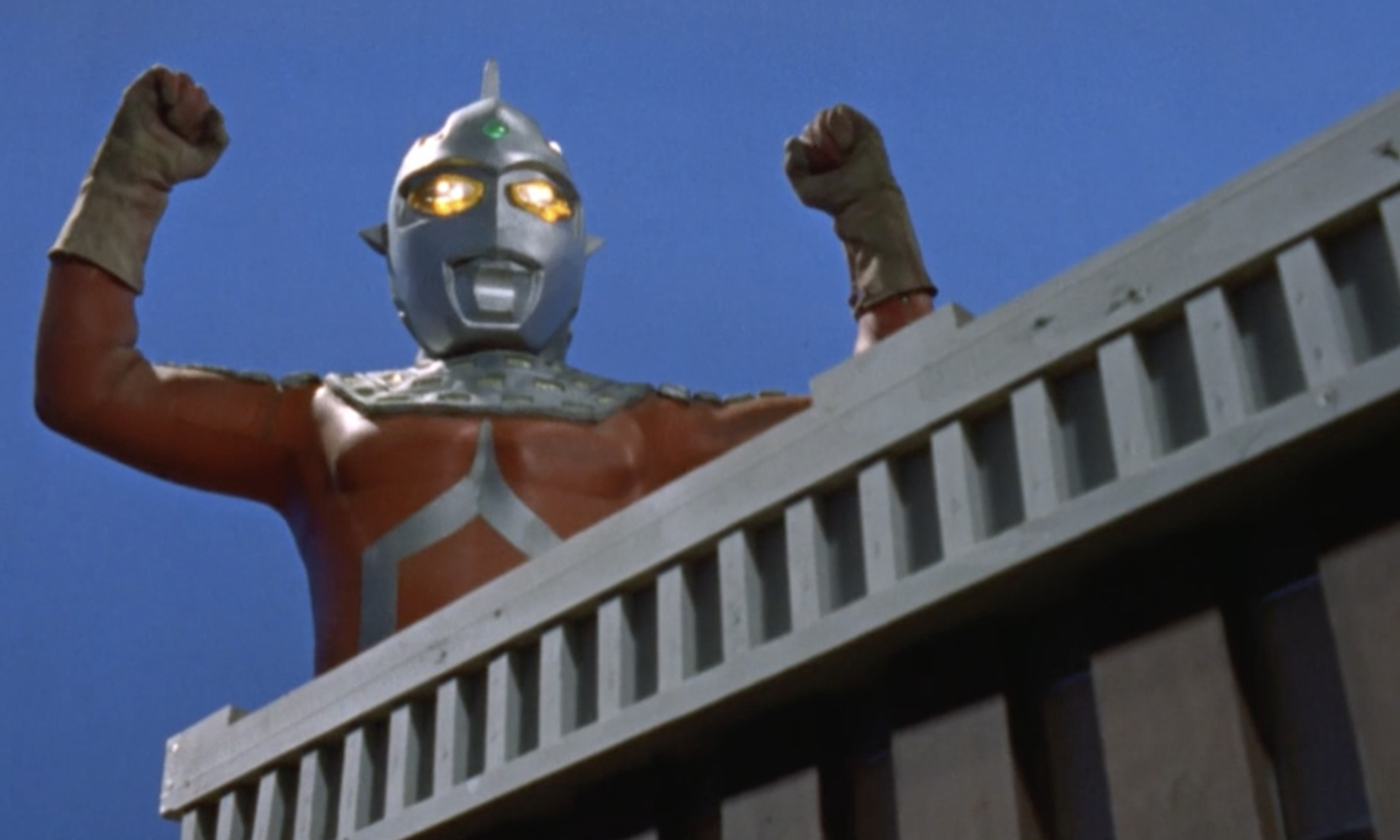
It’s strange and a bit bewildering to think this site hasn’t even reached its second-year anniversary, and I’m already writing the closing post for Ultraseven. Although I’m not tackling the Ultra franchise in strictly chronological order (I’m currently reviewing shows from the 1990s and 2010s), I always intended from the inception of this project to start with the “original trilogy”: Ultra Q, Ultraman, and Ultraseven. I closed out Ultra Q just under a year ago with a post about my favorite episodes, and followed with the post about my favorite episodes of Ultraman in the first month of this year.1
In other words, even though there are still more than 30 shows and 900 episodes in the Ultra series left to review — as well as Ultra movies, comics, and various other giant monster flicks — this feels like the end of my original plan. Or an end. This trio of shows, the ones special effects master Eiji Tsuburaya personally supervised before his death in 1970, is the most important to me.
This feeling isn’t specifically nostalgic. I never even saw Ultra Q or Ultraseven until their North American DVD releases in the 2010s. Ultraman was the only of these shows I saw as a child, and my memories of it are murky. My affection for this original trilogy stems from a love for this period in Japanese television and cinema — and for science fiction globally. It just makes me smile to think that Ultraman and Ultraseven were on television at the same time as the original Star Trek, and that 2001: A Space Odyssey and Planet of the Apes premiered in theaters during Ultraseven’s run.2 The great kaiju movie boom reached its peak while these shows were drawing in enormous audiences. Destroy All Monsters, intended to be the final Godzilla film (surprise, it wasn’t), was flickering on movie screens right as Ultraseven was concluding.
This is a long preamble to a list of my favorite Ultraseven episodes, but it’s what’s been bouncing around my brain while I’ve been putting it together. I plan to continue the site, reviewing three shows simultaneously, and you can expect upcoming reviews of Return of Ultraman, the show that followed Ultraseven. That’s a show I genuinely love. But things won’t feel the same. There’s a unique beauty and power to this trilogy of science fiction and fantasy programs, akin to the uniqueness of the original Twilight Zone — and of that trilogy, I consider Ultraseven the best.
As with my previous two wrap-up lists, condensing my favorite episodes into a compact group for this post was tricky. I ended up with nine entries, which is technically 12 episodes because of the two-parters. (Ultraseven did two-parters better than anyone.) I’ve listed them in original broadcast order.
The Marked Town

Ultraseven’s most famous and influential episode — referenced, parodied, and copied numerous times since. Director Akio Jissoji unleashes a darker vision for the show, drenching everything in moody shadows that boost its aura of violence and paranoia. The premise is outrageous in the best way: an alien tests Earthlings’ resolve with poison cigarettes that transform smokers into violent fiends. The finale is a perfect example of what sets Ultraseven apart from other Ultra shows: a brief monster fight that emphasizes bizarre visuals over action. The setting sun would forever become associated with the franchise because of the gorgeous crepuscular send-off Alien Metron and Seven receive in their showdown.
The Ultra Guard Goes West (Parts 1 & 2)

This two-parter does the same job for Ultraseven that “The Monster Highness” did for Ultraman: deliver a mini-kaiju film to TV screens. If you love watching heroes battle giant monsters among interesting building models, this is the Ultraseven episode for you. Multi-stage robot King Joe is one of the great Ultra villains, and the battles between it and Seven contain some of the finest VFX Tsuburaya Pro had yet done. The episode does more than copy the more action-friendly style of Ultraman. The additional running time offers opportunities to explore an exciting espionage premise with assassinations, foreign agents, alien infiltrators, and Dan interacting with another alien. A full-package Ultra experience.
Showdown at 140 Degrees Below Zero

The TDF base fights to survive an alien-inflicted deep freeze in an effects-packed thriller. Director Kazuho Mitsuta, who did his finest work on Ultraseven (several of his episodes made the list), never misses a chance to heighten the stakes and keep Dan immobilized, unable to transform into Seven due to the extreme cold. The episode also contains the best use of the frequently sidelined capsule monsters, with a terrific fight between capsule monster Miclas and the kaiju of the week in the icy madness. All around, a superb action-suspense tale that lets the humans shine as the heroes without heavily relying on Seven.
Super Weapon R1

One of the darkest, most violent, and most political episodes confronts Cold War brinkmanship with a metaphor tailored to the Ultra universe. The TDF, racing to develop powerful superweapons to combat alien invaders, ends up accidentally destroying an inhabited planet — and then suffers the consequences when the giant avian survivor comes to inflict pain on the Earth. Although the finale offers a touch of hope that humanity will extricate itself from this spiral of destruction, the episode rings with Dan’s gloomy proclamation as an alien observer of Earthlings: “It’s a sad marathon you keep running as you cough up blood.”
The Seven Assassination Plan (Parts 1 & 2)

The devious Alien Guts defeat Ultraseven, then suspend him in the sky on a transparent crucifix. That’s a potent image, and this two-parter around Seven’s impending execution matches that spectacle with a truly epic tale. The Ultra Guard steps up in the absence of their superhero ally to show what they can achieve with everything at their disposal. Anne comes into her own, and poor capsule monster Windom has its last dance. Frequent Ultra director Toshihiro Iijima, in his final episode of the Showa era, pulls off miracles on a cramped budget and paces the finale like a bullet train. If not the best outing of Ultraseven, it’s the best representation of what makes it work from week to week.
Ambassador of the Nonmalt

The masterpiece from director Kazuho Mitsuta, as well as a deeply personal story about prejudice and genocide from writer Tetsuo Kinjo, arguably the most important creative person on the Ultra shows after Eiji Tsuburaya. Kinjo’s script dares to question the basic premise that the heroes, the Ultra Guard, are always in the right when they defend Earth from “alien” invaders. But what if the aliens aren’t aliens? What if they’re the original inhabitants of the Earth? The story takes these questions to surprisingly dark places and uses a child as the vehicle for its criticism of the heroes. It hits hard on all levels and is arguably the most powerful social commentary in the series’ history.
Nightmare of Planet No. 4

And now the masterpiece from director Akio Jissoji, a terrifying tale that evokes the best of The Twilight Zone as well as George Orwell, while still letting Seven blow up a bunch of stuff. Dan and Soga find themselves on a planet that resembles a futuristic fascist Japan ruled by brutal androids. That’s right: AI and fascism in one package — not relevant to today at all! Jissoji’s visual mastery of the ice-cold robot planet and the moments of extreme violence where dissidents die before firing squads are still shocking to watch. It’s the most adult episode of any Ultra show, and I’m amazed Tsuburaya Pro got away with airing it.
The Saucers Have Come

Akio Jissoji’s last episode of the Showa era is, like most of his work, a visual wonder. The confrontation between Seven and the invading saucers of Alien Perolynga is a work of impressionistic beauty unlike any other kaiju fight. But what stands out more is that the episode offers a look at the world of Ultraseven from the viewpoint of average working-class citizens, which isn’t something we’ve seen much before. The story of Fukushin, an amateur astronomer who yearns to escape from dreary planet Earth, is a tragedy of ordinary hopes among extraordinary circumstances — the kind of downbeat story Ultraseven could do best.
The Biggest Invasion in History (Parts 1 & 2)

The series finale that all Ultra shows try to top. For the franchise’s 50th anniversary in 2016, fans voted Part 2 as the greatest Ultra episode of all time. It’s easy to see why. The scale is towering, and the destruction and death toll from Alien Ghose’s assault on Earth are harrowing. The first time I saw it, I was stunned by the volume of carnage. Yet the scope isn’t a gratuitous spectacle. Instead, it feels as though the show — especially Dan’s role as an alien defender of Earth and his relationship with Anne — has built up to this pivotal event. The cast and crew rise to the challenge and nail every moment. It’s a farewell story that stays with viewers and reminds them of what made Ultraseven a landmark in Japanese science fiction.
Honorable Mentions

Several episodes on my short list didn’t make the final cut because I wanted to keep this post under some level of control. I can easily imagine some of these making other fans’ lists of favorites:
- Fly to Devil Mountain – A good character story for Soga that removes Dan from most of the action. Nurse is a fascinating style of kaiju.
- Pursue the Undersea Base – Strong action and an intriguing link to Japanese Imperial history. Although mostly I just like Iron Rocks as a kaiju concept.
- Search for Tomorrow – Another effective character study, this time of Captain Kiriyama, who finds himself at odds with his own team.
- Return to the North! – Furuhashi gets to take the starring role in a white-knuckler with emotions heightened to appropriately hysterical levels.
- The 700 Kilometer Run – An excellent espionage-themed adventure that uses a car race for its backdrop. Plus, it has the gloriously ridiculous … Dino-Tank! Love you always, Dino-Tank.
- Glory for Whom? – One of the most intriguing villains of the series: not an alien or monster, but a human glory hound who tries to wreck the teamwork of the Ultra Guard for his own fame.
- The Vanishing City – Worth it just to watch Seven chasing a roly-poly hedgehog monster through an empty city.
Leaving Ultraseven & the Original Ultra Trilogy

Ultraseven is my favorite show of the Ultra Series. Rewatching it simultaneously with Ultra Q and Ultraman brought out a few faults I hadn’t realized were there before, such as mismatches between the first and second halves of several episodes, and how the poor capsule monsters got essentially jettisoned from the premise. But this rewatch also heightened the show’s strengths: intelligent science-fiction themes, wide genre experimentation, and incisive social critique.
In style and interests, Ultraseven falls between its two predecessor shows. Ultra Q focuses on the strange and bizarre, with atmosphere and ideas frequently playing a bigger role than the monster of the week. Ultraman relies on colorful action and adventure with a charming central cast. Ultraseven explores the science-fiction oddities of Ultra Q while engaging in the large-scale superhero action of Ultraman — and that combination doesn’t always click. But when it does, you get series high points like “Super Weapon R1” and “The Marked Town,” episodes the franchise still references today.
Ultraseven is not as consistent in quality as Ultraman or as gob-smackingly nuts as Ultra Q, but its peaks are so high and the intelligence behind its writing and directing so evident on screen that it emerges as the best of what this franchise can be. Just the back-to-back airing of “Ambassador of the Nonmalt” and “Nightmare of Planet No. 4” is one of the great stretches in the long history of the Ultra shows; those episodes alone would have made Ultraseven into one of the most memorable science-fiction shows ever produced.
A lot of what I thought I was going to write to conclude this post ended up at the start. So, to close this chapter of a major era of the Ultra Series, I’ll repeat that the site isn’t going to vanish. I’m eager to get into my rewatch of Return of Ultraman. Perhaps I’ll return to the original trilogy shows in the future and do a series of “Episode Revisits.” Why not? You’ll never need to twist my arm to get me to watch “Kanegon’s Cocoon” again.

- I’m actually writing this in May 2026, so the wrap-up to those earlier shows feels even closer. ↩︎
- I’ll get fancy with the date matching: Planet of the Apes premiered several days before the first airing of “Project Blue,” and 2001: A Space Odyssey had its premiere four days after the first airing of “Super Weapon R1.” ↩︎

