
Directed by Hirochika Muraishi. Written by Chiaki J. Konaka. Airdate April 26, 1997.
The politics and history of the Terran Peace Consortium have materialized in several Ultraman Tiga episodes so far: “The Devil’s Prophecy,” “The Day When the Monster Appeared,” and “The Battle of Zelda Point.” This is the first episode to make TPC politics its centerpiece. It foregrounds two figures who represent the opposing poles of the organization’s purpose: the dovish Commissioner Sawai (Tamio Kawachi) and the hawkish Director Yoshioka (Ken Okabe).
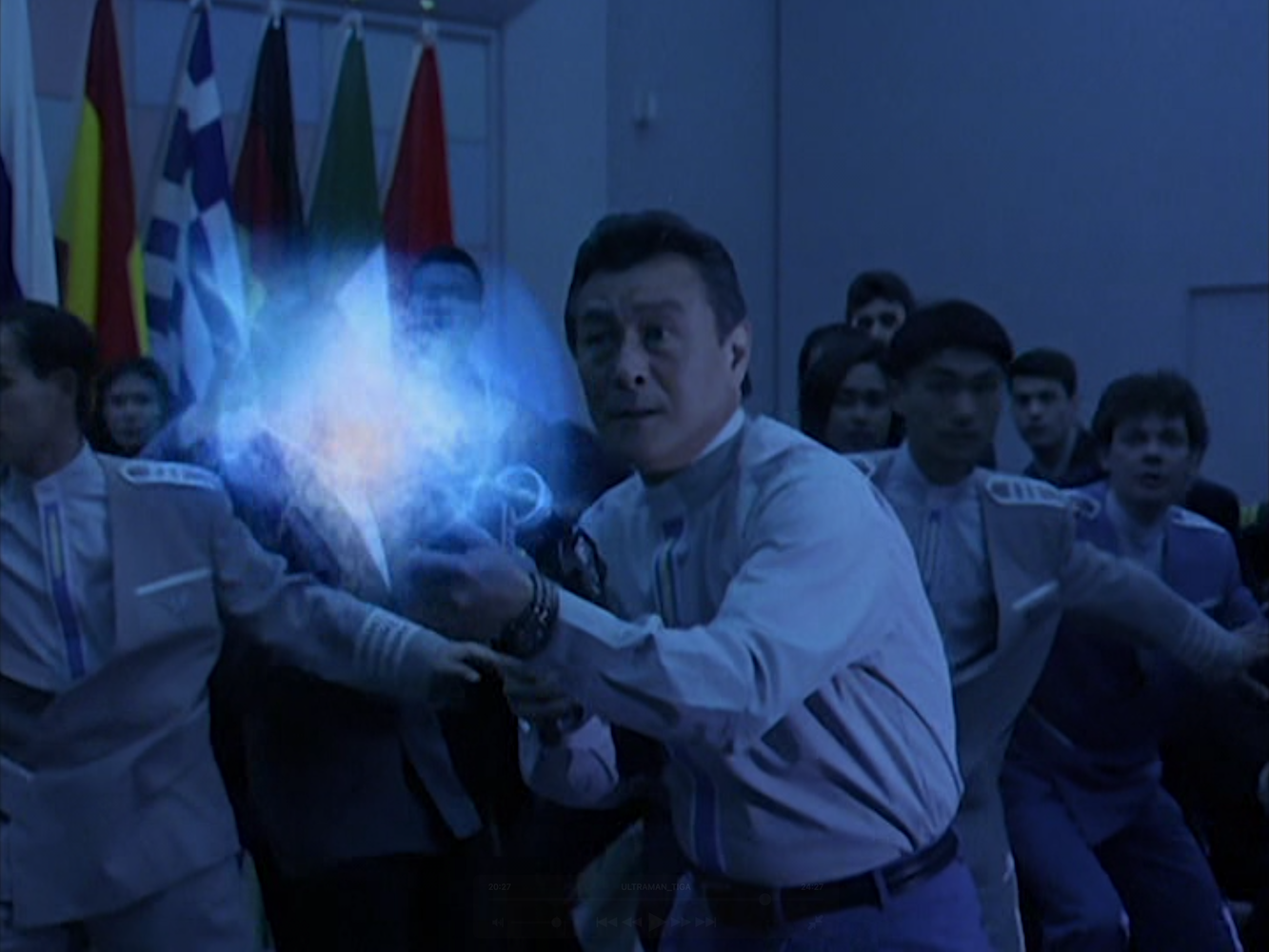
Sawai flies south on a secret mission, which Iruma later explains is a gathering of TPC’s leaders in a facility on the southernmost of the Cliomos Islands. This is the same location as the original summit nine years ago that led to the dismantling of the United Nations Defense Force and the subsequent creation of the TPC. Sawai’s flight vanishes mysteriously, and before GUTS can mount a major search mission, Sawai sends a transmission from Cliomos. He announces that the TPC is forming a one-world government with him as its leader. An energy barrier surrounds the island to prevent any interference with the new global overlords.
Sawai’s declaration of unilateral tyranny makes no sense to anyone who knows him, particularly Iruma. Obviously, an external force has intervened. (I’m not saying it’s aliens, but it’s definitely aliens.) GUTS concocts a two-pronged attack to take down the barrier and rescue Sawai and other TPC leaders. Daigo finds himself in the unusual position of working beside Chief Yoshioka aboard a submarine that’s attempting to sail underneath the force field.
The first half of the episode contains some of the best-directed drama and writing in Tiga. Through flashbacks and television reports, viewers receive a compressed history of the TPC’s founding. We learn about Sawai and how he transitioned the militaristic UNDF into the current TPC through diplomacy and his vision for peace. We see the commissioner’s relationship with a younger Iruma and learn how Daigo started his rise to join GUTS, and why he feels a strong dedication to Sawai. It’s a chance for Daigo to shine as an actual character rather than just “the guy who turns into Ultraman and dates Rena.”
The tension in these early scenes is simmering rather than hysterical, and that’s the correct approach: the episode is about the TPC triumphing as a unified organization despite fractures in philosophy and personalities, not about an organization that’s inherently dysfunctional, as the former UNDF is hinted to have been.
This unity comes across most strongly in Yoshioka, who is the episode’s major surprise. Until now, Director Yoshioka has been portrayed as a capable but unlikable officer with a lingering attachment to the violent methods of the old Defense Force. He acted outright sexist toward Iruma in “The Devil’s Prophecy,” which didn’t exactly endear him to me. When he first appears in this episode, it’s to demand that GUTS make an immediate strike on Cliomos, causing Iruma to point out that GUTS is only for defense against monsters and aliens. It’s expressly how Sawai designed it. (This is a gesture toward Japan’s actual Self-Defense Force, which can only act in defense, disaster response, and peacekeeping missions. If kaiju were real, they’d handle those too.)
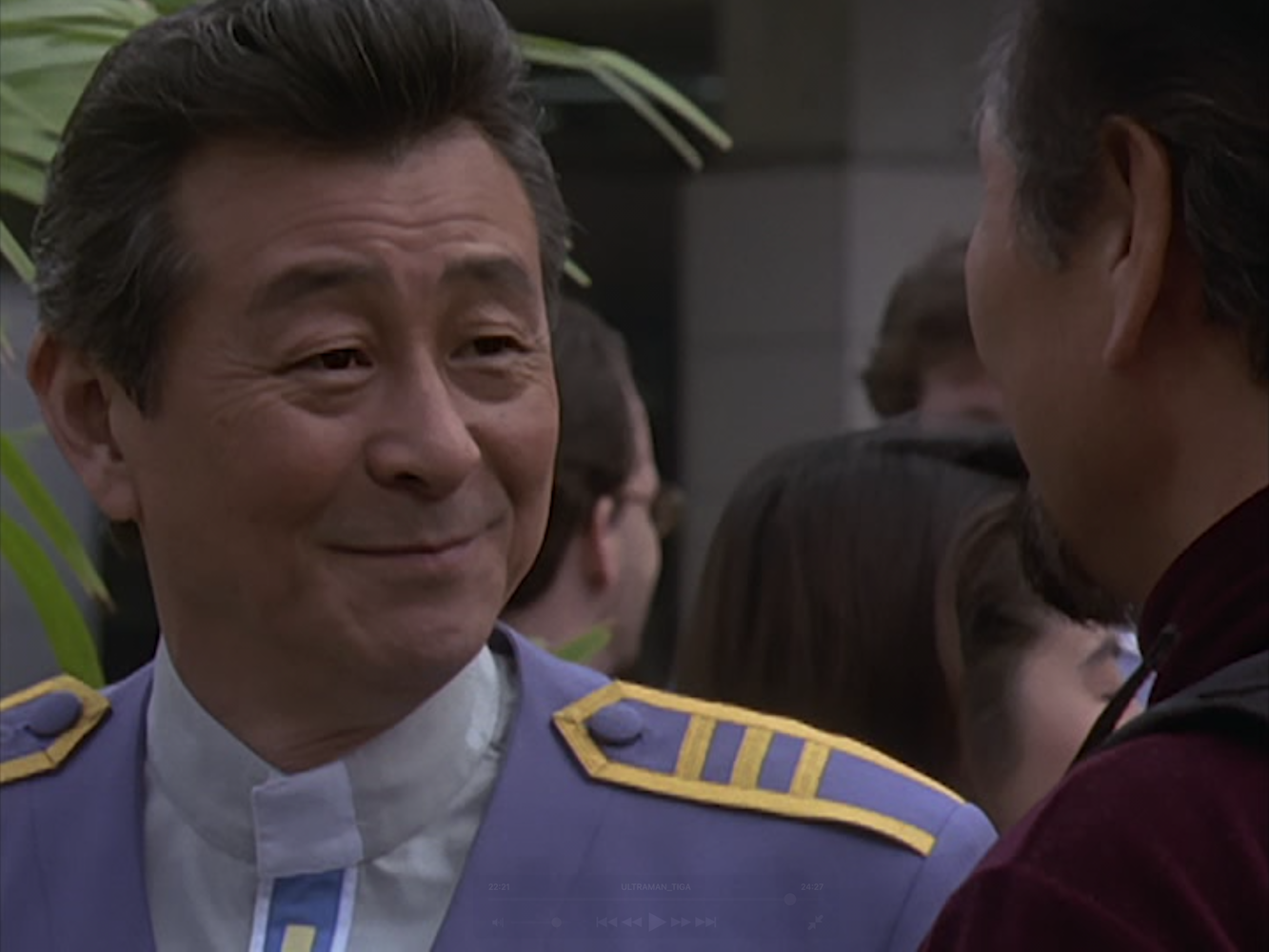
It would seem an impossible task to pull Yoshioka up from all negativity and make him appealing, but Konaka’s script and Okabe’s performance manage it. Making Yoshioka part of the mission to Cliomos as the co-pilot of the Dolpher-202 submarine with Daigo starts his mini-redemption. His focus turns to rescuing Sawai, and it becomes clear that Yoshioka has immense respect for the man despite being at odds with him for 20 years. He turns into the on-the-ground hero of the story, and his resolution with Sawai shows that there’s a better person under what we’ve seen before. Yoshioka still needs to apologize for being a chauvinist to Iruma, however.
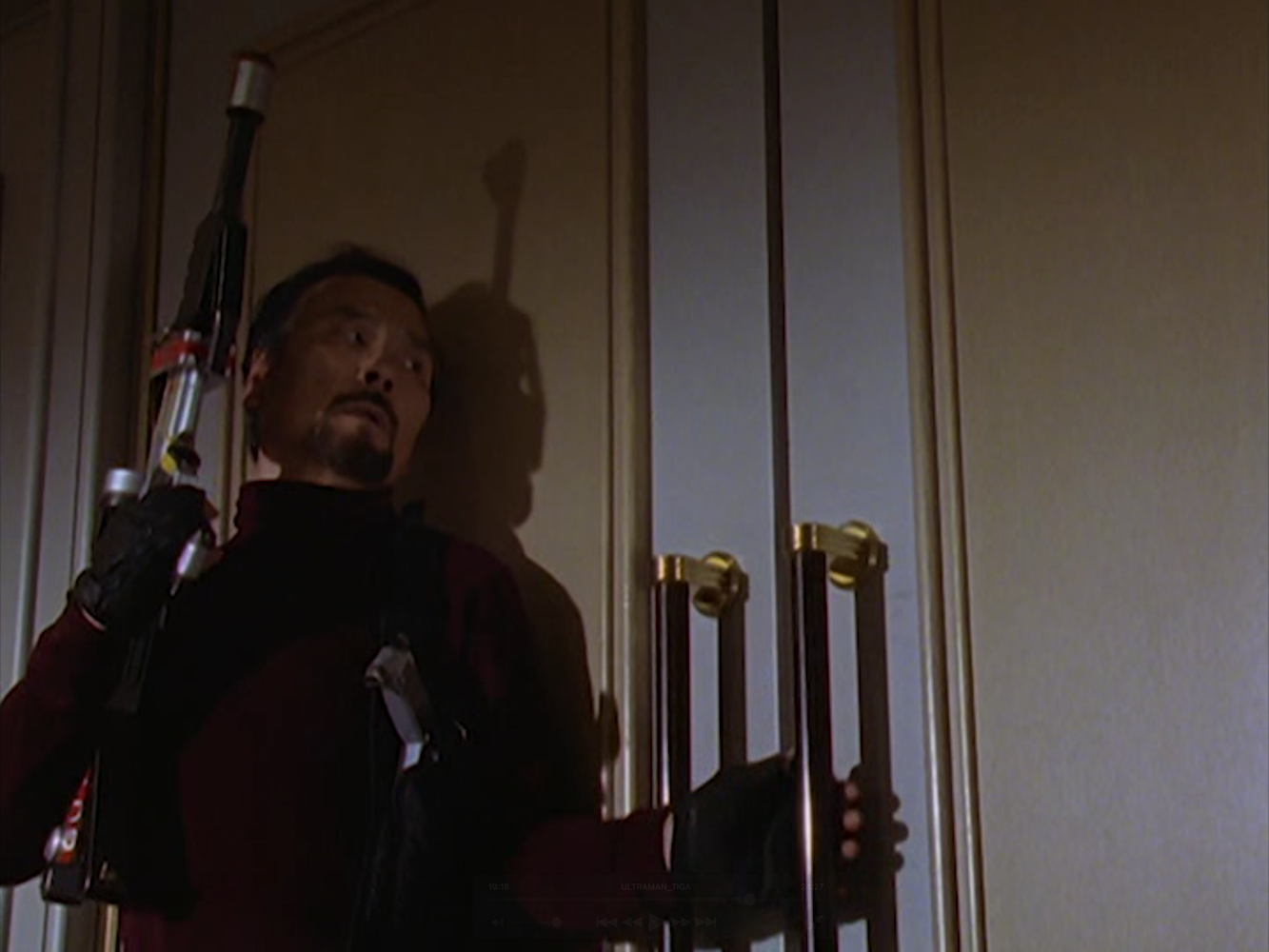
The second half of the episode drops off from the dramatic heights of the first. It feels rushed, and the action doesn’t live up to the initial promise of GUTS rallying to the rescue. Seeing Sawai and Yoshioka change into laser-gun-wielding action heroes is a thrill, the two of them reliving their youthful days. But the Ultra-scale action with the alien entity and Tiga confronting it is subpar. The alien business never gains traction; it’s left almost completely unexplained. I don’t need everything spelled out in an Ultra episode, and ambiguous aliens can work. In this case, however, it feels like the story’s foundation crumbles just when it’s needed most.
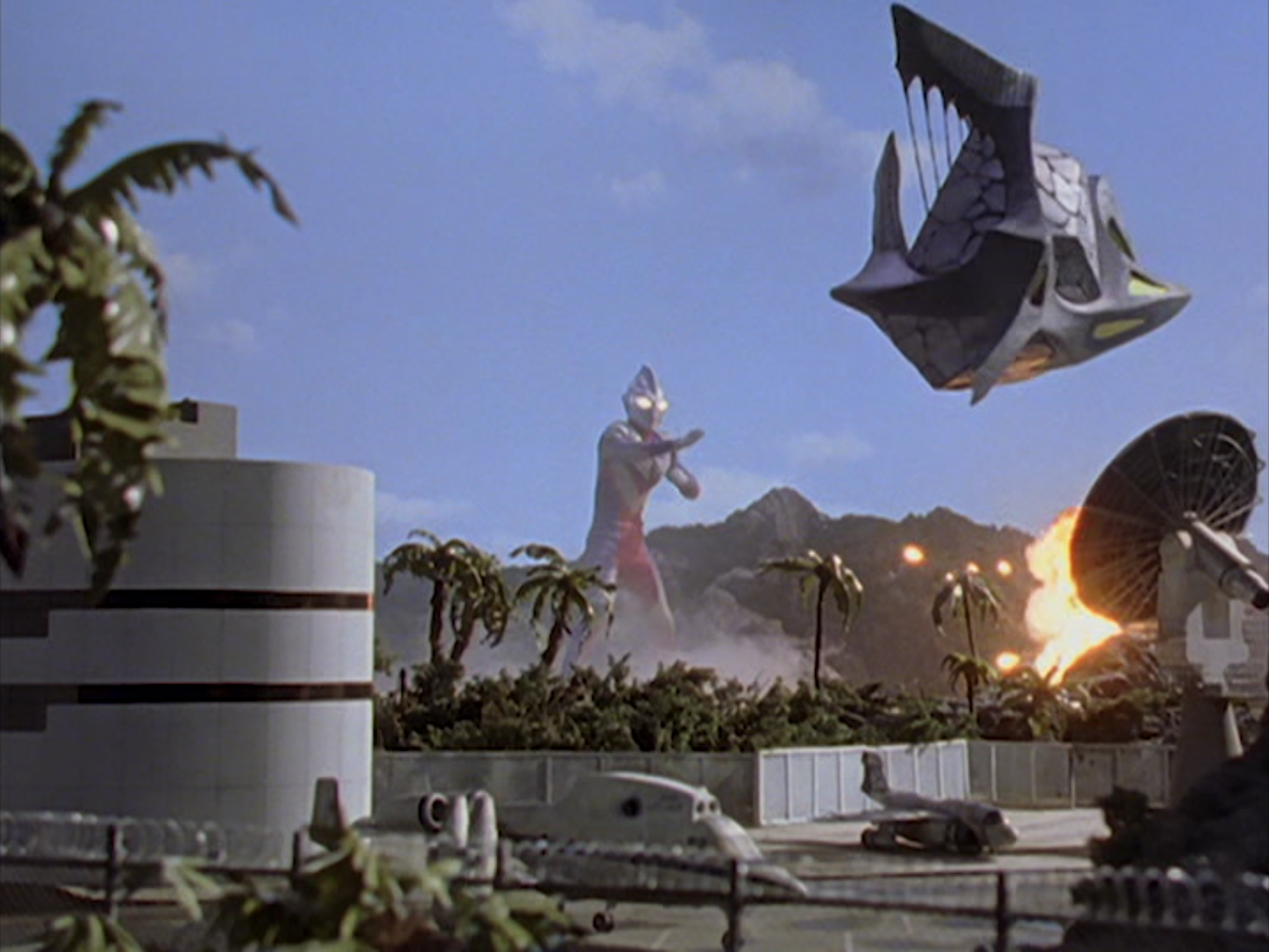
It doesn’t help that Desimonia, the cyborg weapon and kaiju of the episode, is a bust. It has an abstract design like Bullton’s in “Passage to Infinity” that’s sleek and striking. In action, however, it does little more than hover and fire a few laser beams.
Considering the stakes and how many key semi-regulars take part, this should’ve been a two-parter. That would grant more time with the characters and allow for a satisfying action finale with the aliens.
In fact, this episode is sort of a two-parter, though not presented as such. The next episode, “Sleeping Beauty,” follows up with the alien menace. If you watch the episodes back-to-back, it makes “To the Farthest South” better and retroactively fixes some of its back-end problems. I’m going to break my usual rules and not judge this episode completely independently. So thanks in advance, “Sleeping Beauty,” for giving this good episode a boost to great.
Rating: Great
Previous: Vampire City
Next: Sleeping Beauty
 The Ultra Project