
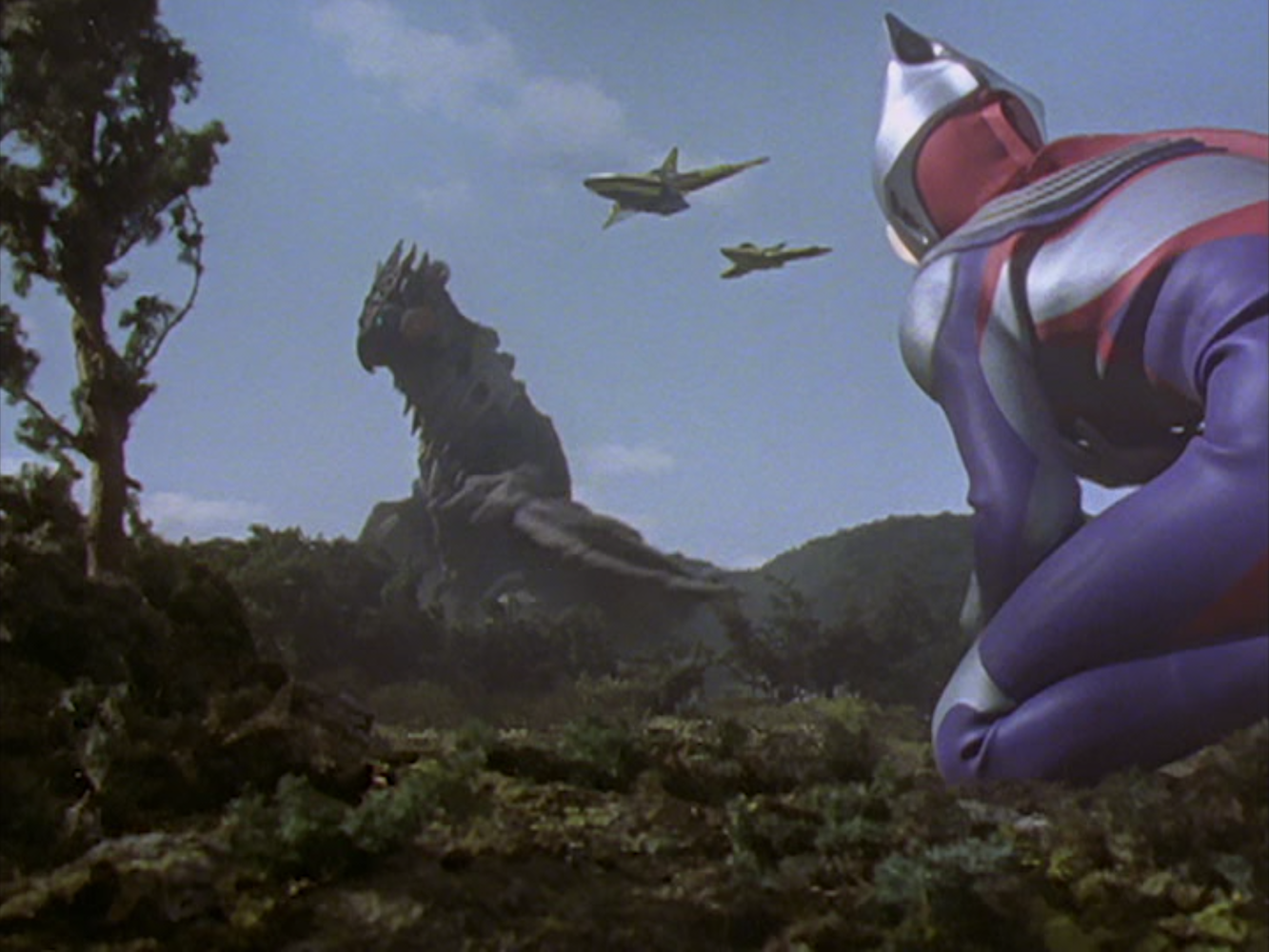
Directed by Tsugumi Kitaura. Written by Ai Ota. Airdate April 12, 1997.
Ai Ota’s third script for Ultraman Tiga continues her style of crafting fantasy stories with childlike slants. But these are not necessarily “childish” stories. “The Battle of Zelda Point” is built on a horrible tragedy: the death of a young girl and her father’s belief that he was responsible. The episode has its bleak moments, but it also has a fairy-tale quality and a transcendent conclusion that prevent the heavy subject matter from overpowering the tone.
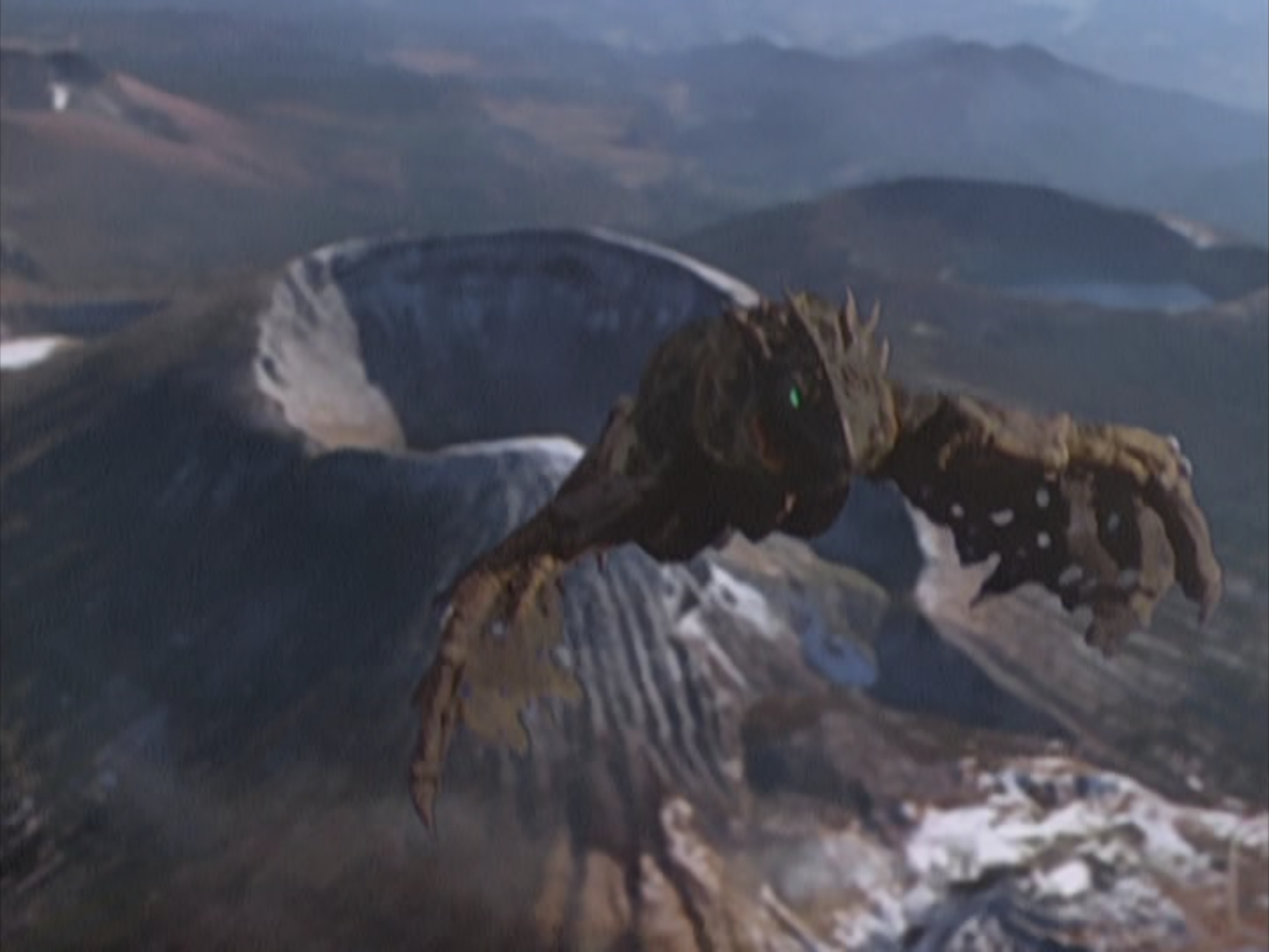
A kaiju resembling a rotting, dark parakeet rises from Mt. Rausu in Hokkaido and flies toward Zelda Point, a secure vault left over from the more militaristic organization that preceded the TPC. TPC head Sawai orders the GUTS Wings to do everything possible to prevent the bird creature from reaching Zelda Point because a highly volatile gas is stored there. If ignited, this “Zelda Gas” could wipe out a large portion of Japan.
Sawai fills in Captain Iruma (and the audience) on the bleak backstory. Twenty years ago, scientist Masachika Nezu (Minori Terada) invented the Zelda Gas in an accident. He took a small sample to work on at his home laboratory. While he was away, the sample exploded violently enough to destroy his home and start a forest fire. The blast killed his young daughter, Asami (Yuka Koide). The gas was sealed away, and Nezu was chased from the scientific community to live in guilt for two decades.
And what’s with the giant bird thing? Dr. Nezu believes it’s Asami’s pet parakeet, Shiela, which survived the explosion and is now moving in on the substance that killed its beloved owner.
This sounds a bit silly on paper, despite the tragedy surrounding it. But it works well in Ai Ota’s hands, and the filmmakers and actors — especially Terada as Nezu — pull it off without slipping into comedy. The design of the giant Shiela allows you to see the original parakeet underneath without triggering any chuckles. The only element that doesn’t keep pace with the overall quality is some uneven digital flying effects, but that has always been a weakness with Ultraman Tiga.
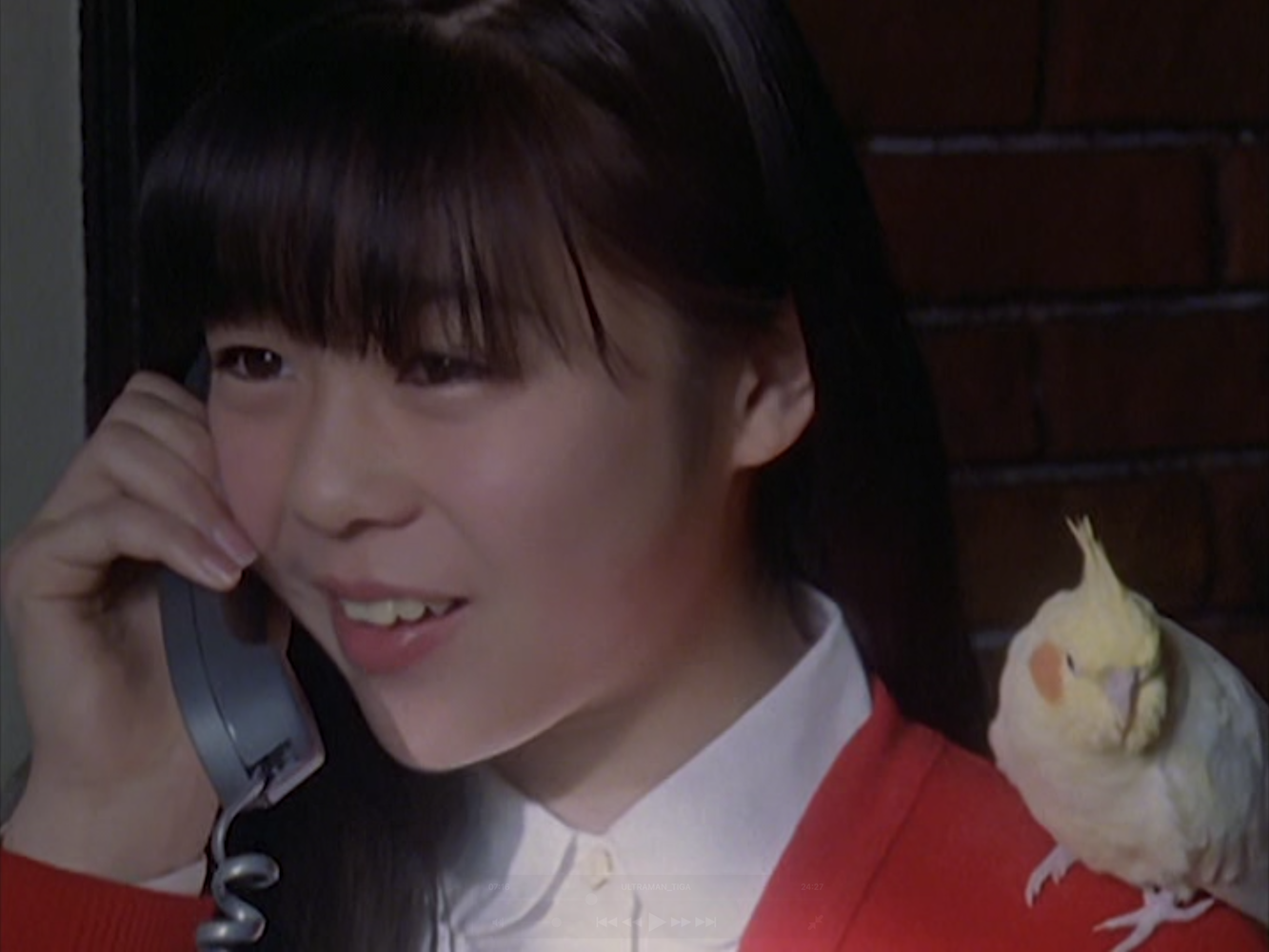
There’s no explanation for how parakeet Shiela transformed into kaiju Shiela and then hid inside a volcano in Hokkaido for 20 years. There doesn’t need to be. The element of the fantastic Ota laces through her script makes an explanation unnecessary. You could argue that the effects of the Zelda Gas explosion may have caused the change in the bird, but there’s no reason to seek a concrete answer.
The effects scenes are plentiful as the GUTS Wings battle Shiela to prevent it from reaching Zelda Point. Tiga has a limited role, with only a small part during the finale at Zelda Point. Tiga can’t do much against Shiela because of an injury, but it wouldn’t be right for the alien hero to be the one to resolve the story anyway. The protagonist of the episode is Dr. Nezu, and the climax appropriately centers on him facing the monster that stands in for his deceased daughter and his guilt.
Nezu’s story unfolds through several revelations. At one point, Shinjoh assumes the man is trying to work with the Zelda Gas and develop it, prompting him to verbally lash out at the scientist as heartless for still experimenting with the deadly material that killed his daughter. He then realizes that Nezu has been working for decades to find a way to completely destroy the gas. We also discover that Shiela’s goals aren’t quite what everyone assumes, leading to an unusual and beautiful climax that has little to do with laser blasts and giant heroics.
The story follows a tradition in the Ultra series of stories about monsters connected to tragedies involving a child. The monsters bring either revenge or redemption. The most well-known examples are Ultraman’s “Terror on Route 87” and “Phantom of the Snow Mountains,” as well as Return of Ultraman’s “The Devil Tamer and the Child.” A bird avenging a child is the literal story of Ultra Q’s “I Saw a Bird.”
“The Battle of Zelda Point” steps back a bit from the tragic peaks of those episodes and gives viewers a gentler moral for the finale. This likely reflects Ai Ota’s writing style, which isn’t as pessimistic as Tetsuo Kinjo’s or Shozo Uehara’s. Ota delivers a lesson about how, as long as you’re alive, there is always the possibility of taking positive action. The narrator states exactly that over the coda. (“Yes, there will always be something we can do.”) I don’t think the moral needs to be stated this explicitly, but it’s effective anyway, making the episode another excellent example of how the Ultra series can explore human drama within the context of giant monsters and alien heroes.
Rating: Great
Previous: GUTS Base Under Attack
Next: Vampire City
 The Ultra Project