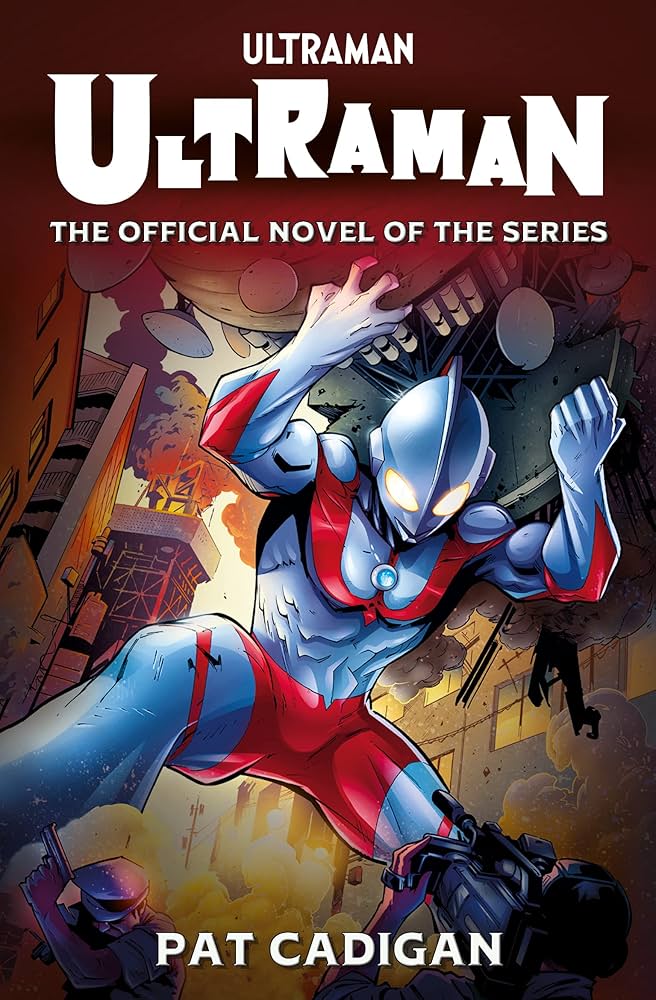
By Pat Cadigan (Titan Books, 2023)
When I heard that there was an upcoming English-language novelization of Ultraman, I was excited. Even more excited when I found out that Pat Cadigan was writing it. Cadigan is a science-fiction legend, one of the key writers of the cyberpunk movement of the ‘80s, winner of numerous awards. Having her write an Ultraman book indicates that somebody at the top was taking this project seriously. Additionally, I was curious about how a novelization of this type of television show might work. How do you create a single, regular-length novel from a highly episodic show with 39 episodes?
As I discovered when I first read the book, Cadigan’s approach to adaptation was similar to what Hideaki Anno did with the movie Shin Ultraman: lean into the episodic nature of the show and adapt a string of select episodes. The seven lengthy chapters of Ultraman: The Official Novelization of the Series each cover one episode: “Ultra Operation No. 1” (Chapter 1), “Shoot the Invader” (Chapter 2), “The Monster Anarchy Zone” (Chapter 3), “The Monster Highness” Parts 1 and 2 (Chapters 4 and 5), “The Forbidden Words” (Chapter 6), and “Farewell Ultraman” (Chapter 7).
That’s a good spectrum of episodes. “The Monster Highness” and “The Forbidden Words” are obvious choices. The former is the most straightforward giant-monster adventure of the series and piles on the action. Its two parts create a strong, sustained middle for a novel. “The Forbidden Words” features a juicy adversary in Mefilas, and Cadigan does an excellent job with his unusual villainy. “Ultra Operation No. 1” and “Shoot the Invader” aren’t among the strongest episodes, but since they are the first episodes, they’re critical for crafting the story of Shin Hayata’s adventures as Ultraman.
And this is Hayata’s book. Making Hayata the protagonist and the most frequent POV character is one of the major decisions Cadigan makes in the novelization. Hayata, as I’ve often pointed out in my reviews, is the least interesting of the core characters of Ultraman. Audiences observe him from the outside and never know much about his inner life. The show leaves it ambiguous how much Ultraman is in control of Hayata. The final episode suggests that Hayata’s personality may have lain dormant the entire time, and the Ultra warrior was always in charge, but there’s no solid answer.
The novelization establishes that Hayata is in almost full control, even when in giant form. While Ultraman is battling a monster, the text will sometimes switch to referring to the hero as “Hayata,” such as during his verbal sparring with Mefilas. Hayata can sense the presence of the Ultra in mental impressions and heightened perceptions. (“The alien in him could identify [mineral composites] but despite their merged state, he was unable to get any kind of feel for how he was doing it, only that it seemed natural, even normal.”) Otherwise, Hayata is in the pilot’s seat. He’s the one making the choices, he’s the one acting as a hero.
It’s a big credit to Cadigan’s writing skill that she makes Hayata interesting on paper as a lead. He’s established as second in command after Captain Kiriyama, which the show implies but never really addresses. We learn about his sense of obligation to the Science Patrol and his overall decency as a person — what makes him a hero and worthy of the trust and respect of the Ultra warrior. He may not be as colorful as his teammates, but he works as the lead hero in a book.
The rest of the cast isn’t abandoned. The Science Patrol functions much like the odd, fun bunch we know from the show. Most of their dialogue is original, not lifted from the scripts, and Cadigan adds plenty of humorous exchanges between them. There’s a touch of classic Star Trek in the camaraderie and friction between the SSSP members. The dialogue has a modern flair that matches the updated setting — this isn’t retro-future 1960s, but an altered 2020s with the internet, Wi-Fi, streaming, and reboots of The Real Housewives. It’s contemporary, but the modern setting isn’t forced. This still feels like the Science Patrol in a world that feels like Ultraman.
The characters tend to lose something on the page. This isn’t really Cadigan’s fault; it’s a pitfall of novelizing a visual medium. The nuances of the actors’ performances don’t translate as well to the page. This most specifically harms Ide, the show’s most fascinating and beloved character. Actor Mansari Nihei brought something special to the SSSP’s resident scientist and eventually its most moral member; his performance guided the development of the character. Ide is still effective in the novel (Cadigan thankfully dropped his early comic cowardice), but he’s not the standout. Because Cadigan chose to adapt episodes that have Hayata at their center, she had to leave aside Ide’s big starring roles in “A Little Hero” and “My Home Is Earth.”
“My Home Is Earth” is arguably the most respected episode of the show, but I understand why Cadigan chose not to adapt it. Not only is the story just too heavy, but Hayata plays only a minor role, so it doesn’t fit well with the arc charted for the novelization. There’s an entire parallel Ultraman novelization where Ide is the protagonist and “My Home Is Earth” and “A Little Hero” are key chapters … but that’s not the novel Cadigan was commissioned to write.
The character of Hoshino, the child mascot of the Science Patrol, is missing, though that’s not a terrible loss. I’m not anti-Hoshino, but he wouldn’t work well in a more realistic version of the SSSP. This Science Patrol would never let a child join their ranks or put them in a position where they could be harmed. The novelization already has two important child figures: Osamu in “The Monster Highness” and Satoru in “The Forbidden Words.” There’s no real role for Hoshino in this reimagining.
The chapters stay mostly faithful to the episodes they adapt, but there are a few key changes. Cadigan significantly improves “Shoot the Invader” by fixing its most controversial element. Ultraman doesn’t casually destroy the entire Baltan race at the end, but instead pushes their ship away from Earth. With Hayata in full control of Ultraman, it would be horrific to show him killing 2.03 million sentient creatures on only his second outing as a hero. Osamu receives a different introduction in “The Monster Highness” that works with the narrative style. The alien invasion in “Farewell, Ultraman” is toned down so the battle between the SSSP and the Zetton fleet ends rapidly and moves the action straight to the fight with giant Zetton.
Overall, the novelization is a lively and fun read for Ultraman fans. On one hand, it’s familiar. It’s the show you love. It’s cozy, with a modern YA adventure novel feel to it. On the other hand, the shift of perspective to Hayata and the fresh dialogue offer new morsels to enjoy. “The Monster Highness” jams that way it’s supposed to, and Cadigan understands how to write Red King as a total bastard in “The Monster Anarchy Zone.”
Cadigan followed up Ultraman with a novelization of Ultraseven last year. I’ve already got my copy, but I’m waiting to read it until after I complete the reviews for that show. I’m interested to see how she’ll tackle the more complex science fiction of Ultraseven. I already have a good idea of which episodes she’s going to adapt, which includes “The Marked Town.” I hope that’s as fun as I think it will be. Cigarette rage!
Rating: Good
 The Ultra Project