
Directed by Hajime Tsuburaya. Written by Shozo Uehara. Airdate April 2, 1967.
Here we are, at the penultimate episode of Ultraman, and it’s enlightening to look back at the earliest episodes for comparison. At the start of the show’s run, the network and sponsor were tight with money, which kept the visual effects limited. The Tsuburaya Pro VFX team did fine work with what they had, but early episodes like “Five Seconds Before the Explosion” and “The Secret of the Miroganda” visibly suffer from the budgetary deficiency.
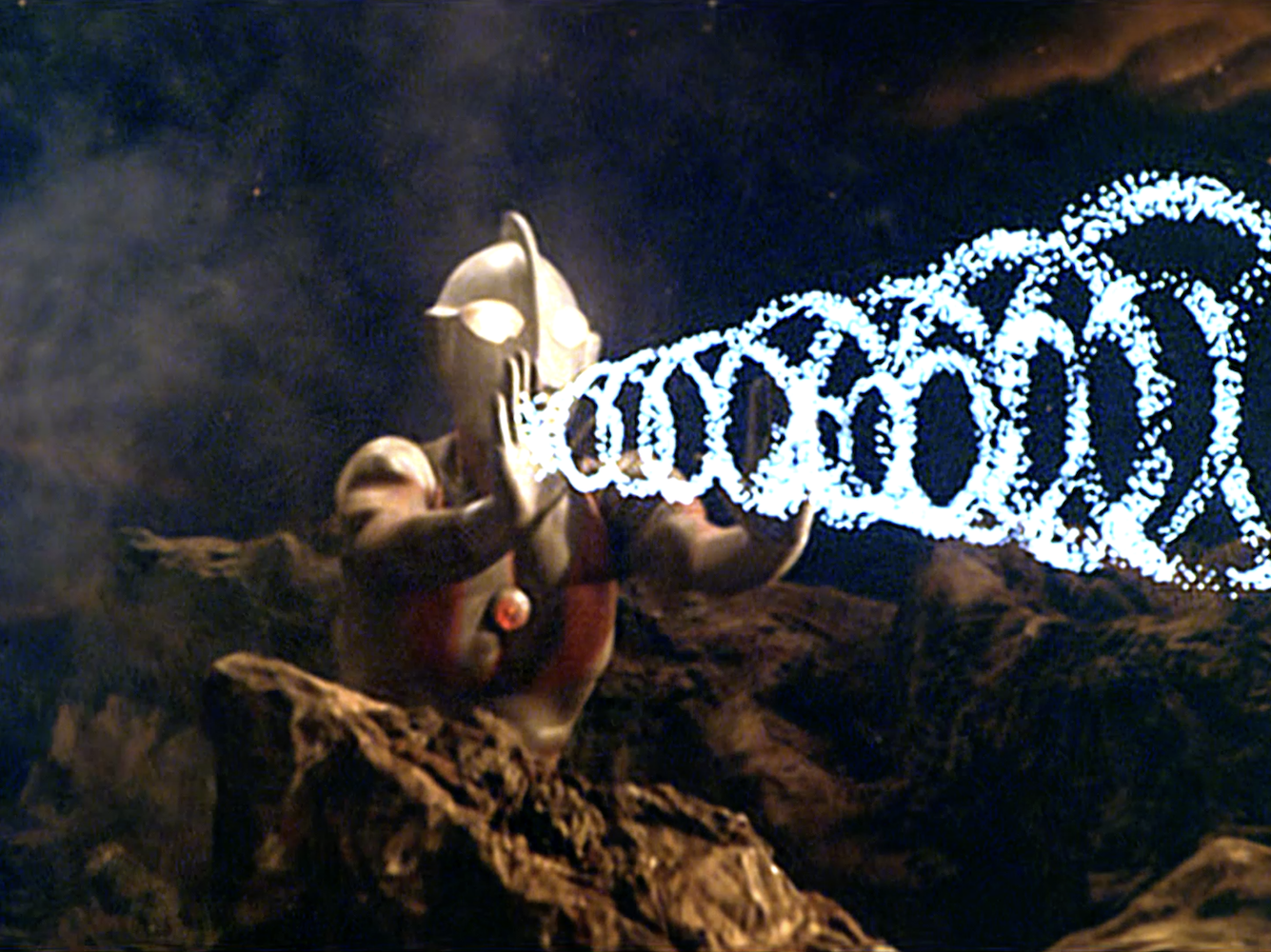
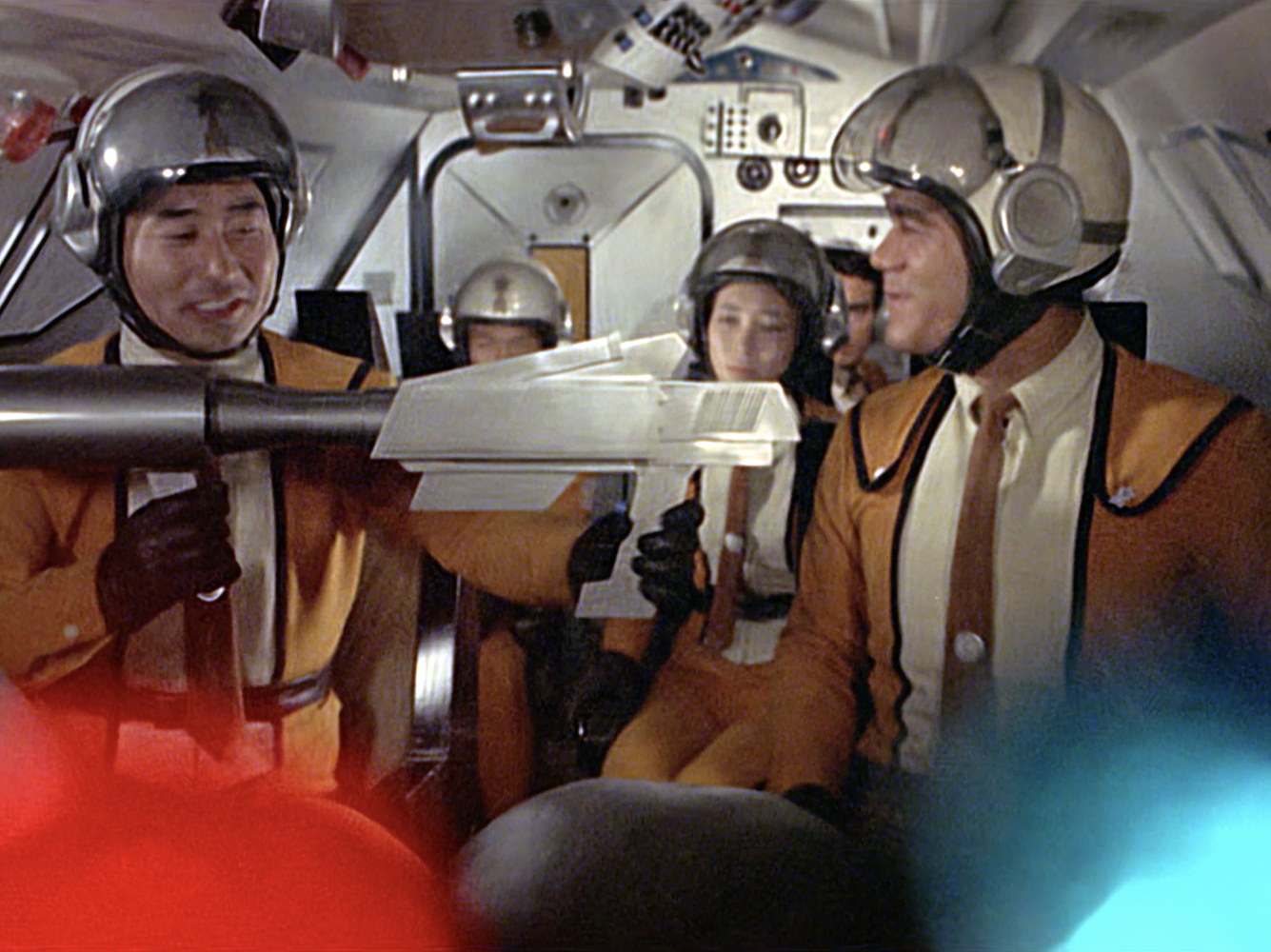
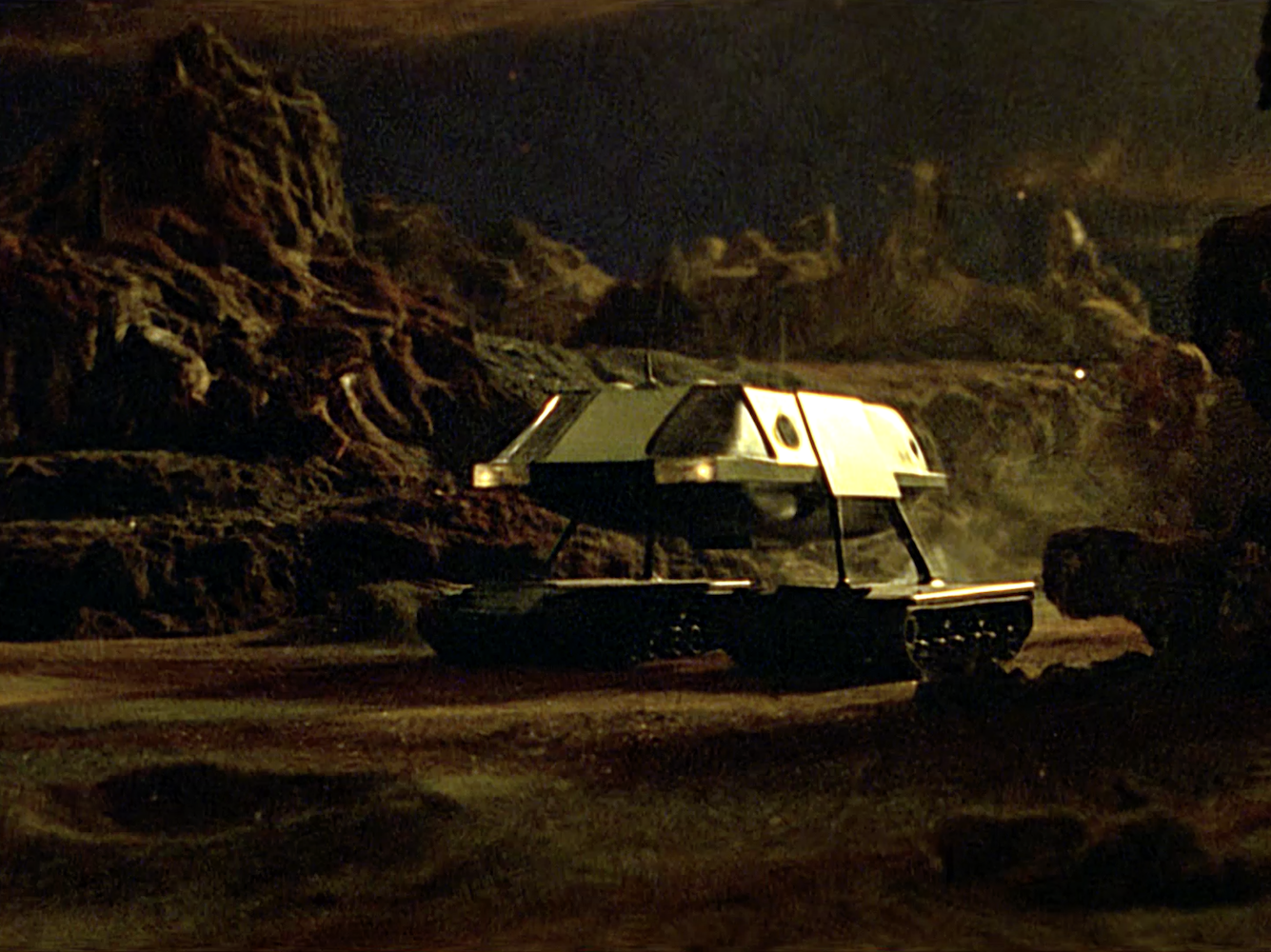
Now look at “Spaceship Rescue Command,” a full-on space epic with cinema-league spectacle and packed from start to finish with special effects. The Tsuburaya Pro team, under the direction of Eiji Tsuburaya’s longtime assistant and cameraman Sadamasa Arikawa, creates a full miniature set for an alien planet, two giant monsters, two new SSSP vehicles, an Ide-invented super gun, a space station, laser blasts, a flight through a field of meteors, a docking sequence, and opticals for new Ultraman powers. It’s science-fiction eye candy that recalls some of Tsuburaya’s rich work on films like Battle in Outer Space (1959) and Invasion of Astro-Monster (1965), as well as his influences, 1950s Hollywood planetary adventures Destination Moon (1950) and Forbidden Planet (1956). It is the visual effects masterpiece of Ultraman.
The Science Patrol has gone into space before, but this is the first time they’ve flown beyond the immediate reach of Earth. Space Station V2, under the control of NASA (not that one; the Nippon Astronautics Space Agency), loses contact with Earth while running a ground probe on the mysterious Planetoid Q. The SSSP leaps into the Shiratori, a spacecraft used for long-distance voyages, to find out what happened.
They discover that the crew of V2 has been blinded by a strange light from the surface. The light burned out a vital fuse in their system, and unless it’s replaced, the station will go critical in less than 24 hours. The only place to find another fuse in time is in the Prospector, the probe on Planetoid Q. With two feuding monsters on the planetoid, Saigo and Keylla, the job won’t be easy — and the round trip will take 20 hours, minimum.
Tetsuo Kinjo sketched the early outline for the episode, but it was Shozo Uehara who ended up writing the full script, only his second for Ultraman. His first was the classic “The Monster Anarchy Zone,” and you can feel a similar energy and excitement pulsing through this script: fast-paced adventure and constant peril. Uehara’s plotting is tight, using the ticking clock of the impending destruction of the space station to keep the action constantly hurtling forward.
The Science Patrol has one of its best showings as a team. Almost like an answer to the theme of “A Little Hero,” where Ide feared that Ultraman made the SSSP useless, the Science Patrol does 90% of the work, including destroying a monster on their own. Ultraman shows up to solve one last problem — and I suspect the Science Patrol may have been able to succeed even without Hayata transforming at the last minute. (Unfortunately, Fuji is forced to remain at V2 with the blinded crew, once again getting cut from the main action.)
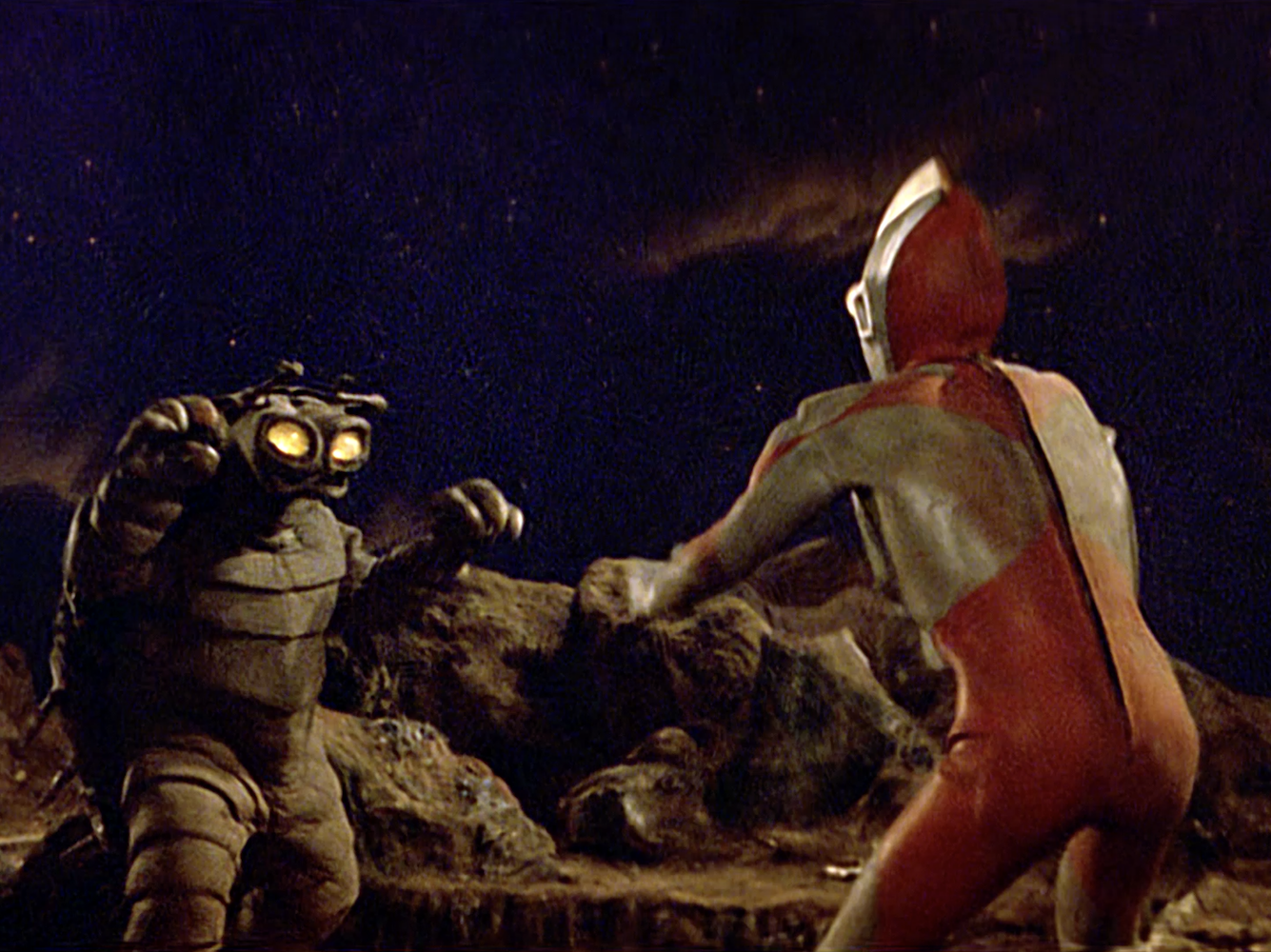
The monsters aren’t the episode’s focus: they’re additional obstacles for the heroes to overcome on their mission, which is a refreshing “adventure movie” departure from the show’s standard formula. Keylla is a memorable kaiju, with large glowing eyes and a round beetle-like appearance that makes it oddly endearing. The quadruped Saigo isn’t as interesting, nor does it hang around for long.
The fight between Ultraman and Keylla (as well as the earlier scuffle between Keylla and Saigo) is really a bonus — an extra treat added to all the other action and spectacle. The battle on the planetoid is good roughhousing fun, and Ultraman pulls out a new weapon that gives the episode a glittering send-off.
The grandeur of “Spaceship Rescue Command” was Tsuburaya Productions’ way of showing that they were capable of bigger things and could compete on an effects level with what was showing in cinemas. The show’s run was almost over, and the production team was exhausted (Tsuburaya turned down TBS’s request for another 13-episode order), but the ambition on display shows that the company was eyeing a future with big science-fiction programming — and hopefully the budgets to realize it.
The scope of “Spaceship Rescue Command” does make me wonder what an additional 13 episodes of Ultraman might have been like. Would Tsuburaya Productions have kept pushing for more space-centered adventures? A 39-episode slate seems too short for such an important show in the franchise, especially when the rest of the classic-era programs received around 50 episodes each.
We did eventually get Ultraseven, the natural outgrowth of the science-fiction aims shown here (although that show would run into the same budget problems at the start). The Ultra series was ready to take the next leap forward.
But first, they had to wrap-up the story of Ultraman…
Rating: Great
Previous: A Little Hero
Next: Farewell, Ultraman
 The Ultra Project