
Directed by Yuichi Abe. Written by Keiichi Hasegawa. Airdate July 17, 2013.
The second outing for Ultraman Ginga is a minor improvement over the rough first episode. It’s standard for Ultra shows to have stronger second episodes because they need to jam less set-up into a half-hour. “A Midsummer Night’s Dream” gives us more time with our new protagonists, Hikaru and Misuzu, to establish their relationship, and there’s an odd but enjoyable villain. Not a kaiju or alien villain, but a nutball motorcyclist who likes to run people over for committing crimes. Like being too flirtatious.
Misuzu and Hikaru’s relationship is firmly in the style of Saturday-afternoon YA drama, as is most of the human action of Ginga: themes about courage, facing fears, pursuing your dreams, etc. That’s not a terrible thing. It feels surface-level, but when the action centers on Hikaru and Misuzu, it has sincerity. Plus, these scenes don’t take such heavy blows from a budget pulled from petty cash.
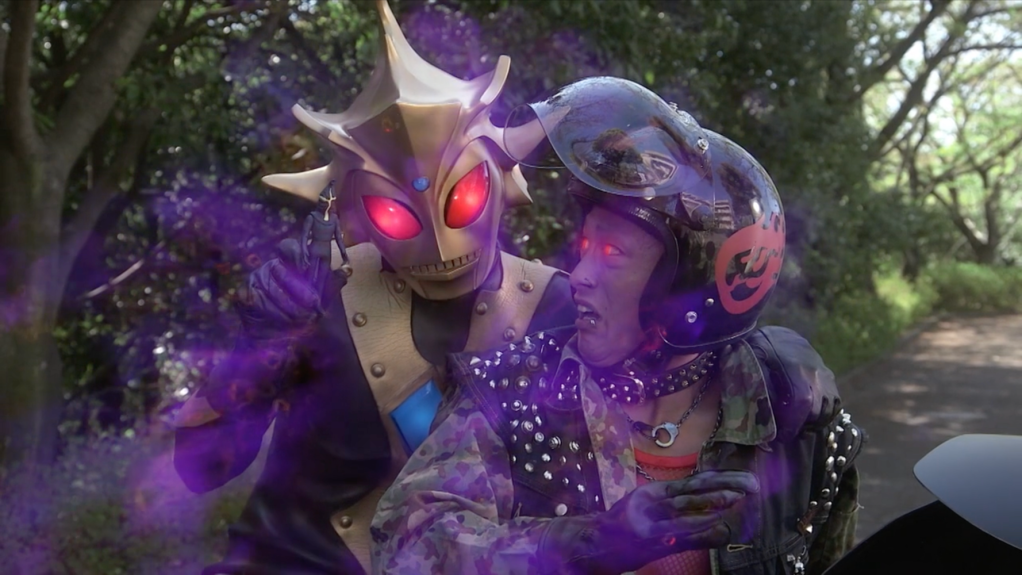
The episode solidifies Ginga’s pattern for presenting its monster of the week. From his shadowy toy-collection lair, the “mysterious” villain (it’s obviously Dark Lugiel; I don’t think that’s any kind of spoiler) sends forth Alien Valky with the Dark Spark to turn a black-hearted human into a monster. This time, Valky targets the chaos nut wheeling around on the motorcycle, turning him into Alien Kemur from Ultra Q.
This vehicular terrorist, referred to as the “Chaser,” is a hoot. He’s the best part of the episode, hands down. The Chaser wheels around the school and town, threatening to run down people and children for his own amusement. (Was this an actual problem in Japan at the time? Were “Chasers” a punk subculture?) He snarls, shouts, and contorts his face while spitting absurd lines: “Quit all the flirting. It gets on my nerves!” I’m disappointed he gets turned into Alien Kemur; I’d rather he have more screen time and we skipped the pointlessly recycled alien. He’s ridiculous in the best way and enlivens events whenever he shows up.
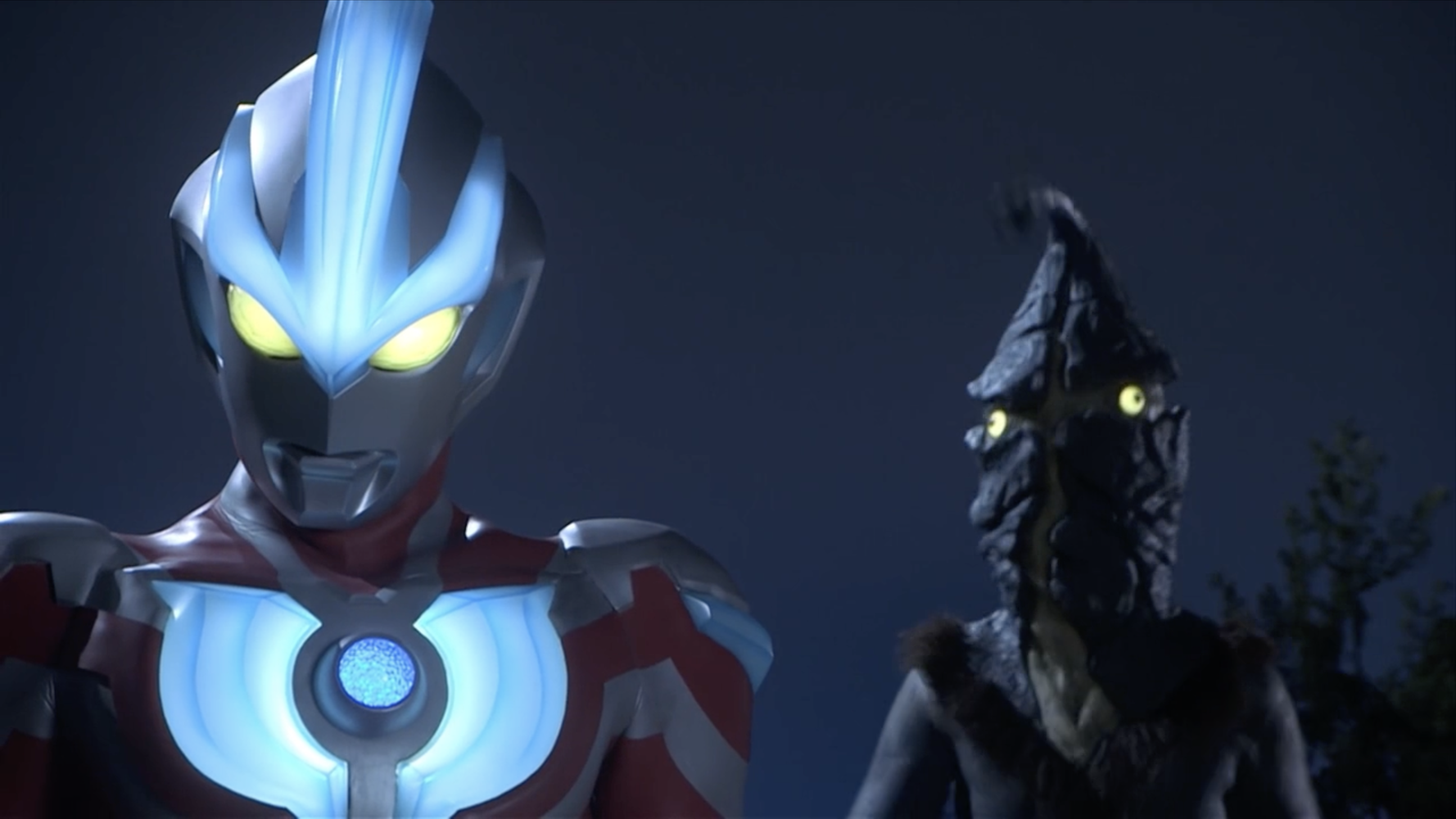
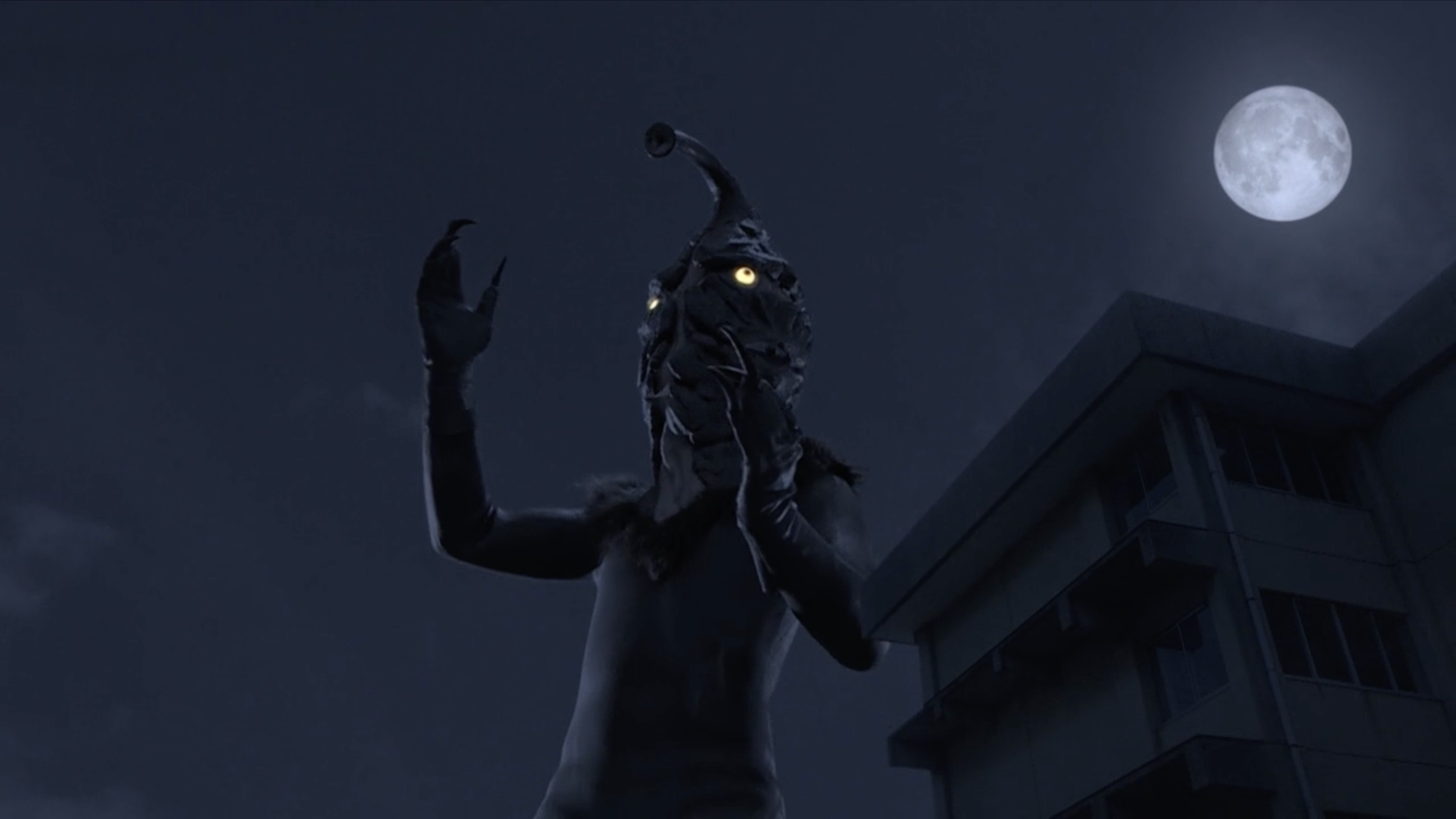
The other ridiculousness in the episode fares far worse, as one attempt at comedy after another flounders. I’m a sucker for the bizarre humor of the Ultra shows, but this is sad and a smidgen desperate. Alien Kemur chasing Misuzu down an elementary-school hallway, flailing its spindly body and booming its bass laugh, isn’t funny-weird. It’s just weird. It doesn’t even work as a reference to Kemur’s first appearance in Ultra Q (as if the kids tuning in have even seen Ultra Q) because there’s nothing clever about Alien Kemur’s appearance. He’s just another costume Tsuburaya Pro had in the warehouse. Hitting Alien Kemur with a broom and a football, or having him use flatulence as a weapon … none of this is funny. It’s shabby and second-hand embarrassing.
The low budget continues to hobble the show. The HD photography is flat and dull. There are several poorly shot day-for-night scenes. One scene has ugly-sounding location audio that wasn’t fixed in post-production. These aren’t issues I’m accustomed to seeing in other Ultra shows, and they’re a constant reminder of how rushed and underfunded Ultraman Ginga was.
We get a few more key pieces of series set-up. Most important is the brief introduction — starting with a poorly timed “comedy” collision — of Tomoya Ichijoji (Takuya Kusakawa). Tomoya is an intelligent and aloof student who’s come to see the Ginga shrine, specifically the Ginga Spark. He’ll become the third lead of the show as well as its most interesting character.
For the benefit of both the audience and Hikaru, the Ultraman Taro figurine delivers exposition that gives the show framing within the larger Ultra franchise: Taro comes from the main Ultra universe, The Land of Light continuity that’s filled with the famous Ultra warriors and monsters. Hikaru’s own universe has never seen an Ultra before, and Ginga appears to be unique to it because Taro hasn’t heard of Ginga before. Once again, credit to Taro’s voice actor for breathing life into the inanimate doll and building a connection with Hikaru where the visuals fall short.
By the way, if you were hoping the title of the episode meant there’d be a connection in theme, character, or even a bit of dialogue to Shakespeare’s play — sorry, nothing. I was hoping for a donkey-headed kaiju.
Rating: Mediocre
Previous: Town of Falling Stars
Next: The Twin-Headed Flame Beast
 The Ultra Project