
Directed by Noriaki Yuasa. Written by Niisan Takahashi.
The progression of the classic Gamera series doesn’t follow conventional movie franchise logic. This logic says that once a series completes the transformation into children’s entertainment, it will enter a period of steady decline — if it hasn’t already. Although Gamera vs. Guiron was psychedelic fun with little in the way of story to interfere with kids’ enjoyment, it should have signaled an irreversible trend toward lower budgets and sillier, simpler plots.
Yet the next Gamera film is an uptick in quality and scope. Gamera vs. Jiger is still 100% a children’s movie. But of the four Gamera films in a row that use a pair of pre-teen heroes, one Japanese and one Caucasian, Gamera vs. Jiger has the most interesting story. It effectively combines its child protagonists with adult characters who aren’t a pack of doubting, obstructionist dopes. The Japanese Self-Defense Force returns and has military engagements with the monster, urban destruction roars back in a big way, people seem in legitimate danger, and the plot takes an intriguing science-fiction turn with elements from Fantastic Voyage. It’s the best installment since Gamera vs. Gyaos and a surprise to find in a series that’s about to go on hiatus after its next film.
The young heroes are Hiroshi (Tsutomu Takakuwa) and Tommy (Kelly Varis), a much improved duo compared to those of the previous two films. Instead of delinquents who cause trouble for the adults before the monster action gets rolling, Hiroshi and Tommy are smart, diligent, and resourceful. They earn enough respect from the adults that having them involved in the action around the monsters makes sense.
Although Gamera is portrayed as a helpful beast, the giant turtle isn’t there to assist the kids specifically, which makes the boys’ choices look even more heroic. This is the closest the Gamera movies come to the feel of a classic “boys’ adventure” book. Tsutomu Takakuwa is also the most personable child performer in the series. Kelly Varis comes across as a bit anonymous, but at least he’s never annoying.
Gamera vs. Jiger has a bigger-budgeted appearance than Gamera vs. Viras or Gamera vs. Guiron, but it still makes a few cost-cutting maneuvers. There’s stock footage, but it only appears under the main credits. Forgivable. To eat up time, the filmmakers instead take us on a prolonged tour of Expo ‘70 in Osaka, or the future site of Expo ‘70, since it wasn’t finished at the time of shooting. I doubt the filmmakers would’ve attempted this if they had to find a way to shoot in the middle of the exposition. An archaeologist who’s dating Hiroshi’s sister gives the boy a tour of the expo site that runs through shots of every pavilion and pushes the exposition’s theme of world cooperation. The archaeologist then explains that he’s arranged to move a megalith called the Devil’s Whistle from Wester Island in the Pacific as part of the exhibition. That sounds suspiciously like colonial theft to me, but hey — world cooperation!
Moving the Devil’s Whistle does turn out to be a mistake, since the monolith was placed there by the ancient race of Mu to imprison the monster Jiger. Gamera, apparently aware of the presence of all evil monsters — terrestrial or extra-terrestrial — tries to prevent humanity’s foolish mistake. But the archaeology team still moves the Devil’s Whistle to the Expo, sending Jiger out in pursuit to eliminate the object that kept it locked up for so long.
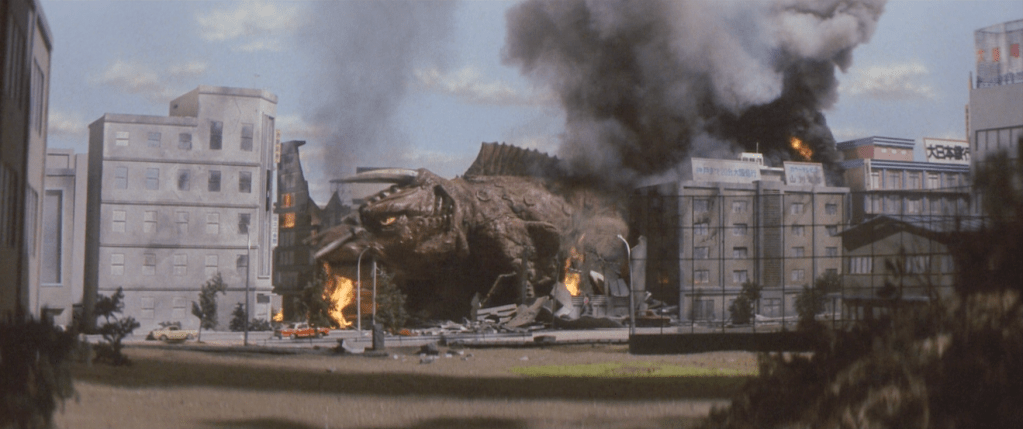
Jiger combines elements of older, more realistic dinosaur kaiju with the outlandishness of the Gamera series. The quadruped monster resembles a ceratopsian with a Dimetrodon dorsal crest; it might have fit into the earlier Godzilla movies without much change. But Jiger has the most extensive array of odd gizmos of any Gamera opponent: an “Ultra Wave” from its snout capable of skeletonizing people, spears ejected from its tusks, air jets in its frills allowing its non-aerodynamic body to fly, and a tail spike that injects larva into an opponent. Jiger is nasty business, able to incapacitate Gamera twice (which means we get three monster fights, yeah!) and wreck Osaka in scenes that must have cost twice the budget of both previous films.

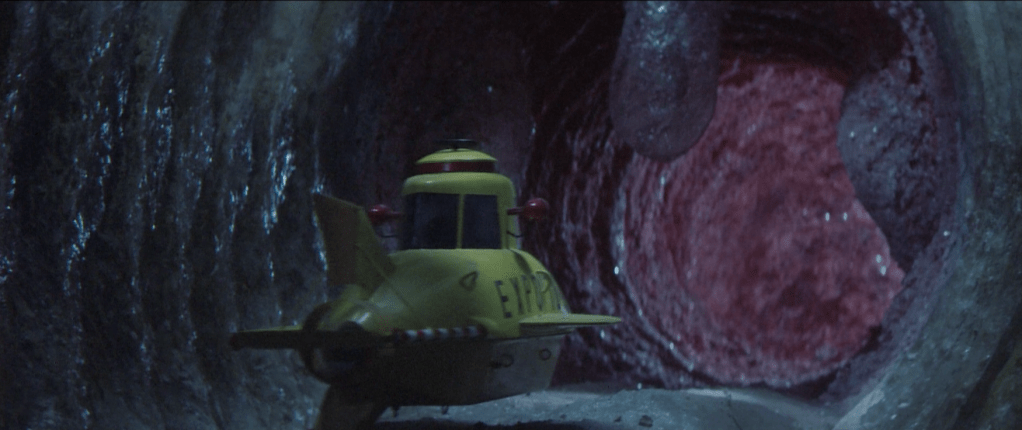
Jiger delivers Gamera’s most humiliating defeat yet with its larval-injecting spike. This incapacitates Gamera face-down in the water, unable to recover. Once the scientists figure out the problem, Hiroshi and Tommy dash off to pilot a mini-sub from the Expo into Gamera’s mouth to seek out and destroy the offending larva.
Gamera taking a mid-movie break is a staple of the series. This time it happens twice, but the script actually does something with the second Gamera time-out. Normally, the plot trudges on with the child heroes until Gamera naturally recovers. Now, the finale rests on Hiroshi and Tommy making a journey through inner space to rescue their giant turtle pal.
The scenes inside Gamera’s body, as the two boys communicate with home base and attempt to find the dangerous larva, are among the most imaginative in any of these movies. They show a good intersection of “weird” with “plot-practical.” The resolution rests a bit too much on chance (it turns out Jiger is susceptible to wireless phone transmissions!) but the sequence stands out as clever and visually impressive.
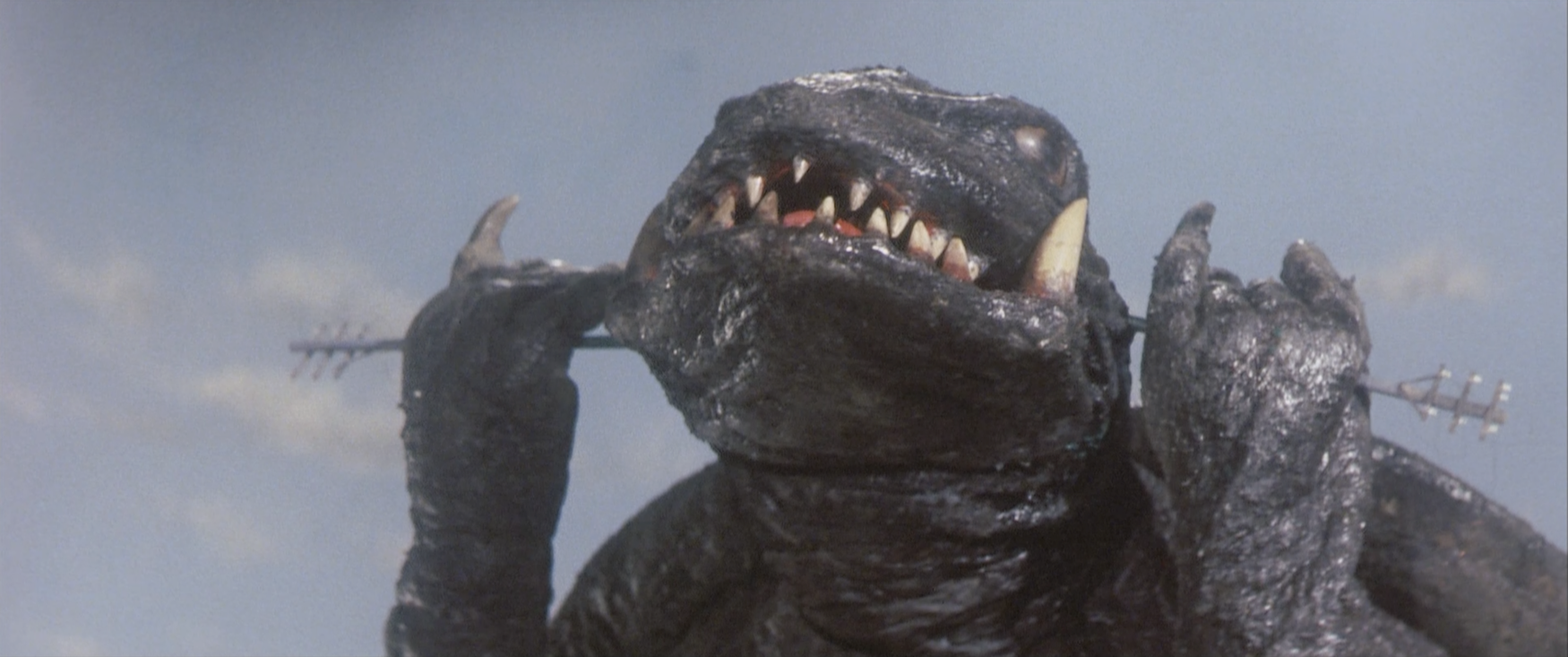
The last fight, kept at the edge of the Expo ‘70 site because Gamera kindly wants to avoid destroying it and driving up the budget, suffers from the slower choreography the monster battles have adopted since Gamera vs. Viras. The maneuvers are as entertainingly odd and anthropomorphized as ever: Gamera grabs a metal club and smashes off Jiger’s tail stinger, jams telephone poles into its ears to block the Ultra Wave attack, and somehow understands the importance of the low-frequency sounds of the Devil’s Whistle and hurls it right into Jiger’s head. Loopy stuff, good times — that’s the overall reaction I have to the movie.

When AIP Television released Gamera vs. Jiger in the US, they renamed it Gamera vs. Monster X. This was probably done to link it to Monster Zero, the title given to the 1965 Godzilla film Invasion of Astro Monster when it was finally released stateside in 1970. Sandy Frank did not pick up Gamera vs. Jiger for television distribution in the 1980s; I’m not certain why. Because of this, the movie vanished from US airwaves along with Gamera vs. Viras in the 1980s when AIP’s rights expired.
If you don’t know anything about the history of the Gamera series or the direction of the Japanese film industry, you might imagine that Gamera vs. Jiger was the mark of a new stretch of quality films. However, economics and fatigue would now defeat Gamera more effectively than any giant monster with a larva-injector tail. The next installment would shut down the series for nine years (and 1980’s Gamera: Super Monster barely qualifies as a “Gamera” film) and plunge it down to embarrassing depths. The cosmic forces that aligned to make Gamera vs. Jiger a good time realigned to make Gamera vs. Zigra … well, we’ll get to that.
Rating: Good
Previous: Gamera vs. Guiron
Next: Gamera vs. Zigra
 The Ultra Project