
Directed by Toshitsugu Suzuki. Written by Bunzo Wakatsuki. Airdate March 31, 1968.
The Cold War and fears of nuclear war lurk behind much of tokusatsu, especially in the Showa era. The movie that ignited the tokusatsu genre, Godzilla, is the quintessential cinematic nuclear metaphor, and Japan is the nation most acutely aware of the horrors of nuclear weapons as “deterrents.” The specter of the Cold War haunts many of Ultraseven’s tales of alien invaders. In “Super Weapon R1,” the subtext of the madness of the arms race becomes the text, the explicitly stated theme. This could’ve turned out heavy-handed. Here, it all works, resulting in one of the great and enduring Ultra episodes.
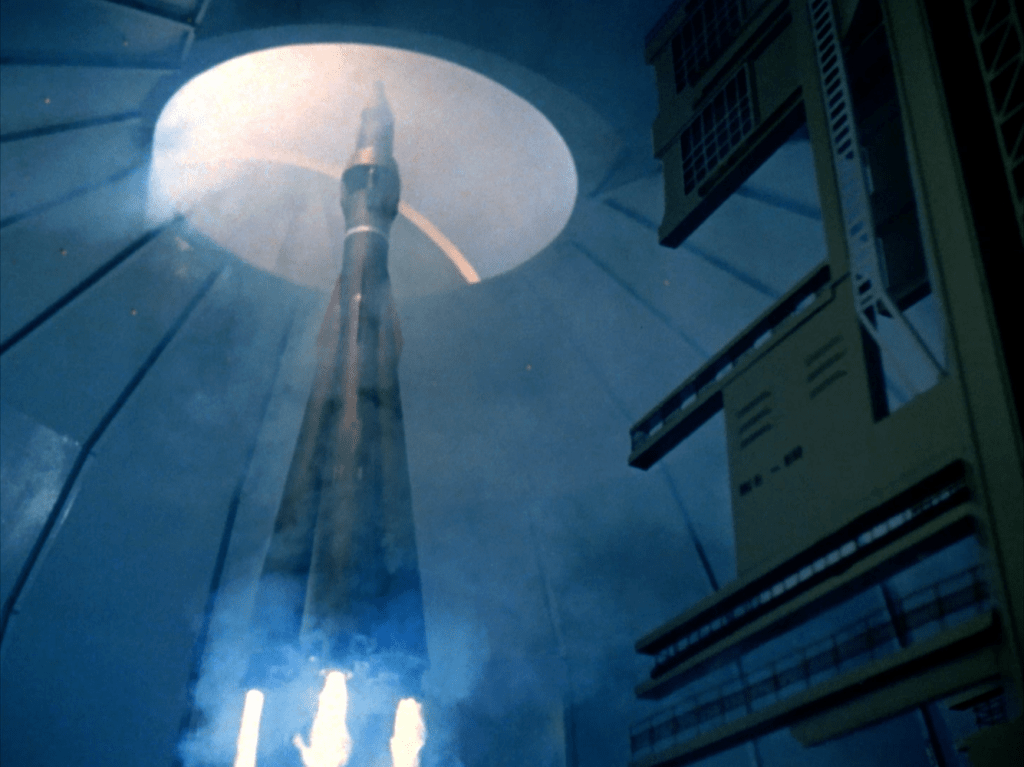
Because this is Ultraseven, the participants in the arms race aren’t two Earth nations, but Earth and the extraterrestrials continually targeting the planet. The TDF has been researching methods to put a final end to the alien attacks. (Project Blue apparently never panned out.) Their newest invention is a series of rockets capable of blowing up planets. Yes, the TDF has devised their own Death Star. Professors Maeno (Nami Tamura) and Segawa (Junichiro Mukai) arrive at TDF headquarters to oversee the final test of rocket R1, which has the power of six thousand hydrogen bombs. It’s only the first of a planned series of increasingly devastating rockets.
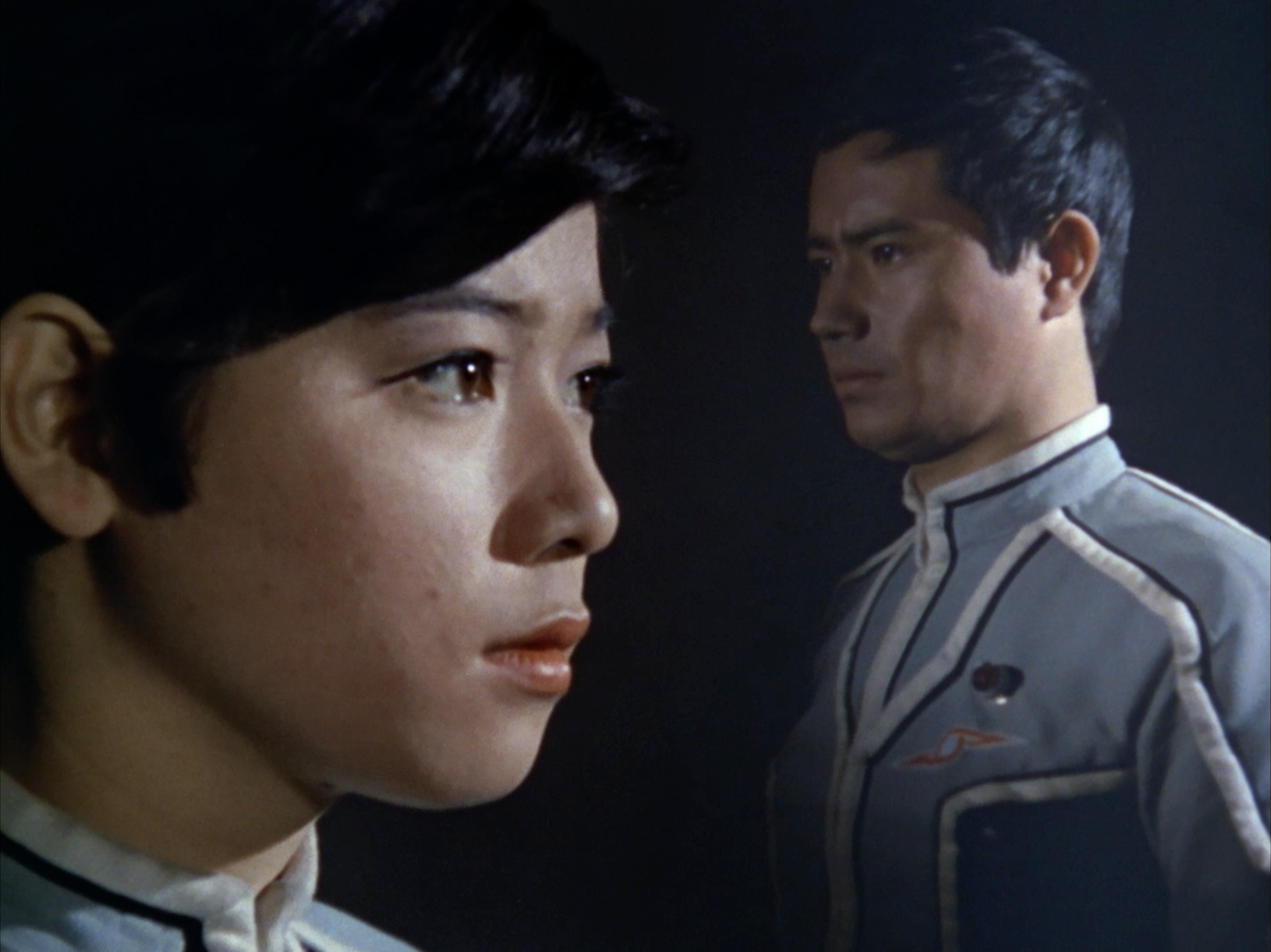
The potential to “protect peace” excites the TDF brass as well as the Ultra Guard. Furuhashi, predictably, is thrilled: “Any planet that tries to invade will be blown to bits!” Even Anne gets swept up in the energy of this escalation of Earth’s offensive capacities. She assumes testing the R1 will be enough to tell alien species to keep their hands off Earth.
This saber rattling horrifies Dan, however. Or maybe we should say it horrifies Ultraseven, because his peacekeeping alien race understands better than humans where brinkmanship of this kind will ultimately lead.
Dan explicitly states the Cold War theme in a line he first says to Furuhashi, and which rings out several more times in the episode: “It’s a sad marathon you keep running as you cough up blood.” Shots of a chipmunk running on a wheel underscore the line at one point so viewers know the script isn’t messing around when it talks about getting caught in a downward spiral of violent one-upmanship.
Where is this spiral headed — in this episode, at least? A big monster, of course.
To test the R1, the TDF fires the rocket at Planet Gyeron. Professor Maeno, the project’s astrobiologist, is certain the planet is devoid of life. The R1 destroys Planet Gyeron as expected, but the celebration on Earth doesn’t last long. The planet did have at least one inhabitant, the eagle-like creature Star Bem Gyeron. The blast made it extremely large, and now the kaiju is heading along the rocket’s path toward the planet that launched it so Star Bem Gyeron can unleash some understandable frustrations.
A lot goes on in under a half hour. Look how much I had to cover before getting to the episode’s kaiju. Once Star Bem Gyeron enters the story, all the grandiose talk of peace-through-arms shatters. Dan blames himself for failing to stand up against the R1 project, although I don’t know what he could’ve done as the sole voice of reason. The TDF debates making everything worse by launching the ten-fold more destructive R2 rocket at Gyeron.
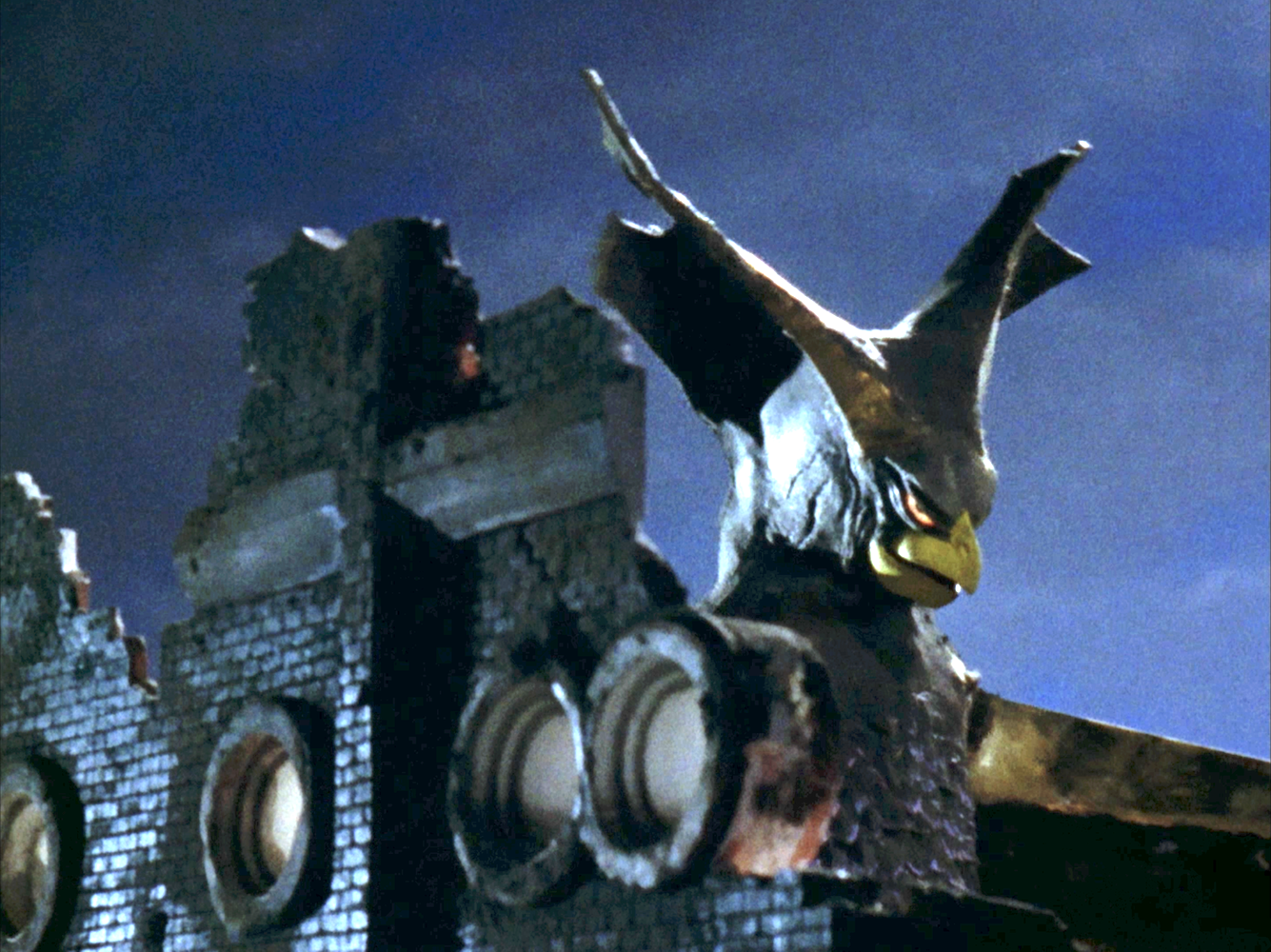
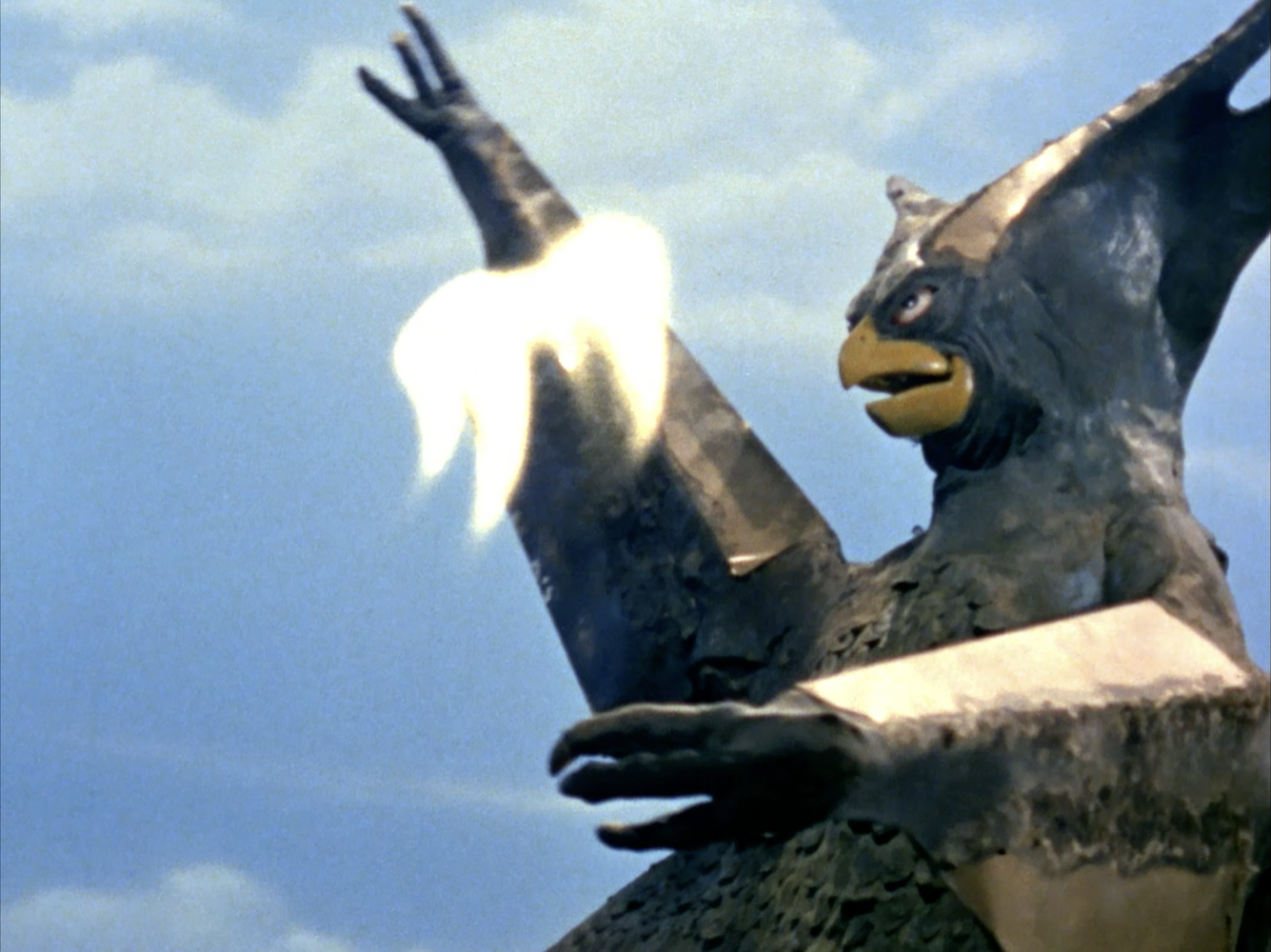
The kaiju of the episode is a strange one: Star Bem Gyeron has avian facial features that look a bit friendly, but its body is harsh angles and metal surfaces that can deflect Seven’s Eye Slugger. This contrast was likely done on purpose, the same way that the two large special effects scenes with Gyeron take place in wildly different locations: a ruined plain with a bombed-out church at night, and a lush field with flowers in the day.
The blasted plain with its derelict cathedral is the episode’s most striking image. The production crew based the ruins on the remains left of Urakami Cathedral after the Nagasaki bombing. The actual cathedral was rebuilt in 1958, so the location isn’t literally meant to be Nagasaki. Figuratively, however, it’s hard to miss the connection. People unfamiliar with images of the cathedral will still recognize wartime bombing, and the creepy Gothic look lends extra gravity to the scene.
When Seven at last faces Gyeron, the contrasts become starker. Heroic music plays as Seven at last gets his bearings in the tough battle against a kaiju that has good reason to be enraged. When Seven destroys Gyeron, it’s ugly. Shockingly violent. After Dan’s grand talk of peace, it’s disturbing to see the hero go to such brutal extremes to destroy a foe. A story about misplaced glee in keeping peace through the threat of massive violence ends on a bright day among blooming flowers — where an alien hero who has preached peace gorily rips apart his foe. Intentional dichotomy? I suspect so.
The coda offers a glimmer of hope that humans can learn their lessons and turn away from a race toward the abyss. Chief Staff Officer Takenaka (Kenji Sahara) promises Dan that the R1 program will stop, and Professors Maeno and Segawa admit their mistakes. (Notably, everyone diplomatically spreads around the blame so the fiasco is positioned as a general failing of humanity, not a failing of any individuals.) But this optimism is tenuous. The mood leans toward humans continuing the same errors in that sad marathon leading to mutual annihilation.
“Super Weapon R1” is the first of an informal trilogy of exceptionally bleak — and exceptionally good — Ultraseven episodes about grave social issues. “Super Weapon R1” examines the arms race; “Ambassador of the Nonmalt” confronts racial genocide; and “Nightmare of Planet No. 4” tackles fascism. Much of Ultraseven’s legacy as an important science-fiction show, one I believe worthy to compare to its contemporary Star Trek, rests on the intelligence and daring of these episodes.
Rating: Classic
Previous: Showdown at 140 Degrees Below Zero
Next: Operation Cyborg
 The Ultra Project