
Directed by Fred F. Sears. Written by Paul Gangelin and Sam Newman. Starring Jeff Morrow, Mara Corday, Morris Ankrum.
In these movie breaks, I’ve so far looked at monster films from Japan and the UK. It’s time to pay a visit to the B-movie factories of 1950s Hollywood, the original laboratories where the giant monster craze was spawned and mutated. I grew up on these movies on Saturday and Sunday afternoons, seeing many of them before I saw my first Godzilla movie. I still have immense love for them, their often corny earnestness, and their peculiar cultural zeitgeist of the anxiety-ridden 1950s.
What film to start with? I could go with one of the classics that influenced Eiji Tsuburaya and Toho Studios, like Them! (1953) or The Beast From 20,000 Fathoms (1954). But since I recently looked at Rodan (1957), one of the great flying monster films, it feels appropriate to pick a lesser flying monster film from Hollywood: the much-ridiculed The Giant Claw.
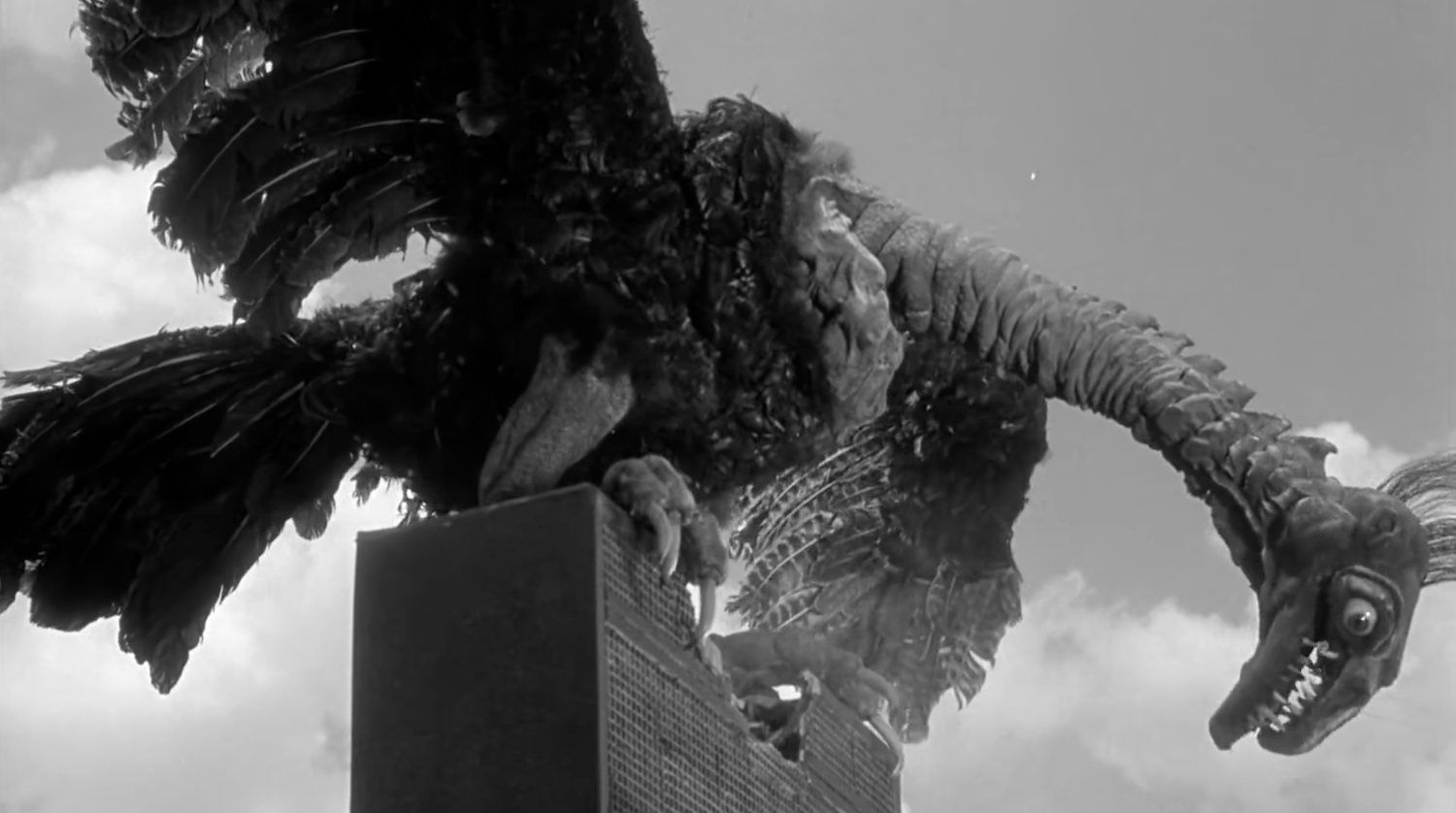
The Giant Claw has a terrible reputation. You can see why right on this page: its monster. The original movie poster promised a creature that was some type of super-eagle. What appeared on screen was … well, take your pick, there are so many fun, derogatory ways to describe it.
Is it a rejected Muppet with mange? Did somebody animate your Thanksgiving turkey and it wants revenge? Did Beaky Buzzard from Looney Tunes land a live-action deal?
Play along, roll your own! Countless other online reviewers have. This is well-trodden internet territory. I first recall coming across mocking reviews of The Giant Claw on the internet back in 1998. We all thought those Beaky Buzzard jokes were so funny.

Here’s the surprise: I don’t think this is a bad movie. I’ve seen much worse from the period. The Giant Claw is a serviceable Cold War giant monster movie that holds together as 84 minutes of entertainment. The ridiculous-looking monster isn’t a detriment to the film — it’s a boost, adding an off-the-rails feeling to material that’s otherwise firmly on the tracks of its genre and time.
The Giant Claw follows the ‘50s B-movie playbook from frame one. It opens with a documentary-style montage of a military and scientific operation in the Arctic, i.e., mostly stock footage. A stern-voiced narrator (director Fred F. Sears, who has a good radio voice) doles out exposition before closing with an ominous outro: “A significant moment in history. The moment when an electronic engineer named Mitchell MacAfee saw something in the sky. Something that was almost the beginning of the end … of life on this Earth.”
The story that now unfolds is by-the-numbers. Mitch MacAfee (Jeff Morrow) sees something strange in the sky, which he describes as the size of a battleship. It doesn’t show up on radar, so no one believes Mitch at first. Investigation eventually reveals the existence of the titular monster, and scientists and the Air Force hustle to discover some method of defeating it. Meanwhile, Mitch romances mathematician Sally Caldwell (Mara Corday), at one point inviting her to spank him.

Since Mitch is both a pilot and electronic engineer, he’s able to get involved in the double-decker action of science and shooting. The action climaxes in New York City, where the giant bird causes mayhem on the ground (stock shots from The Beast From 20,000 Fathoms and Earth vs. the Flying Saucers) and terror in the air before (mild spoilers) jets use missiles made from unobtanium to bring down the flying menace. Thus Does Man Reassert His Dominion Over the Earth.
The Giant Claw boasts a decent talent pool of low-budget stalwarts. Producer Sam Katzman was the head of Columbia Pictures’ B-movie unit, and his potboiler films are usually a cut above similar fare. Director Sears was not a visionary, but he was an experienced professional with dozens of credits in crime dramas and Westerns, as well as the Ray Harryhausen classic Earth vs. the Flying Saucers. Sears knew his way around low-budget genre pictures, and The Giant Claw has all the marks of a journeyman getting the job done. Unfortunately, this was one of his last pictures: he died the year it was released at age 44.
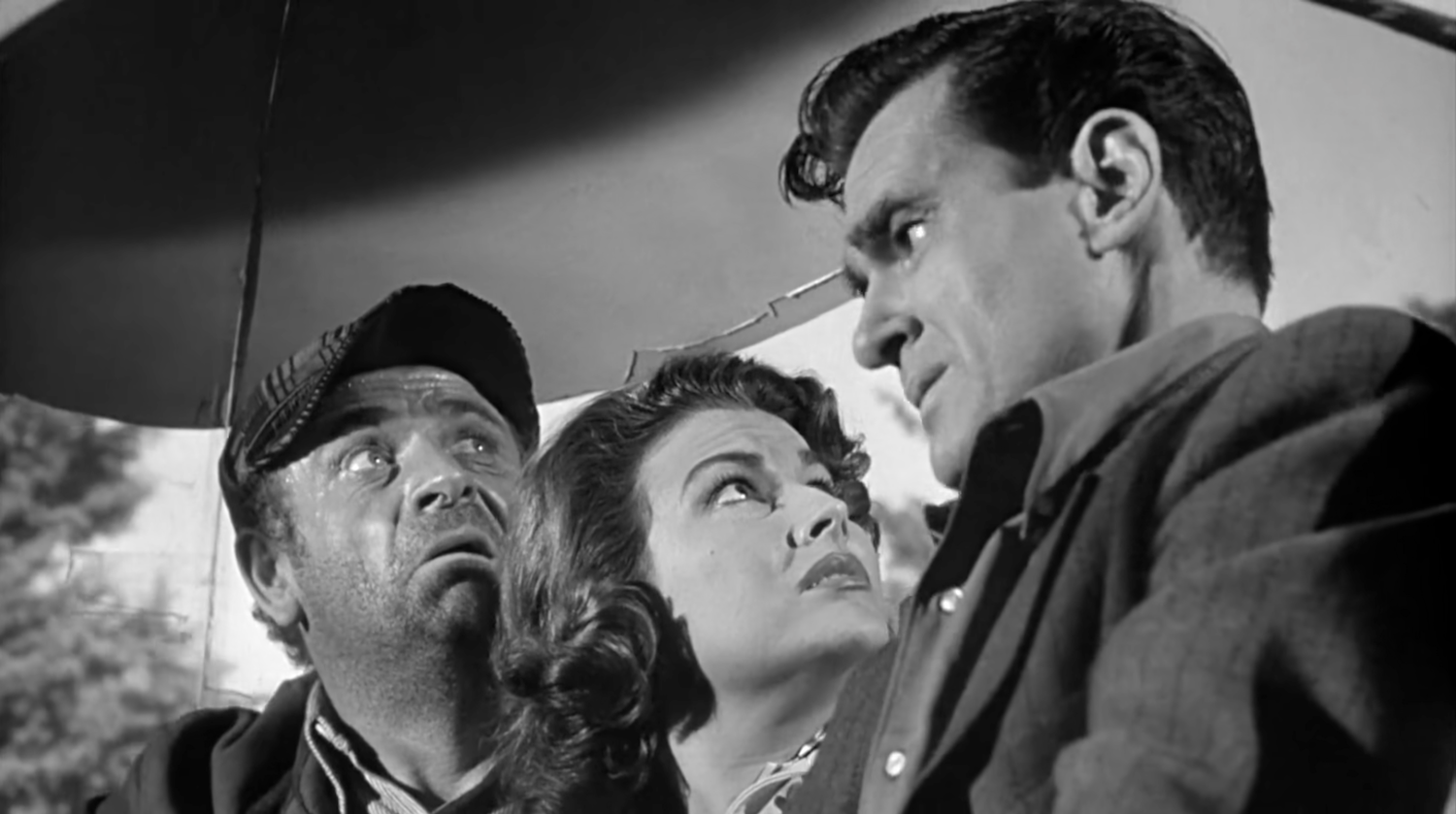
The cast is similarly robust. Jeff Morrow has the iron-jaw determination to pull off his stock character, and he gives the part all he has. Corday plays a more nuanced and capable female character than usual for the genre, although she still has to go melty for MacAfee at the end. Morris Ankrum once again suits up as the chief of military operations, and any genre fan will find him a comforting presence.
Now it’s time to get back to the Big Bird in the room. The giant creature has a strange in-universe origin: an extraterrestrial beast from an antimatter galaxy that projects an antimatter shield, making it invisible to radar and effectively invincible. The science is slack and wacky, but in line with ‘50s science-fiction films. A character mistakes the giant claw for la Carcagne, a creature from French-Canadian folklore whose cries foretell death. That adds an interesting layer to the beast. The right design could have emphasized the monster’s alien and mythic nature.
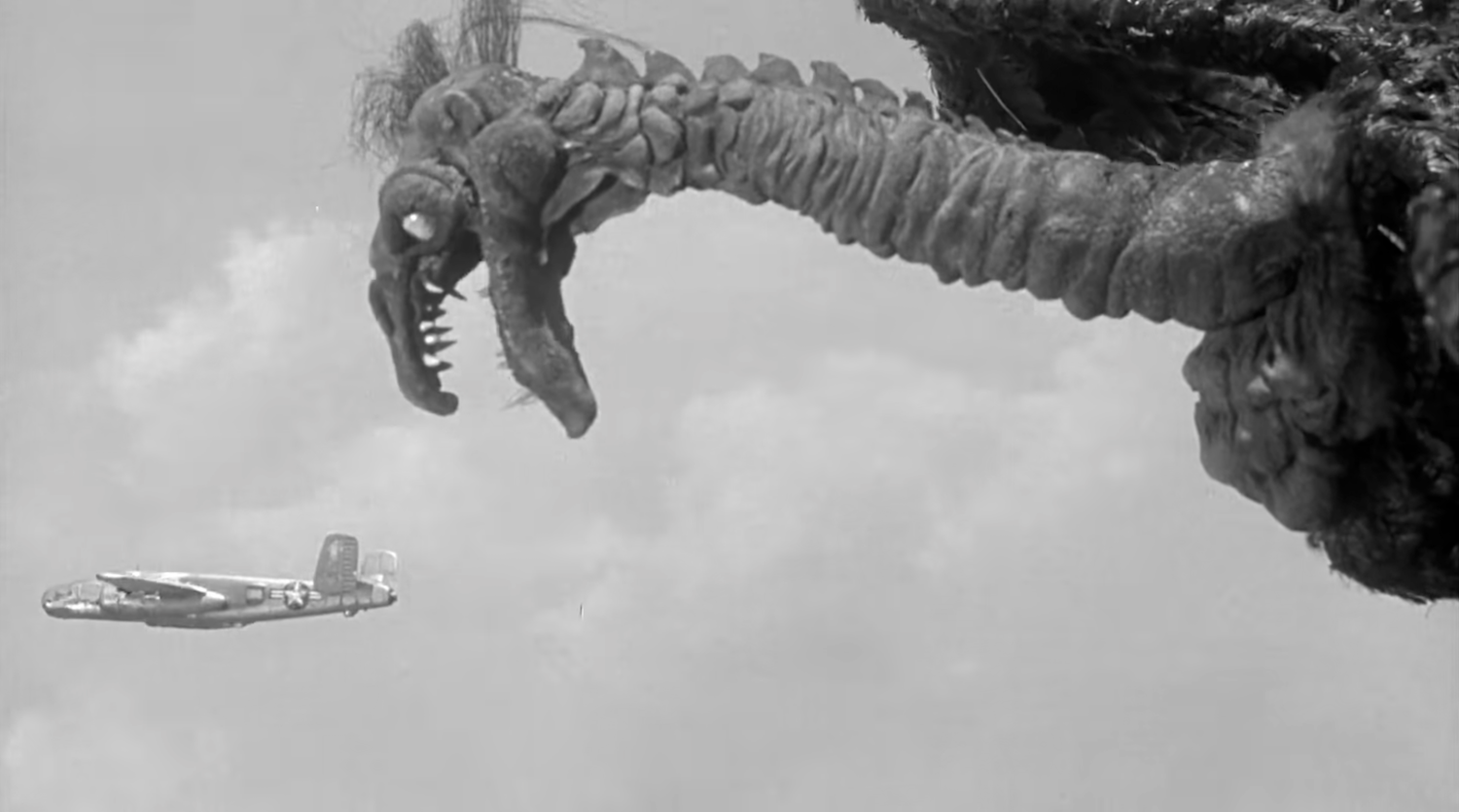
Instead, the design is … a turkey-buzzard-vulture combo with oversized eyes, flared hairy nostrils, and a tufted mohawk. Anyone who sees it for the first time is stunned at the audacity of something like it appearing in a supposedly serious science-fiction film. The actors never saw designs for the monster or any of the visual effects while shooting the film. According to Bill Warren’s book Keep Watching the Skies, when Jeff Morrow saw the creature on screen for the first time at a special hometown screening, he was so mortified that he snuck out of the theater to the sounds of audience laughter.
What happened here? It’s unclear. Sam Katzman tried to get Ray Harryhausen to do the effects, but he was either too busy or the budget wasn’t large enough to afford time-consuming stop-motion animation. According to a long-standing rumor, Katzman turned to a Mexican company to create the creature at a cut-rate price. No one seems to know what Mexican company was involved.
The technicians credited for the effects are Ralph Hammeras and George Teague, with an uncredited Lawrence W. Butler on second unit effects. All were seasoned Hollywood pros. Hammeras and Teague had worked in partnership on crime dramas (including the wonderfully strange 1947 fantasy-noir Repeat Performance). Butler’s impressive special effects résumé includes The Thief of Bagdad (1940), The Caine Mutiny (1954), and Robinson Crusoe on Mars (1964). I have a hard time imagining any of these pros would have crafted a headlining monster so outrageous.
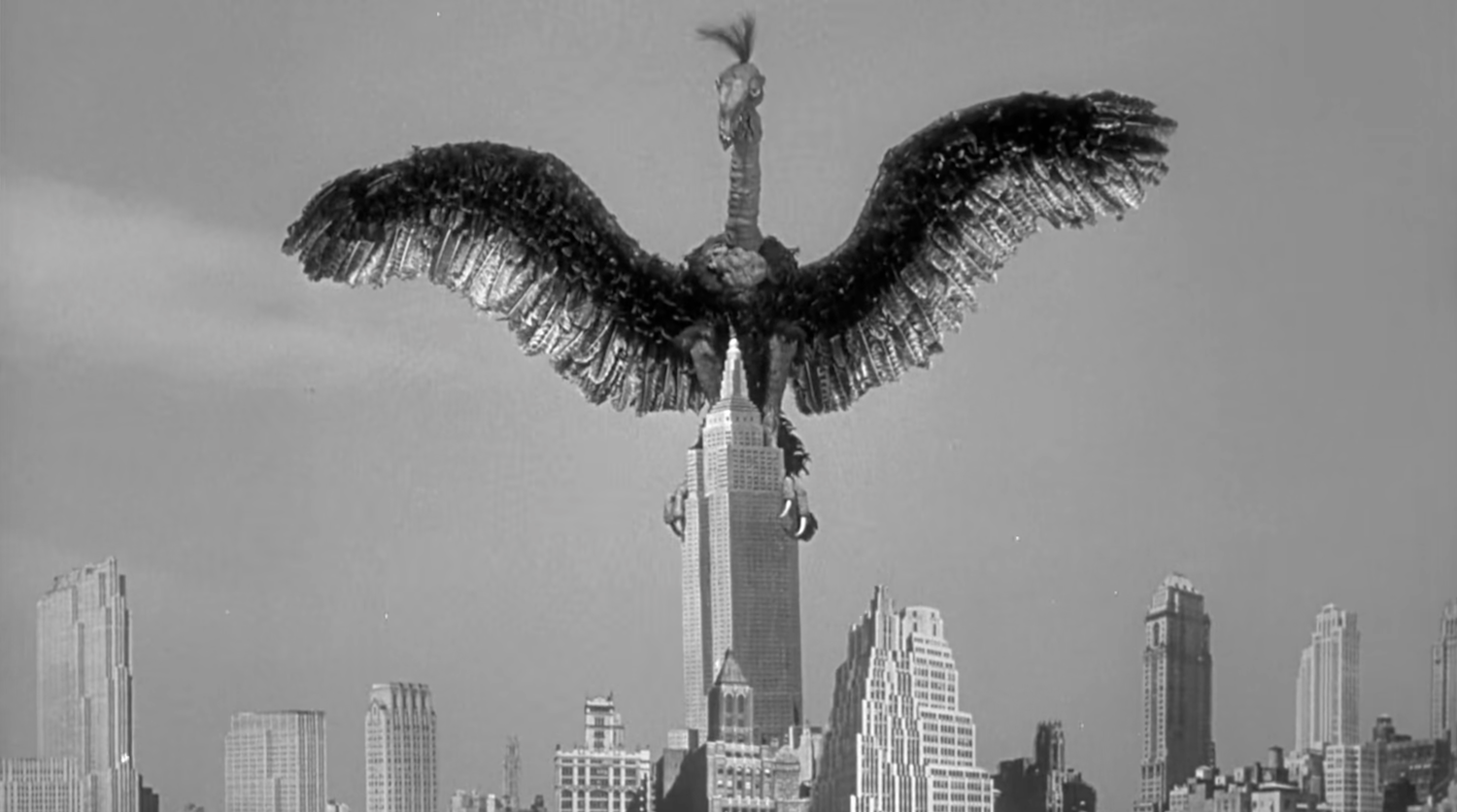
Once I get past the initial face-punch of the giant claw’s nutty design, I must admit … I rather like it. It’s entertaining to watch. It has excellent articulation and functions effectively as a big, dangerous monster in the VFX scenes. The destruction of the Empire State Building, the attack on the UN, grabbing trains off the tracks, engaging with fighter planes — these sequences all work in the B-movie setting. I’ve seen far more boring giant monsters, like the locusts in Beginning of the End (photographically enlarged normal grasshoppers) or the shadow of a lobster in Teenagers From Outer Space. No matter what you think of the giant claw’s appearance, it looks like genuine work was put into it.
Perhaps my love of the colorful creativity that Tsuburaya Productions brought to their kaiju has rubbed off on me, but I no longer snicker (much) at the dopey googly-eyed giant claw. It makes me smile. It’s so innocent.
The Giant Claw would have been a better film if Ray Harryhausen had done the effects. Look what he brought to It Came From Beneath the Sea!, which isn’t as well-directed or acted as The Giant Claw. People have fond memories of It Came From Beneath the Sea! because of the quality of Harryhausen’s stop-motion cephalopod. With a Harryhausen creature as its star, The Giant Claw might be considered a minor 1950s classic.
However, we don’t have that movie. We only have this movie: a solidly constructed B-flick with a quirky yet entertaining mistake as its main draw.
Rating: Average
 The Ultra Project