
Directed by Toshitsugu Suzuki. Written by Onisuke Akai. Airdate Feb. 25, 1968.
We begin as many giant monster stories have: a ship afloat at night on a calm ocean, the crew relaxed and chatting. Suddenly, a strange light flashes in the water, a frightening sound tears through the air … and the ship explodes and sinks into the sea, the victim of a cryptic leviathan.
The original Godzilla opened this way, and “Pursue the Undersea Base!” gives us a similar version. Except this time, the underwater destroyer is no monster. Ultraseven has something different it wants to show you.
The Ultra Guard learns about the unexplained disappearance of heavy transport vessel Daisan Kuroshiomaru as well as several other ships around the globe. They launch an investigation using their submarines, the Hydrangers. They encounter an undersea alien vessel, and the action shifts toward stopping the giant adversary of the week until Seven pops in to give his usual assist. It’s a standard action-heavy story with slender plotting.
“Pursue the Undersea Base!” does have several notable elements: exciting visual effects sequences with various UG vehicles in combat, a suspenseful ticking clock (visualized literally but strikingly), a guest spot from Kenji Sahara as Staff Officer Takenaka, and the tension of watching Ultra Guard members getting knocked out of action one by one. But it’s still fairly straightforward. What elevates it into something memorable is its “kaiju” … Iron Rocks!
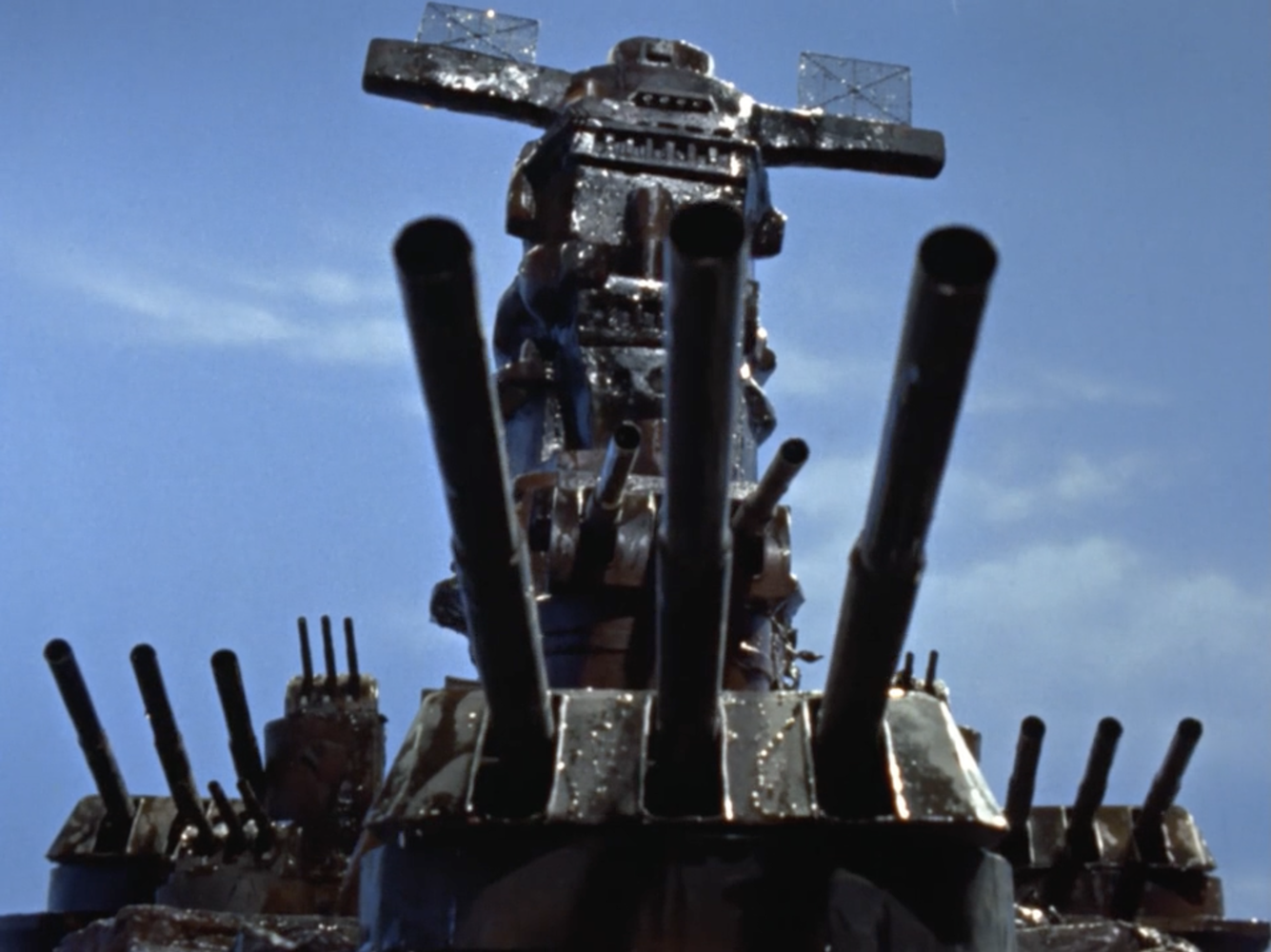
Iron Rocks isn’t a monster, a robot, or a giant alien (although aliens are, of course, manipulating it). It’s an ingenious twist on the giant villain concept: a conglomeration of the debris of sunken warships from the ocean floor. Imagine a visual artist taking the parts from five different model kits of World War II battleships and gluing them together into a collage — that’s Iron Rocks. Except all the big guns actually work and can inflict immense amounts of damage. The ship is set to explode if it stops for 15 minutes, and that’s where the ticking clock enters to tighten the tension even more during the finale.

The Ultra Guard discovers early on that the core of Iron Rocks is the famous battleship Yamato. The real Yamato was the pride of the Imperial Japanese navy and was sunk during the final months of the war while on a desperation one-way mission. The ship has become an important symbol in Japan of the end of the Empire, so turning it into part of an alien-controlled monstrosity that starts firing on the Japanese coast has ugly impact. Transforming a national symbol into an aggressively malign ticking time-bomb is the darkest stroke the episode makes, although it may not resonate with viewers outside of Japan.1
Along with its interesting design, Iron Rocks gives the episode a different way to approach the visual effects set pieces. It’s essentially a mobile super-weapon, and when Seven has to face it during the finale, our hero can’t jump to his usual methods of giant monster tussling. Earlier action sequences where Iron Rocks’ guns start shelling a town have the feeling of a war movie, a genre that Eiji Tsuburaya knew extremely well.
An early draft of the script had Seven shrink to human size to go inside Iron Rocks itself and confront Alien Mimy. In the final version, the alien invaders remain entirely off-screen. Alien Mimy does get a few sinister lines uttered through Iron Rocks: “Humans are not using the wealth of resources sleeping at the bottom of the sea, so we will simply take it!” I don’t know why Alien Mimy thinks it can mock humans for not dredging up scrap metal from the ocean floor. Maybe on their planet harvesting underwater scrap metal is a major industry? Oh well, alien invaders don’t need to make complete sense.
There’s nothing wrong with having a basic action story for the occasional Ultraseven episode, and “Pursue the Undersea Base!” has enough extra goodies to keep it interesting. The pacing lags in spots during the underwater pursuit with the Hydrangers, which is always a danger with aquatic scenes. Otherwise, the suspense keeps ratcheting up as the UG runs into one failure after another until the satisfying climax. Alas, poor Amagi gets taken out first, and nobody seems too upset about it. That poor guy just can’t catch a break.
Rating: Good
Previous: Destroy Earthquake Epicenter X
Next: The Human Farm
- Yamato’s most famous television interpretation would come six years later with the influential anime show Space Battleship Yamato, which was initially shown in the US as Star Blazers. ↩︎
 The Ultra Project