
Directed by Kazuho Mitsuta. Written by Toshihiro Iijima. Airdate June 26, 1966.
Director Kazuho Mitsuta’s second aired episode (although produced before “Space Directive M774”) is his first classic. Mitsuta had a knack for intense character-driven stories told with cinematic flair. His episodes look fantastic without being ostentatious. “Blazing Glory” shows Mitsuta operating at a high level and delivering the best possible episode from one of Ultra Q’s most dramatic, human stories.
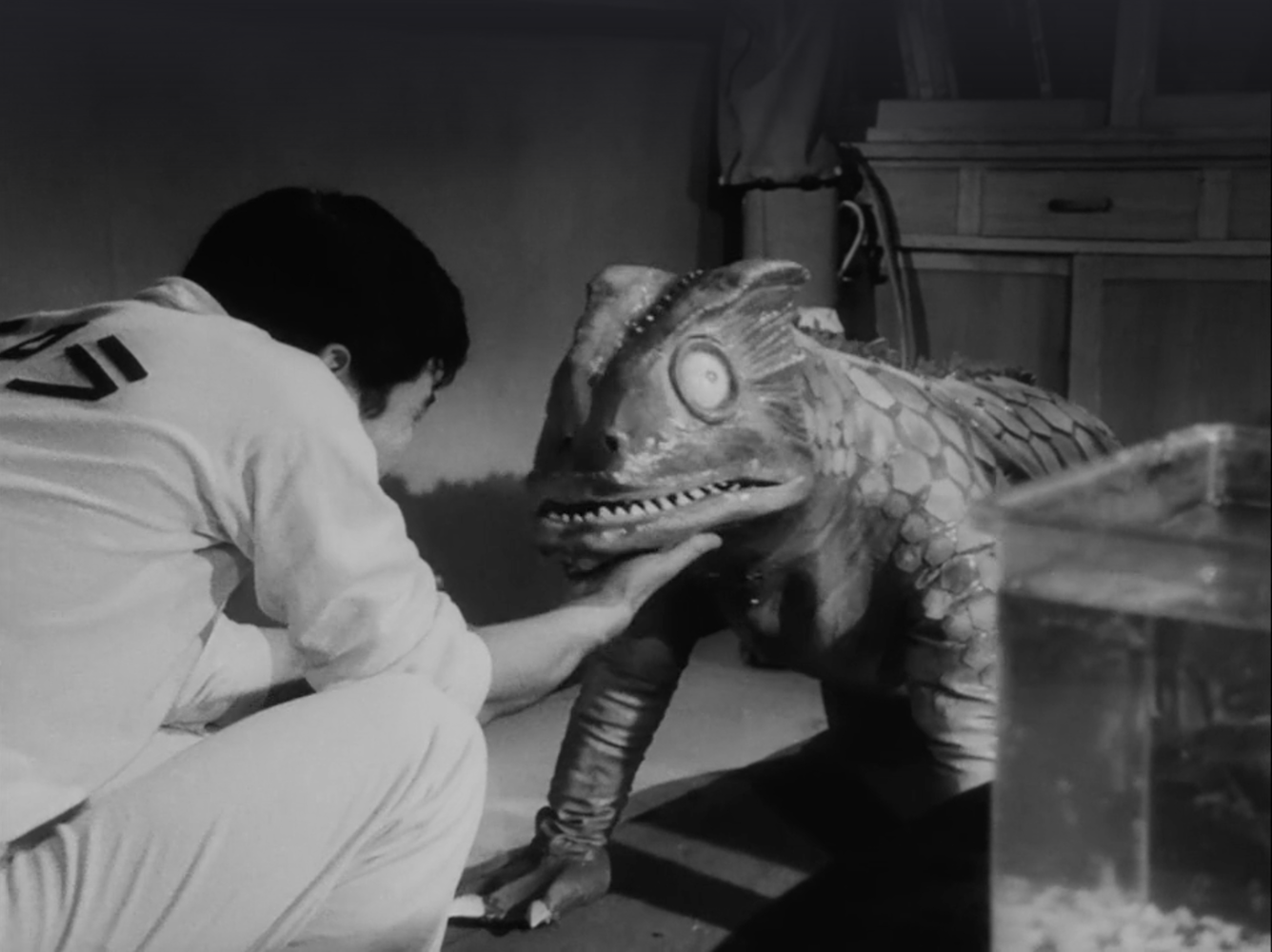
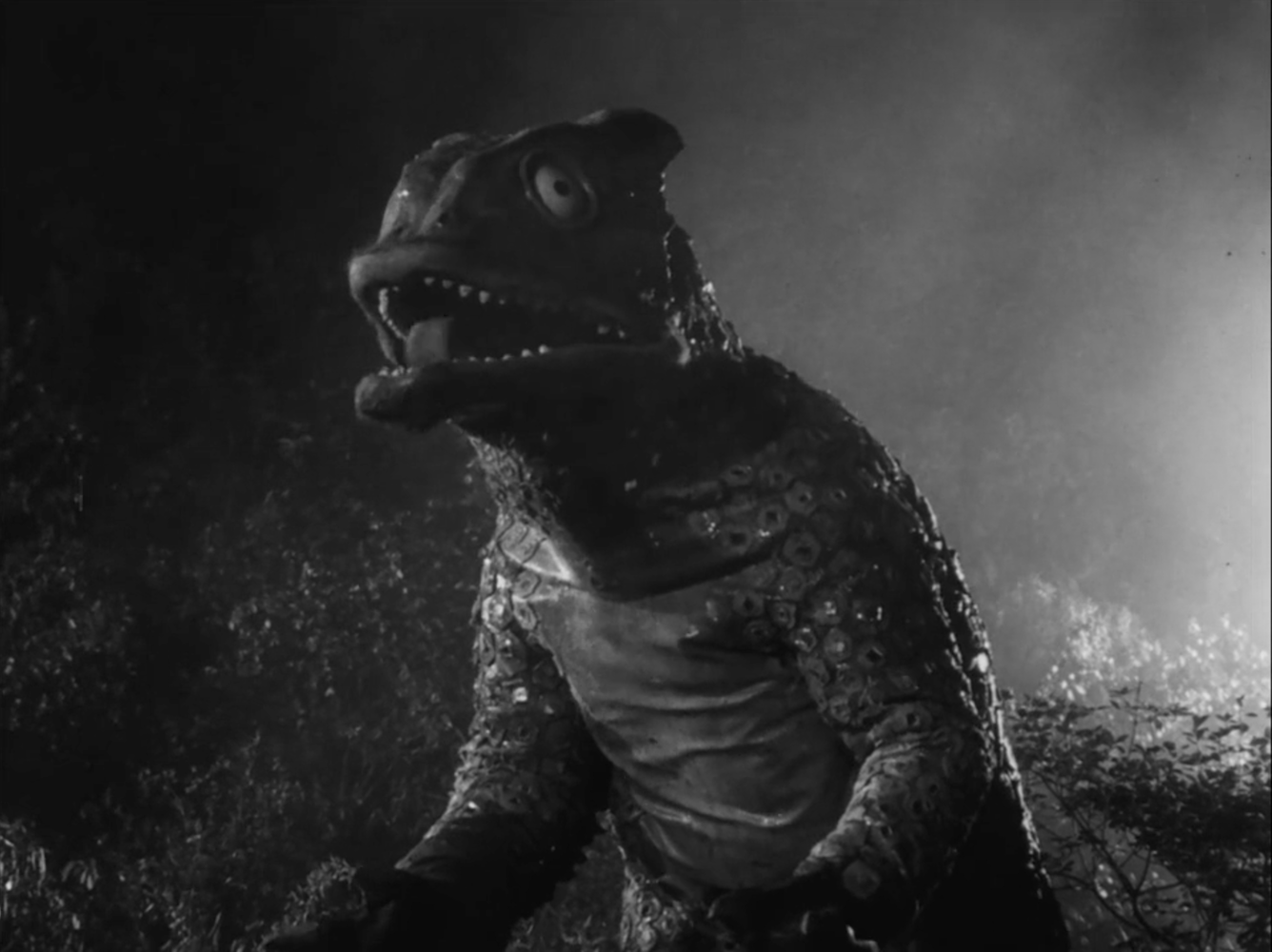
After his numerous victories in the boxing ring, “Dynamite Joe” Aikawa has become a public sensation. The crowds love him and children adore him. Joe has a good-luck charm in his corner: his mascot, Peter, a tiny alligator he keeps in a small water container. Peter is an extremely rare species of reptile that changes its size based on temperature. When Joe takes Peter out of the water, Peter enlarges to human size.
Peter’s size-changing isn’t what’s important to Joe, however. Joe’s been winning steadily since he discovered Peter while yachting in the Philippines, and he believes the strange reptile can predict the outcomes of his matches and then telepathically communicate them to him.
Then, right as Dynamite Joe gets the opportunity to fight for the world championship, he vanishes. While the public clamors to know what happened, Jun discovers Joe performing in disguise as a clown at a resort hotel and drinking heavily. What happened? Jun and Yuriko interview Joe and find out: when he asked Peter about the outcome of his upcoming championship bout, Peter told him, “Joe, you poor thing. It’s your turn to get knocked out.” Joe’s entire world collapsed in moments.
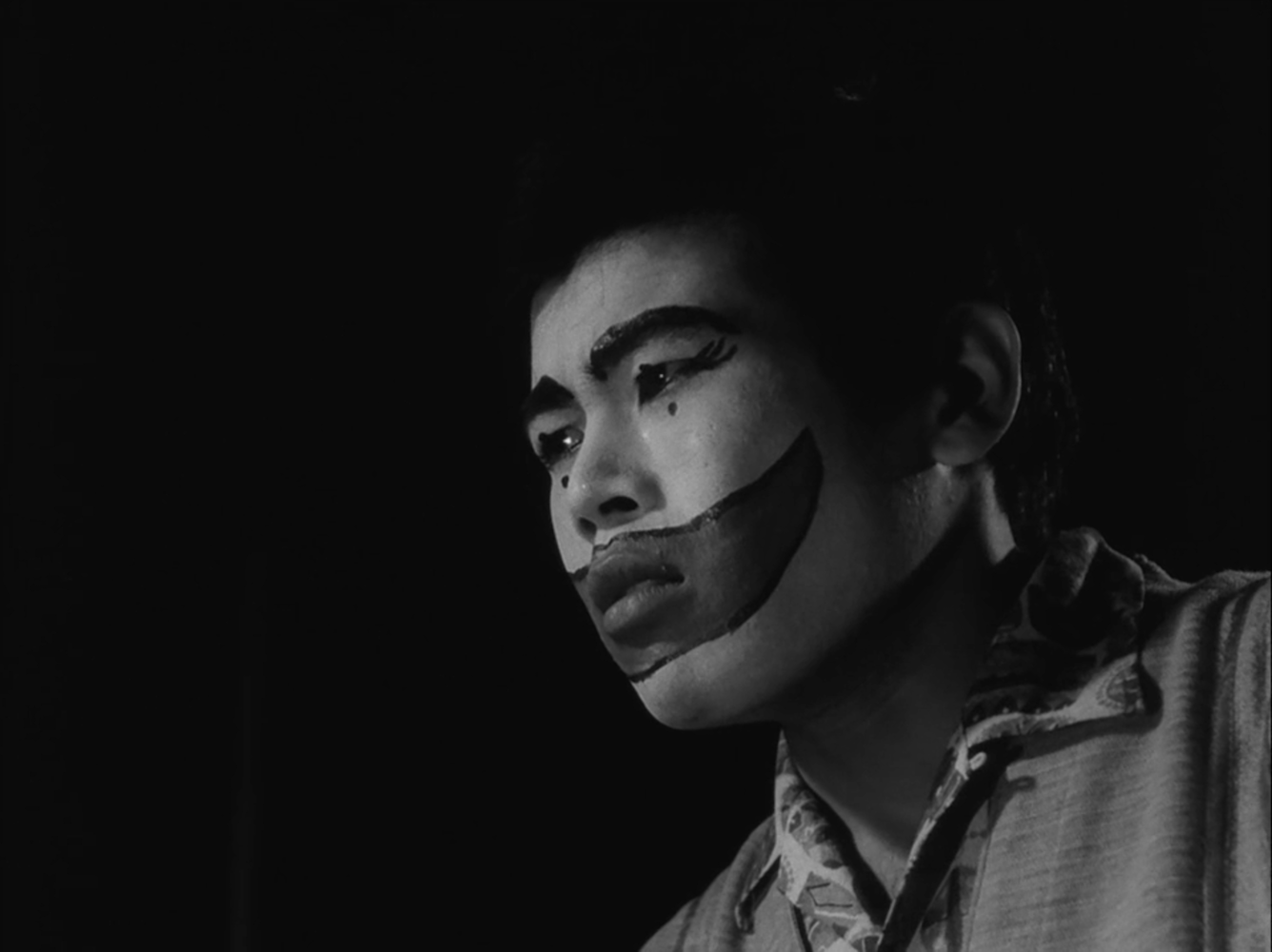
Joe’s story is a familiar one about losing confidence. The feeling that your successes can’t last forever. The terror that you just couldn’t handle the steep fall from your peak to become a disappointment and has-been. You don’t need a super-alligator to tell this story: Joe’s fear of becoming a letdown to everyone who knows him, his fear of failing, is a classic case of Impostor Syndrome.
Yet Peter serves a useful purpose, and it’s not just selling the episode as part of a science-fiction series. We never learn if Peter is actually predicting anything or speaking to Joe. It might all exist in Joe’s mind, which is what Jun thinks after interviewing him. Nothing in the episode contradicts this. (“Well, it’s not like he spoke … but he had that look,” Joe says about the first time Peter made a prediction.) Like Dumbo’s magic feather, Peter may merely be the talisman Joe needs to boost himself. He built so much of his confidence on Peter that the moment he allowed any doubt to enter what he “hears” from Peter, everything shatters. Even when Peter enlarges to giant size during the fiery finale, it still feels organic to the story because of how these last moments affect Joe.
Kentaro Kudo, who at the time was emerging as a major television talent and action star, gives a fantastic performance as Joe Aikawa. When we first see Joe, he’s flitting about the boxing ring and throwing up his fingers to predict how many rounds it will take to KO his opponent. Next we see him crushed, buried under clown makeup that has the special magic of making him look even more dejected and sad. Kudo sells the boxer’s ups and downs, especially when he addresses Peter. We don’t know if Peter has telepathic abilities, but there’s no question that Joe believes he does.
Kenji Sahara as Jun also shines in this episode in a way that he doesn’t in much of the rest of Ultra Q. Jun Manjome tends to be an anemic character, less interesting than his colorful companions Ippei and Yuriko. This isn’t Sahara’s fault; it’s how Jun was designed and written. Jun’s role in the Ultra Q dynamic is the stoic voice of cautious speculation, and that can be a thankless and frankly boring job.
But putting Jun across from a beaten-down boxer in clown makeup places him in the most human light. The scene between the Joe and Jun at a marina, where Joe plunges to his lowest depths while Jun tries to convince him he’s still strong, is probably Sahara’s best in the series. It’s not just the script; I suspect Mitsuta’s direction helped to drive both Sahara and Kudo to do their best work.
Mitsuta’s directorial touch affects the small parts as well, with funny turns from Joe’s desperate manager (Eiji Muto) and the ambitious hotel owner (Takanobu Hodzumi) who wants to stick Peter in his silly show. In another episode, the hotel owner trying to nab Peter would’ve been at the center of the story. Here, it’s just comedy gloss and a catalyst to move into the fiery finale.
The only place where the episode loses energy is an inexplicably long dance number at the hotel before Joe makes his first clown appearance. There’s nothing remarkable about the performance and it seems strange that a ritzy hotel would take pride in such a bland show. Maybe it did need a super alligator on the program.
Although “Blazing Glory” has a giant monster, TBS delayed it until the end of Ultra Q’s run. The show may have been a smash hit, but slower-paced episodes focused on dialogue and adult conflicts weren’t what the network wanted to see from Tsuburaya Productions. It’s unfortunate that quiet and reflective stories like this and “The Devil Child” started to become the exception for the Ultra Series. Thankfully, they’ve never gone away entirely, as there are still enough creators who recall how powerful and psychologically realistic Ultra Q could be — even as it told a story featuring a possibly telepathic, size-changing alligator.
Rating: Great
Previous: The Devil Child
Next: The Disappearance of Flight 206
 The Ultra Project