
Directed by Yuzo Higuchi. Written by Taro Kaido. Airdate Dec. 4, 1966.
This is the Isamu Hoshino episode, the big starring role for the show’s 12-year-old mascot turned actual SSSP member. Hoshino already had a “save the day” moment in “Brother From Another Planet,” but this goes to the next level where he becomes the main character. Hoshino lands in the thick of the action, takes control of piloting the Sub VTOL, and figures out how to defeat the kaiju of the week. Your opinion of Hoshino and little kid heroics will strongly affect how you react to this episode.
I have mixed feelings about Hoshino-kun, as I discussed in the “Brother From Another Planet” review. On one hand, I like his character, especially when he’s paired with Fuji. I think Akihide Tsuzawa does a great job playing him. On the other hand, I don’t agree with making Hoshino into a full-fledged member of the Science Patrol, which feels like reckless child endangerment.
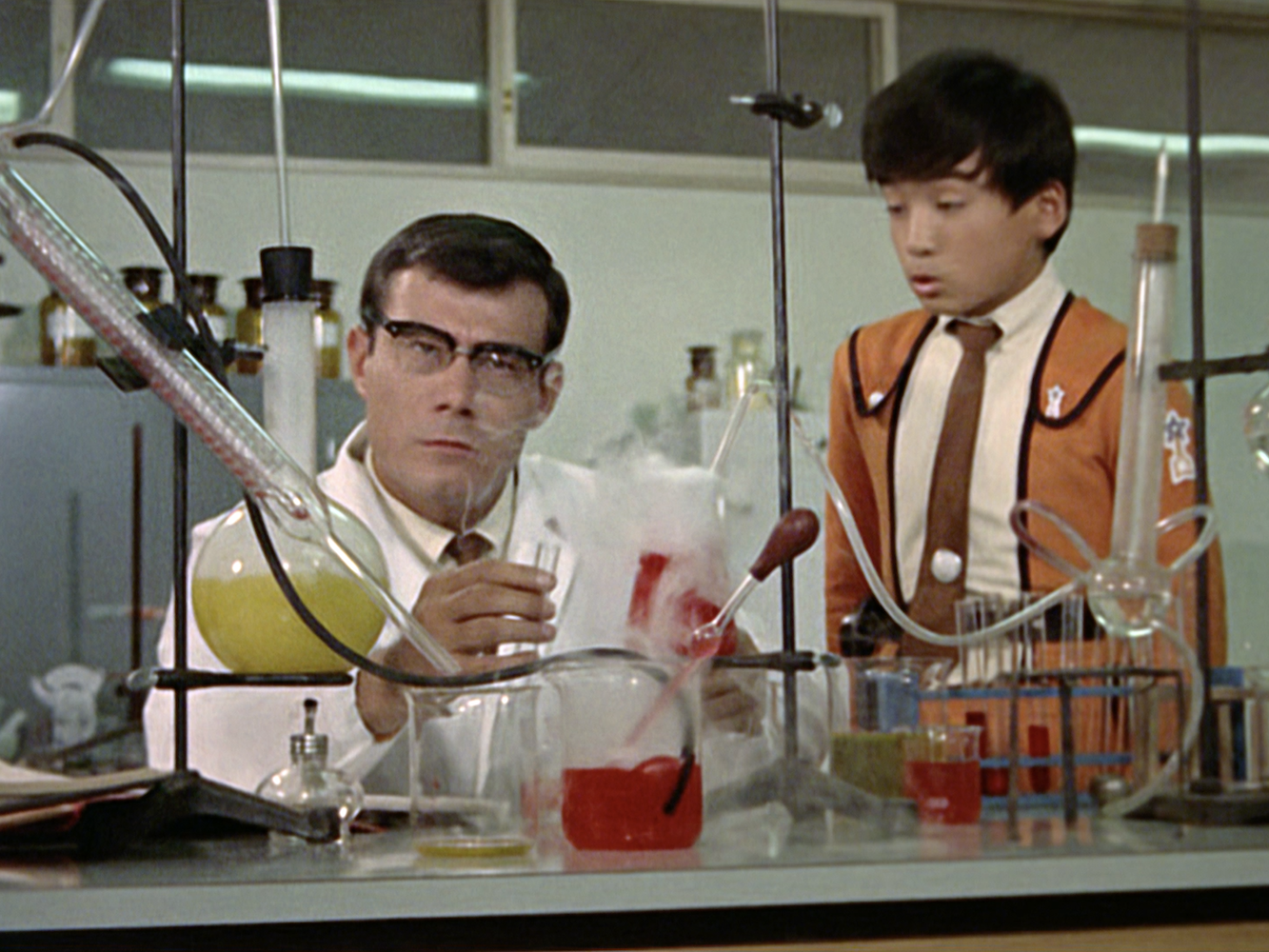
Surprisingly, this episode doesn’t aggravate me. Yes, I groan when Hoshino abruptly deduces the exact method to defeat poison gas monster Kemular while Ide plays with his chemistry lab equipment. Yes, it irritates me that Akiko Fuji, the show’s one female character, gets shoved aside and left unconscious for most of the episode so Hoshino can have the spotlight. I’d much prefer Fuji and Hoshino work together since they’ve shown good chemistry before. Yet none of this is quite annoying enough to derail the episode. It moves fast and breaks things in an appealing way, and it has an underrated kaiju with some great special effects moments.

Once again, an Ultra show defense team gets into a debate about the parameters of their job. When reports come in about odd occurrences around Mt. Omu (numerous dead birds and hikers who thought they saw a large eye staring at them through smoke), Arashi and Ide are adamant that the SSSP shouldn’t bother investigating. Arashi says “he isn’t feeling this case” and calls it “a job for women and children.” Stop right there, Fuji says: she’s a woman and she’ll gladly do it. Great! A terrific setup for the team’s only female member to throw that sexism back at Arashi and Ide and take center stage.
Except she forgot the “women and children” part, which is the cue for Hoshino to stow away on board the Sub VTOL to join Fuji in her investigation. It’s also the cue for Fuji to get knocked unconscious by poison gas when Kemular first emerges so Hoshino gets to do all the heroic work. Fuji won’t be back until she wakes up in a hospital in the coda, when everyone ignores her and the iris closes on Hoshino’s face.
I think I’ve already made clear how I feel about Fuji getting sidelined like this. The episode does at least place Hoshino in legitimate danger. He doesn’t automatically know how to fly the Sub VTOL once Fuji is knocked out; he needs coaching from Captain Muramatsu. Hoshino looks genuinely terrified during this sequence, which sands down the pain of the “kid genius” cliché.
Meanwhile, we’ve got Kemular, the monster who goes a long way toward keeping the episode moving and grooving. Kemular is a quadruped kaiju, but unlike most four-footed beasties we’ve seen on the show, it’s not a redesign of the Baragon costume. Kemular spits out poison gas but also has a tail with twin tines that fire electrical blasts, and its double carapace flips up to create an extra barrier against attack.

It’s a good design, but what really makes Kemular stand out is that it inflicts more carnage in a single episode than most kaiju. It does some wonderful damage to the miniatures of Daibu City and faces down Japanese Self-Defense Force tanks in a scene that recalls many of Toho’s classic science-fiction films. Kemular is cool enough to even have the Ultra Q theme make a comeback when the Science Patrol first engages it. All the special effects around Kemular are first-rate, and it’s strange the monster hasn’t made more appearances in future shows.
Director Yuzo Higuchi wanted to put special focus on Kemular’s finale, an ambiguous “death” that gives the monster a surprising amount of pathos. It’s a memorable scene and another part of the show’s gradual rise toward the full-blown sympathy for kaiju shown in the classic episode “The Monster Graveyard.”
Another interesting bit: a hint during the coda that Captain Muramatsu knows Hayata is Ultraman. When Hayata makes another miraculous reappearance after seeming to have died, Muramatsu says he wasn’t worried because, “Knowing you, I figured as much.”
In conclusion: Ultraman is a show with a huge appeal to children, so handing the reins to a child character for an episode is part of the package deal. I like Hoshino enough as a character to look past the more nettlesome aspects of the story and give “Breach the Wall of Smoke” a higher rating based on the quality of Kemular and the special effects. But for rudely sticking Fuji in a corner when she could’ve been key in the heroics, I subtract points. Let’s not treat Fuji-chan like this again, okay?
Rating: Average
Previous: Terror on Route 87
Next: Overthrow the Surface

 The Ultra Project