
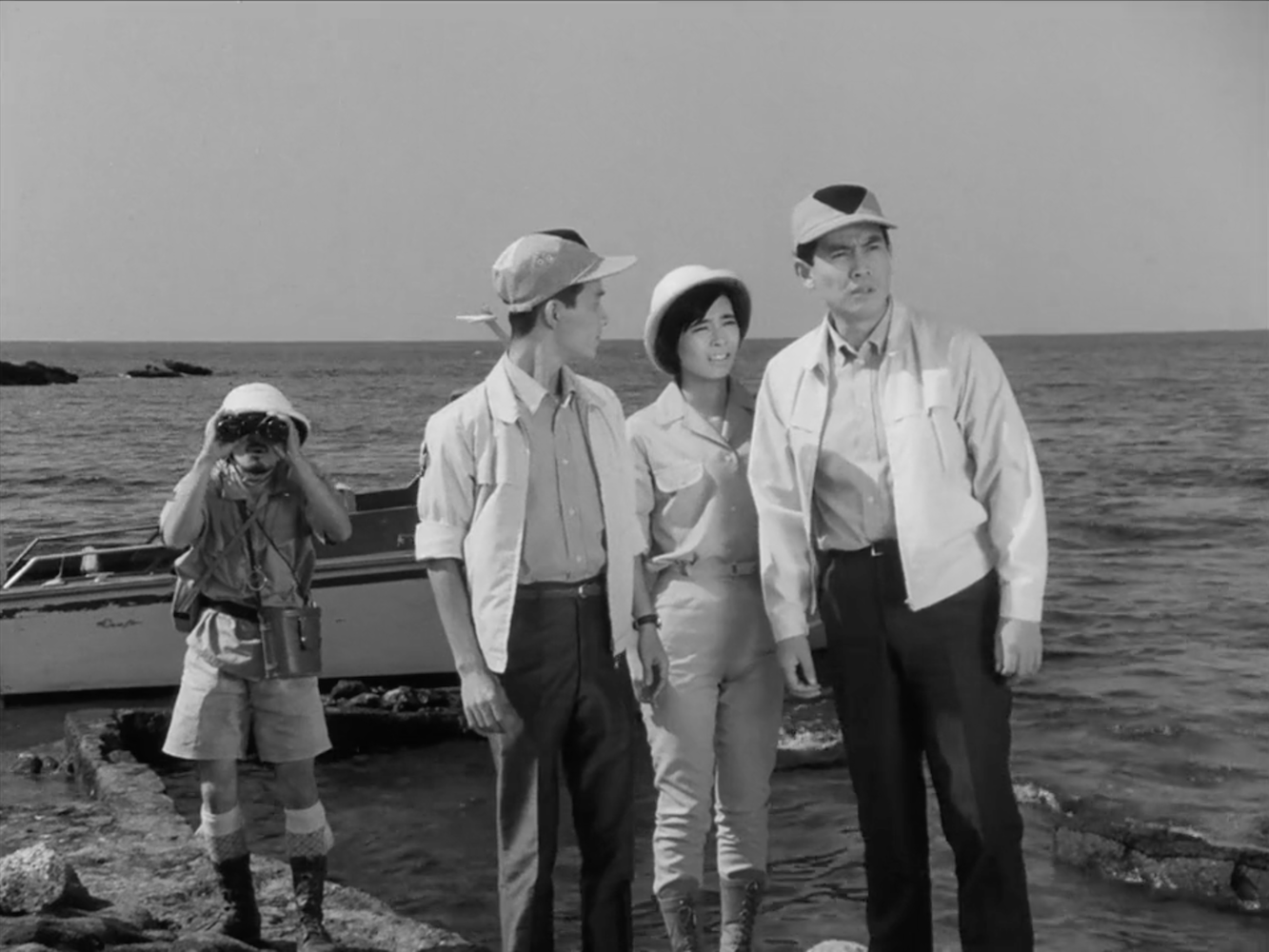
Directed by Samaji Nonagase. Written by Tetsuo Kinjo. Airdate June 5, 1966.
In the world of Japanese special-effects films, the mid-‘60s was the time to go on Pacific island vacations. This was when the Godzilla series left the cities to jet off for two budget-friendly South Seas adventures, Ebirah, Horror of the Deep (1966) and Son of Godzilla (1967). Around this time, Ultra Q took its own trip to the islands, although on an even tighter TV budget. The crew could only afford a recycled octopus prop and stock footage lifted from King Kong vs. Godzilla (1962) to create its giant monster of the week.
Exotic setting aside — not even that impressive on a black-and-white show — “Fury of the South Seas” is an unexciting half hour of Ultra Q. It sticks closely to the island adventure playbook. We open with a shipwreck; one survivor washes ashore, a native girl finds him, the natives are suspicious of him, and the natives worship the local monster as a fearsome god, a concept that goes back to the original Godzilla.
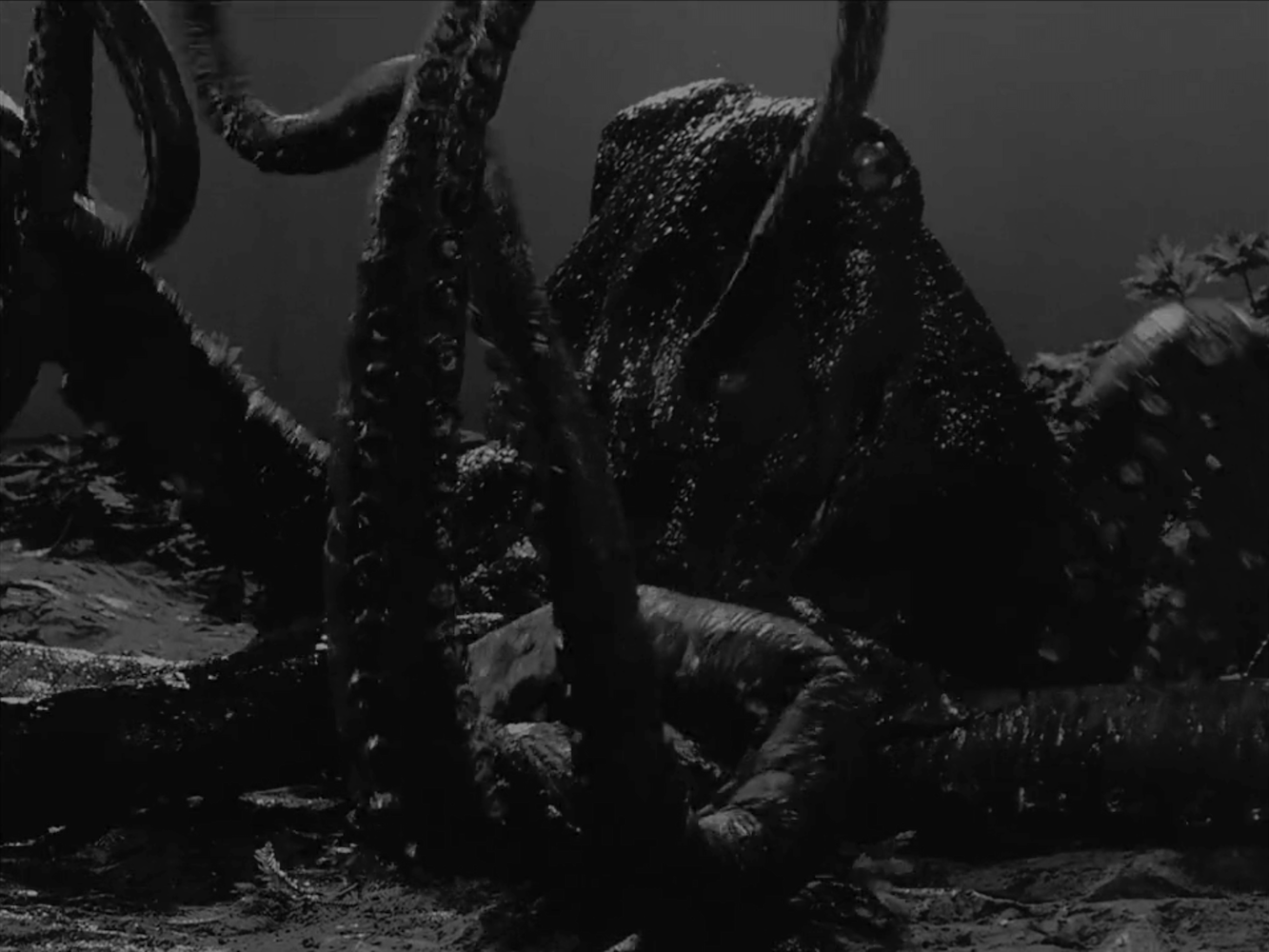
But this tropical monster, big octopus Sudar, is no Godzilla. As I mentioned above, it’s a reused monster. Sudar is created through a combination of recycled footage and the giant octopus Eiji Tsuburaya originally constructed for King Kong vs. Godzilla and then brought back for Frankenstein vs. Baragon (in an unused alternate ending) and the prologue to War of the Gargantuas (1966). The opening, where Sudar’s tentacles attack a fishing vessel, may have directly inspired the sequence in War of the Gargantuas. It’s the best moment in the episode, with a genuine horror shiver. Tsuburaya made it even more grotesque when he tried it again in War of the Gargantuas.
The rest of the episode never gets anywhere near this intensity again. Sudar is quite boring in the remainder of its appearances. So much of the monster “action” comes from murky footage taken from King Kong vs. Godzilla, and that footage didn’t look good in the first place. The octopus attack in that movie is one of its poorest parts, and even a casual viewer will pick up that this footage wasn’t originally shot for the episode.
The plot follows the single survivor of the commercial fishing vessel Daigo Taiheimaru, Yuzo (Akira Kubo). Yuzo was on his first fishing trip with his father when Sudar demolished the ship into driftwood during the opening credits. There’s some promise in Yuzo’s story and his relationship with the native girl, Anita (Noriko Takahasi): he wants to destroy Sudar to avenge his father, but even though Anita lost family to Sudar, she doesn’t have the same vengeance drive. To her, Sudar is the god of the island.
Having an actor of the caliber of Akira Kubo, a familiar face to Japanese SF fans from movies like Son of Godzilla, Gorath (1962), Invasion of Astro-Monster (1965), and Destroy All Monsters (1968), promises more than the episode can deliver. Each bit of plotting feels by-the-numbers, and I have to wonder if writer Tetsuo Kinjo was that engaged in the concept of a South Seas adventure tale. Kubo-san is giving his full effort and acts like he believes the situation is dire, but he doesn’t have much to work with.
Our main trio of characters enters the story in a slightly different way: Seki, Yuriko’s boss at the newspaper (an always welcome appearance from Yoshifumi Tajima), sends all three out to investigate the shipwreck in the “Ocean of Death.” Usually, he only sends Yuriko, who then goes to Jun and Ippei for a plane or helicopter ride to the site of the story. Jun and Ippei don’t work for the newspaper, so Seki giving them an assignment is a strange choice. But I like streamlining the premise of the show this way. It’s an acknowledgment that our three series leads are now a full paranormal investigation team. Seki also sends along a socially awkward translator who’s wearing the “comic relief beard and glasses” these characters always seem to have. The translator doesn’t get in the way too much with comic shenanigans, but he doesn’t add anything special either.
Perhaps viewers in 1966 got more from this episode than I can glean from it today, but it’s easily the least engaging installment of Ultra Q: a giant monster adventure with a bland monster and no real surprises aside from a different location. It does what the series Bible — if Ultra Q even had one — requires, but for this show that’s just not enough. This is a water-logged Pacific vacation.
Rating: Mediocre
Previous: Metamorphosis
Next: The Statue of Goga
 The Ultra Project