
Directed by Noriaki Yuasa. Written by Niisan Takahashi.
The fourth Gamera film adds the finishing touches, the final trio of elements that director Noriaki Yuasa and producer Hidemasa Nagata needed to complete the Gamera style: a Caucasian second child actor, Gamera’s catchy kiddie chant theme, and stock footage. The last of these isn’t a benefit.
Gamera vs. Viras is fully a children’s movie, no quarter given. At this point in the series, many adults will check out and never return. You either have to have children yourself or have a soft spot for child-empowerment stories in order to get involved in movies dominated by super-kids and monsters where the grown-ups must sit on the sidelines as stooges. It also helps if you like watching colorful but inexpensive monster battles.
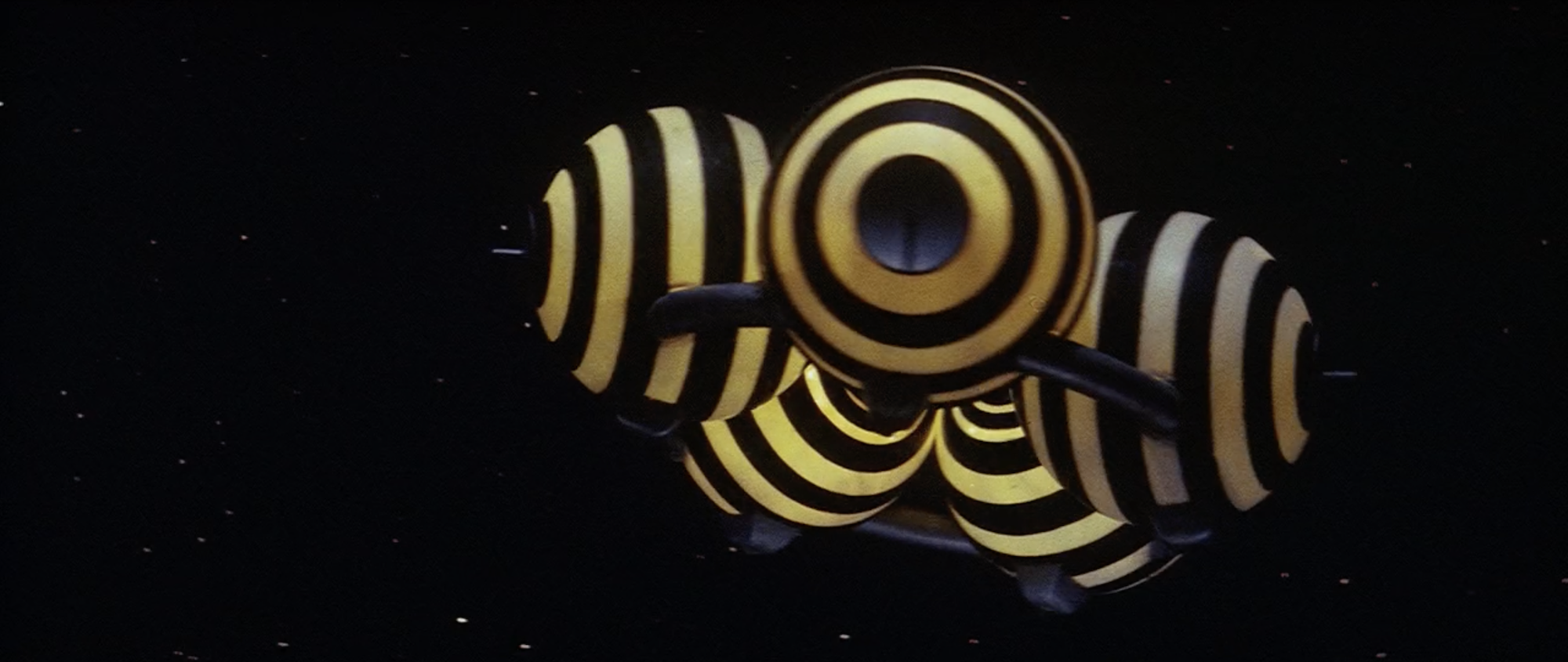
Gamera vs. Viras has a dynamite blast of an opening that puts Gamera in space for the first time — yes, our heroic turtle can also spin through space! A spaceship that resembles five bumblebee abdomens linked together has come from the star Viras to conquer Earth because the Viras need another Class M planet to live on. Gamera shows up and destroys the spacecraft, but the aliens have enough time to transmit a warning to Spacecraft #2 to continue the mission and destroy Earth’s protector monster … Gamera! Cue the “Gamera Is Really Neat!” theme song.
Even with Gamera rescuing kids in two of the previous movies, we’ve made a fast jump to “Gamera the Superhero,” protecting the world from outer space invaders and helping children. It feels as if the series squeezed the same arc of how Godzilla became a hero into only a few installments, and then going one step farther. But the Gamera series probably wouldn’t have continued without taking this route.
The heroes of our story are two eleven-or-twelve-something Boy Scouts, Masao (Toru Takasuta) and Jim (Carl Craig Jr.). Both are kid-power icons who go far beyond the Hardy Boys model. They’re pranksters who always succeed at fooling the adults and getting away with it, have nifty gadgets like a Dick Tracy communicator watch, outwit invader aliens (very stupid alien invaders, but still…), and free Gamera from brain-control so the monster turtle can save the day at the end. Given what they achieve here in mere hours, Masao and Jim will rule the Earth in five years.
The second Viras spacecraft arrives on Earth during a Boy Scout retreat. When the aliens learn that Gamera’s weakness is a fondness for children, the Viras kidnap Masao and Jim and hold them hostage, then turn the subdued Gamera into their mind-controlled slave. However, the Viras are idiots who give the two boys free range on the spaceship, so Masao and Jim eventually turn the tables right at the point when the UN is on the verge of surrendering to an alien civilization in order to save the lives of these two pre-teen industrial saboteurs.

There are some adults in the film, like Kojiro Hongo on his third “lead” role in a Gamera film as a Scout Master, but they don’t have much screen time. There’s a brief nod to the formerly obligatory gathering of the military and scientists (this time just to surrender). Most of the movie is Gamera flying around the groovy-looking Viras spacecraft, and Masao and Jim wandering through the equally groovy interior of the Viras spacecraft. If you love old Star Trek and Tom Baker-era Doctor Who sets, you’ll feel ant home with all the tinkering on the ship and experimenting with its telepathy devices.
The Viras are utter fools and have the drabbest “space” outfits imaginable, looking like they work at a North Korean factory. But in dim light the effects department gives them frightening glowing eye appliances that are genuinely eerie. There’s also a weird moment where one of the Viras detaches and reattaches his arm. I appreciate these odd details that appear in all Gamera films. (I won’t spoil the crazy “decapitation” moment.)
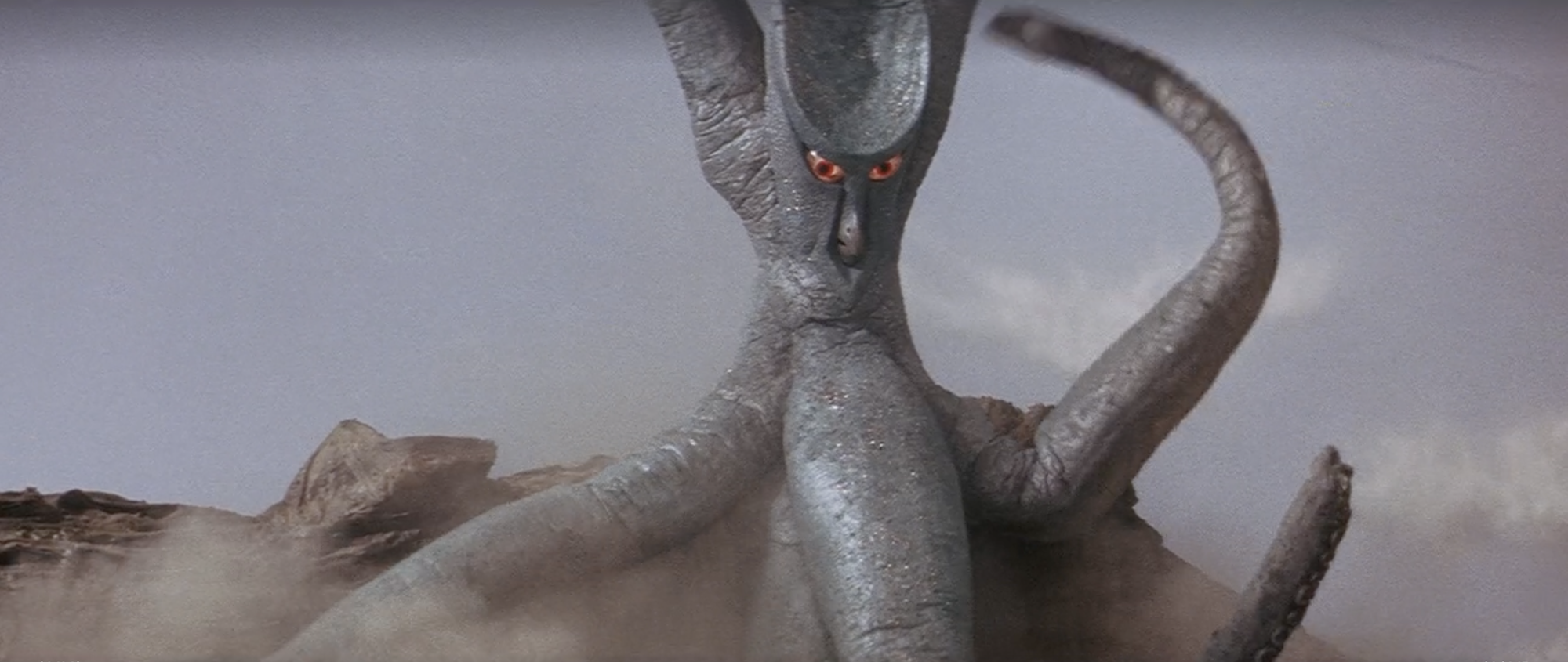
The villain monster, an amalgamation of all the aliens aboard the ship into one kaiju known just as “Viras,” doesn’t appear until the finale. But the monster fight goes on for a good stretch and even gets a touch gruesome. Kaiju Viras resembles a silver squid with a parrot face, and it can turn the top of its head into a stabbing spear. Viras pierces Gamera with this a few times, which looks deep enough to have easily killed the giant turtle. But the wounds hardly slow Gamera down. Masao and Jim yell advice, and Gamera takes it and wins. The battle doesn’t have the same spectacle as the climax in Gamera vs. Gyaos, but it works for the movie.

Now, the bad news: there’s no way around how the stock footage hobbles the movie. To keep Gamera profitable in the days when films had to compete with a wave of special effects shows on television, Daiei Studios needed to slenderize the budget. Recycling VFX scenes offered a way to do that without harming production values elsewhere (much).
The in-story excuse for the stock footage is that the Viras must scan Gamera’s brainwaves to understand the monster’s history and weaknesses. The footage consists of Gamera breaking free from the ice in Gamera the Giant Monster, both monster fights from Gamera vs. Barugon, and the first confrontation with Gyaos followed by Eiichi’s rescue from Gamera vs. Gyaos. Regardless of the excuse, it’s murder on the pacing to have stock footage pop up only 20 minutes into the running time and then trudge on for ten minutes.
But wait, we’re not done yet. Once the Viras spacecraft gains control of Gamera, the aliens send the turtle on a rampage to destroy a power dam. In other words, we get a repeat of the footage from Gamera vs. Barugon of Gamera attacking the Kurobe Dam. Then the Viras send him to attack Tokyo. That means a repeat of the Tokyo destruction scenes from Gamera the Giant Monster, tinted slightly to unsuccessfully disguise that the original footage is in black and white. The only reason the Viras don’t send Gamera on further destruction is because they ran out of footage to cannibalize.
The deluge of reused material restrains me from giving Gamera vs. Viras full approval. I enjoy most everything away from the recycling, no matter how silly or childish it is. I can roll with the wish-fulfillment aspect, and a ‘60s spacecraft is always a good time. But 15 minutes of stock footage in an 81-minute movie — almost a fifth of the running time — is too much for a flimsy story to handle.
On the plus side, those 15 minutes constitute 80% of the good material from Gamera vs. Barugon, so at least you no longer have to watch that film.
Gamera vs. Viras was released direct to television in the US from AIP, who retitled it Destroy All Planets to link it to their successful theatrical release of Destroy All Monsters. The film was not included in the Sandy Frank package of the Gamera films syndicated in the 1980s, so it had a long period of absence from the airwaves. Mystery Science Theater 3000 never did an episode on the movie because they only had the rights to the films Sandy Frank had licensed.
The year 1968 saw the release of several science-fiction movies that have stayed popular over the decades: Barbarella, Planet of the Apes, Destroy All Monsters, Charly, and a little flick called 2001: A Space Odyssey. Among these giants, Gamera vs. Viras can stand proudly as…
Nope, sorry, I can’t finish that joke. But I’m glad I can attempt to make it. Wow, 1968 was some year for cinema of the fantastic.
Rating: Average
Previous: Gamera vs. Gyaos
Next: Gamera vs. Guiron

 The Ultra Project