
Directed by Shingo Matsubara. Written by Hideyuki Kawakami. Airdate Nov. 9, 1996.
Many Ultra shows have scenes in amusement parks. I looked at the earliest one last month, Ultra Q’s “Challenge From the Year 2020.” For multiple reasons, amusement parks are ideal settings for the series. The special effects team can pack them full of creative and fun models to obliterate during monster fights. They make it easy to bring children into the story. And the general tone of amusement parks as spots for thrilling but safe fun matches much of the tone of many Ultra shows. The kick of a good roller coaster is what people expect when watching something like Ultraman Tiga.
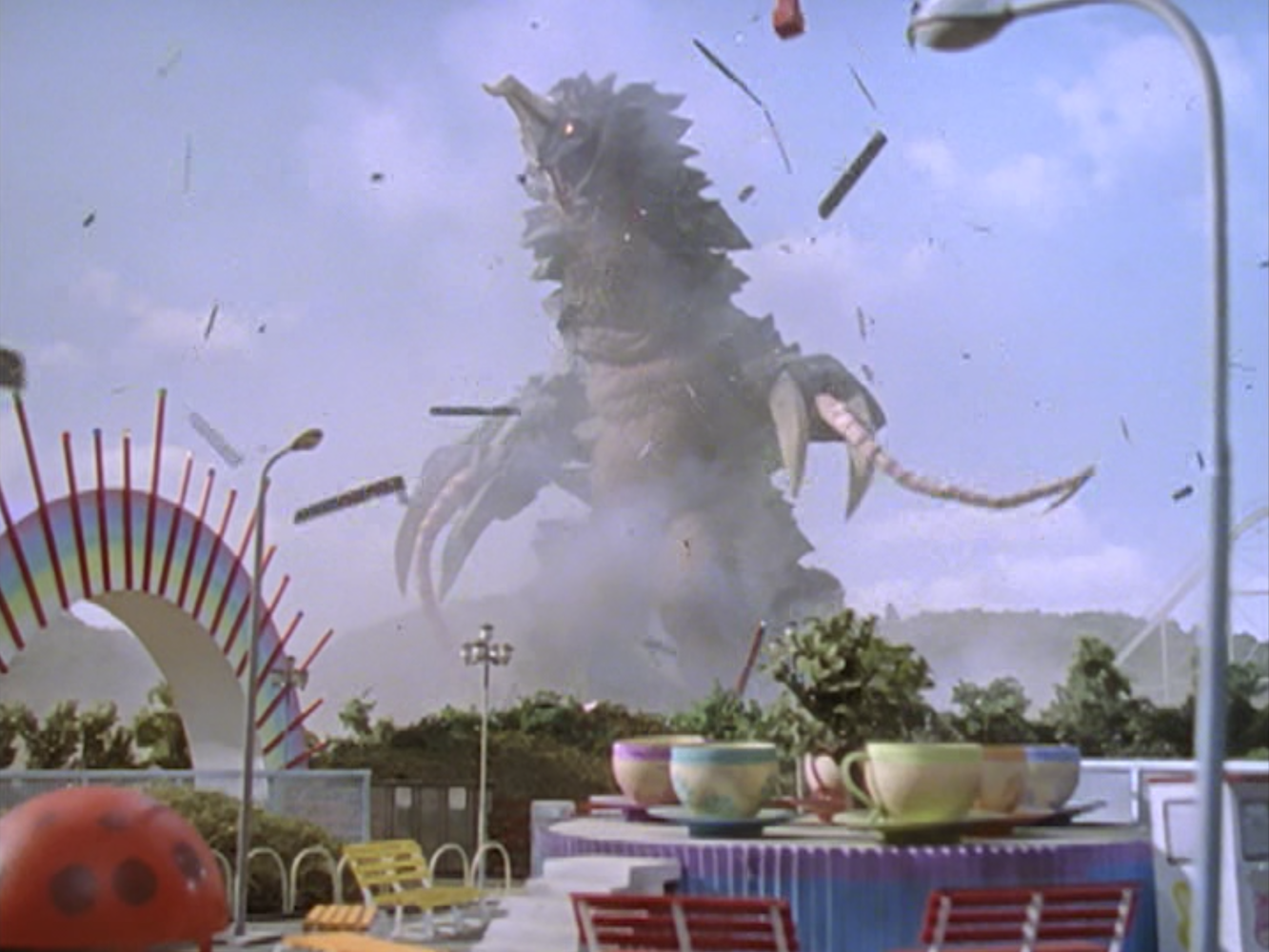
“The Abandoned Amusement Park” doesn’t let viewers down on the promise of a kid-centered good time — although the titular amusement park is in no way abandoned. It’s full of people who are trapped there because of a monster-created force field. A long-slumbering subterranean kaiju, Gagi, awakens beneath Yomiuriland (a real park outside of Tokyo), imprisons park guests inside its “nest” with an invisible barrier, then uses its tentacles to drag children underground where they’ll be hosts for its eggs.
Don’t worry: the story isn’t going anywhere gruesome or nasty with Gagi. At worst, we see the kids later taking webbing off their bodies, and it’s nothing worse than Halloween decoration grade. The scariest the episode gets is the Sarlacc-like tentacles yanking kids down sinkholes, but the tone always remains that of lightweight adventure. One of the big action set-pieces has Shinjoh and a kid recklessly driving a go-kart around the park to distract Gagi, and it’s shot and staged like a high-octane car chase, including a “spectacular crash.” It’s all adorably, purposely dopey.
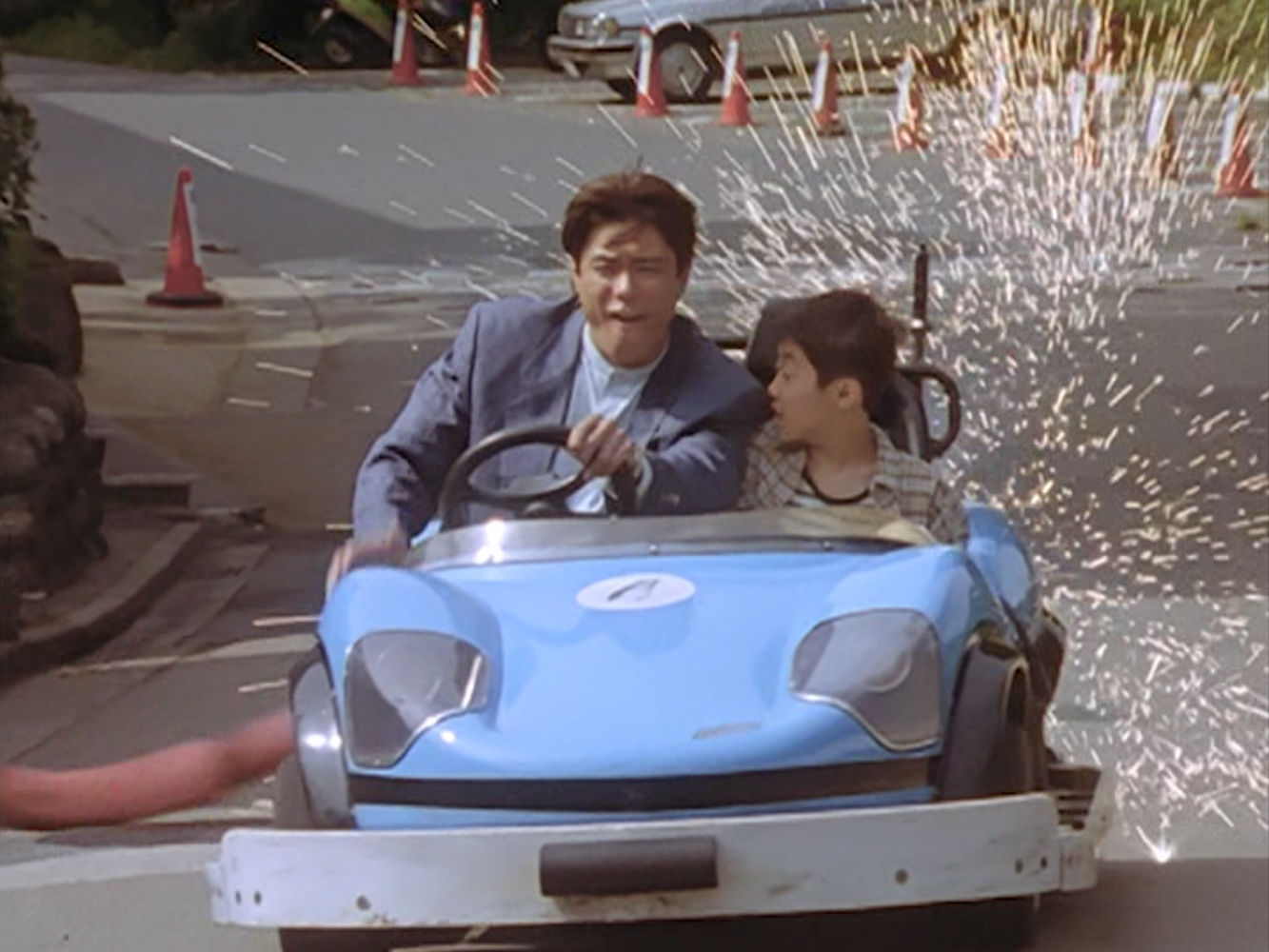
Shinjoh’s sister Mayumi, who was introduced in the previous episode, gets a more prominent role. She and Shinjoh are spending the day at Yomiuriland, playfully bickering again. (This is when we learn that Mayumi has a boyfriend who’s overseas, a fact that’ll be important in a few episodes.) The brother-sister pairing sets up the kid B-story of Haruki, a boy at the park whom Shinjoh has to teach to be brave to help out his younger sister, Akiko. This story strand is a touch generic and has that tired “You’ve got to learn to be a man!” business, but I can’t feel too negative about the general good-natured adventure tone and how the performers hit all the right notes.
Shinjoh had previously gotten some focus in “Goodbye, Planet Earth,” but he wasn’t fully the lead there. Now he carries the non-kaiju side of the story, helping young Haruki overcome his fears as the two turn into a fun hero-and-sidekick duo. This turns out to be a good use of Shinjoh. I’m discovering on these rewatches that I like Shinjoh a lot more than I did before. He works particularly well when Mayumi is around and is a good fit for kid-centered stories because I can easily imagine children looking up to him.
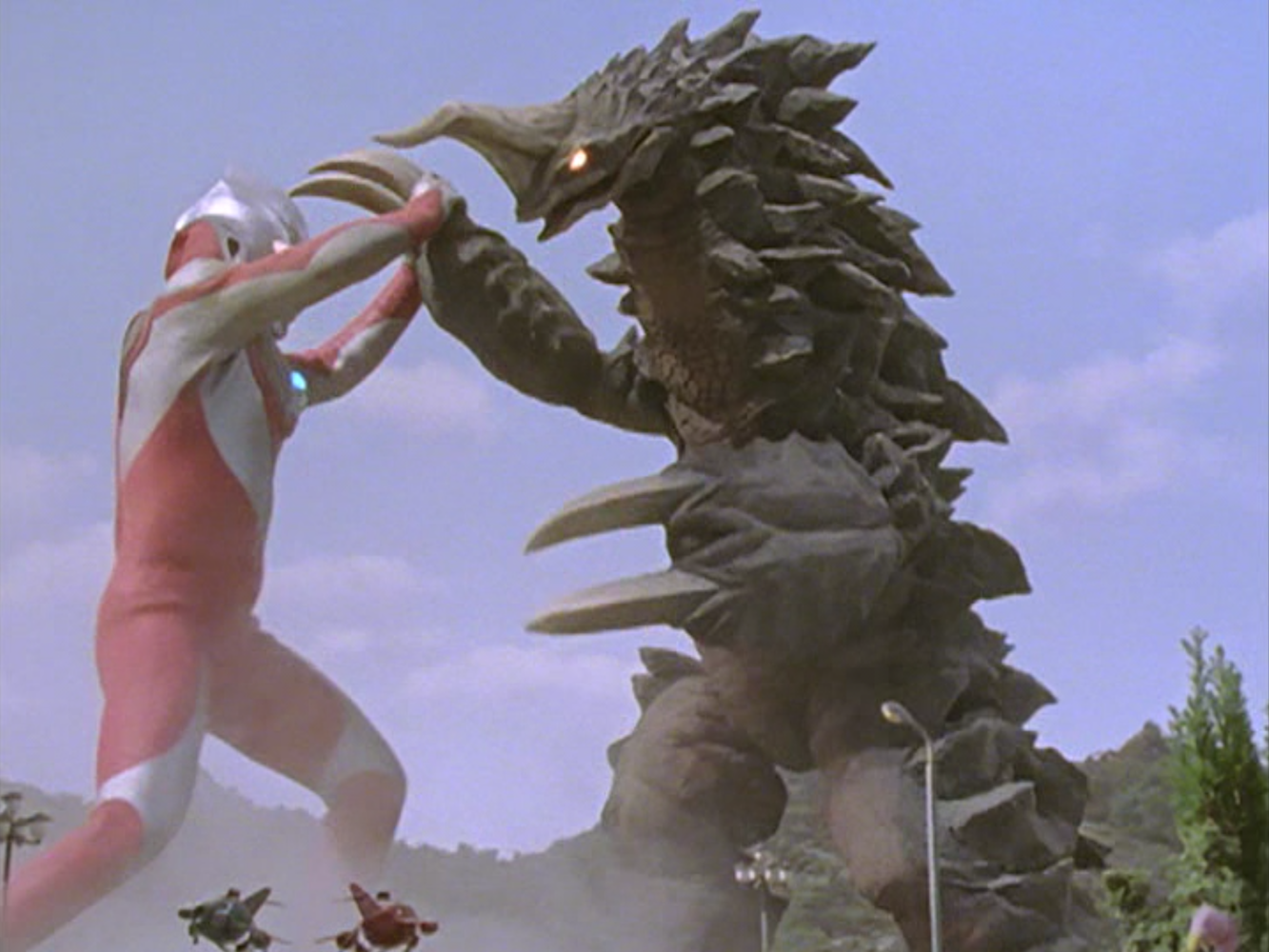
Gagi is a personable monster with a design reminiscent of Showa era kaiju. Its whip-like tendrils immediately call to mind Gudron from Return of Ultraman. The showdown between Gagi and Tiga is sugary fun. As I said at the start, amusement park structures are a blast when costumed stunt performers need something to smash into splinters.
Sadly, the big white wooden roller coaster seen in the episode, White Canyon, is no longer at Yomiuriland. It was one of the first wooden coasters built in Japan, but was permanently closed in 2013 after 19 years of operation.
This may not be an outstanding Ultraman Tiga episode, but it has most of what I like best in a monster of the week story that only wants to be diverting entertainment. It’s far better at doing this job than the Halloween episode. Good effects, strong character bits, a simple moral, and a cool monster that knocks over stuff I like to see get knocked over … it’s the little joys in life, and I’m glad to have the Ultra shows around to provide them.
Rating: Good
Previous: The Girl Who Waits for the Monster
Next: Requiem to the Darkness
 The Ultra Project