
Directed by Toshihiro Iijima. Written by Keisuke Fujikawa. Airdate Nov. 6, 1966.
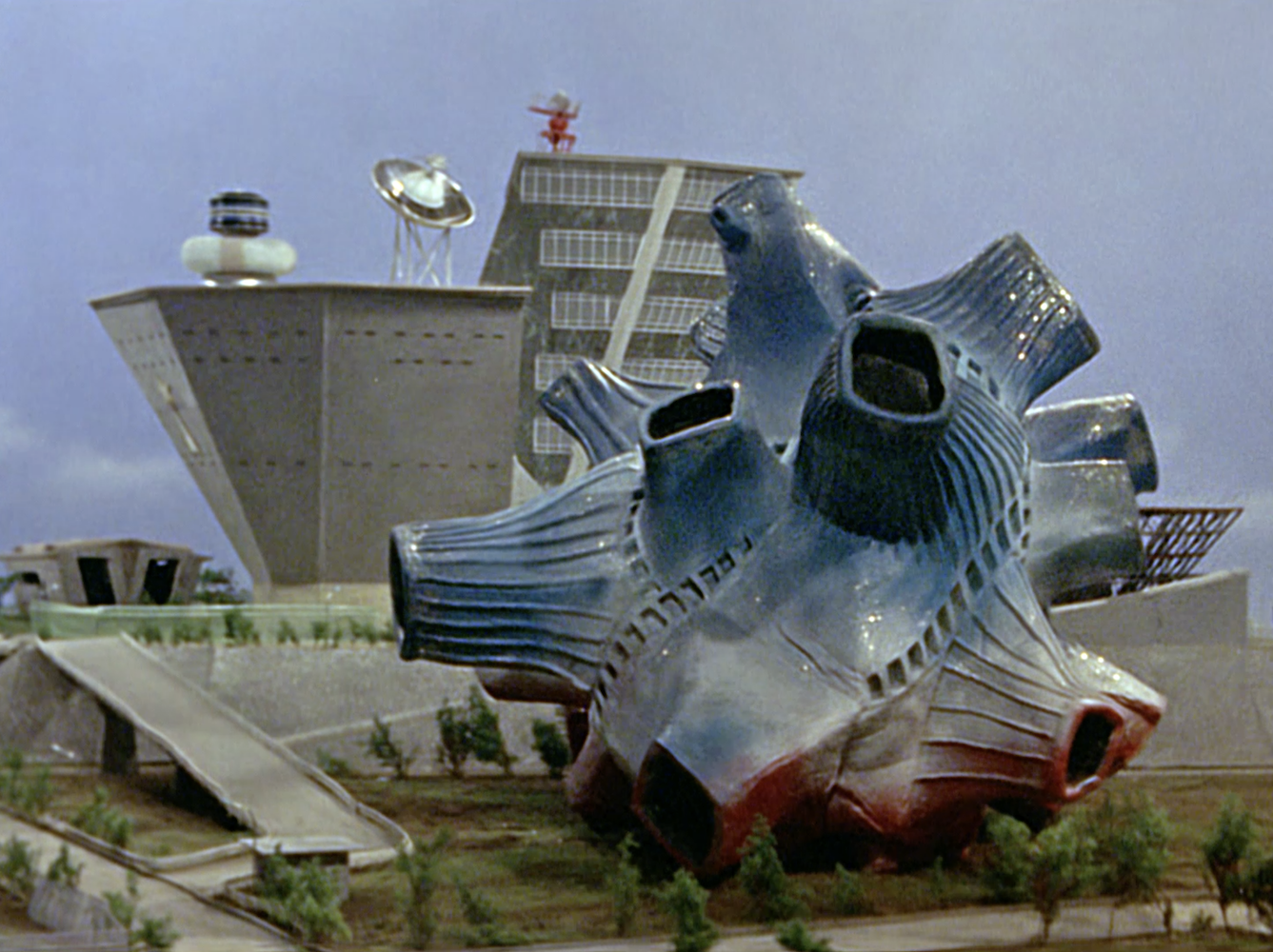
The most surreal Ultraman episode yet. That still places it below the strangest episodes of Ultra Q or an average episode of Ultraman Taro. Those shows set a high bar for weirdness, but “Passport to Infinity” makes a game effort at trippy and abstract excitement. Best of all, we get one of the Ultra series’ most memorable kaiju, Fourth Dimensional Monster Bullton, which resembles a heart valve as designed by Joan Miró.
Bullton is the result of yet more strange meteorites arriving on Earth to create havoc. After two fragments of a space stone trigger bizarre occurrences for the people studying them, the SSSP brings the two rocks together at their HQ for safekeeping. But even Hoshino knows that storing the rocks in the same location is a bad idea. The rocks combine and turn into the full form of Bullton, a reality-warping non-humanoid lifeform that traps several Science Patrol members and scientists inside SSSP HQ, which it has altered into a time-and-space-warping funhouse. That’s the signal for the production design team and camera crew to go nuts.
The abstract strangeness of the episode’s visuals seems like the ideal playground for director Akio Jissoji. But tokusatsu steady hand Toshihiro Iijima is in the director’s chair this time, and his more restrained touch may have worked to keep the logic-loose antics of Bullton from going too extreme. Iijima’s direction on two of the most bizarre Ultra Q episodes, “The Underground Super Express Goes West” and “Challenge From the Year 2020,” shows that he had the capability to handle an off-kilter story and keep viewers centered enough to enjoy it as a science-fiction adventure tale.
The big hero of the episode is designer Tohl Narita. Narita not only bestowed upon the Ultra franchise its most memorable non-humanoid kaiju, he created the striking abstract effects of Bullton’s power, such as an infinite stairway into the sky and a view through a door of Bullton’s “Four Dimensional World.” The Fourth Dimension image was based on one of Narita’s sketches and is a remarkably faithful reproduction of it. Both the infinite stairs and the Fourth Dimensional World are among the most famous images from Ultraman.

Bullton itself is a work of mad genius. All the conventions of kaiju design are tossed out for this metallic sea-anemone/steel-heart contraption. Bullton may not be able to fight like a standard kaiju, but it can warp reality in amusing and dangerous ways. Distorted camera angles and weird lenses, upside-down sets, people passing through walls and walking through interior doors but emerging outdoors — it’s unpredictable fun, and most of it is achieved through inexpensive, creative trickery.
The episode reaches its peak when the Japanese Self-Defense Force attempts a land and air strike on Bullton. The alien entity pulls tricks like making the tanks and the jet planes switch locations — not good for either — and collapsing the ground. Ultraman doesn’t have an easy go at beating Bullton either. The creature uses time freezes and gravity manipulations unlike anything the Ultra warrior has fought before. It’s all enormous VFX good times, although Ultraman’s final defeat of Bullton feels too conventional.
This isn’t a character-driven episode. The “world-famous explorer” who discovers the first meteorite fragment is named “Mr. Yesterday,” which sounds exciting, but nothing about him lives up to that name. The only important character bit is Hoshino finally getting promoted into an official member of the Science Patrol in the coda as thanks for his actions. (We already saw him wearing a Science Patrol uniform in the previous episode, which was likely due to differences in production order.) Fuji is strangely cold toward Hoshino, treating him like a pesky kid she barely knows, which doesn’t feel right for her character. Ide has some hammy fun with the effects of Bullton zapping things around. No major drama awards here, but the episode has more than enough going on to allow the characters to coast a bit. Hoshino’s promotion to an actual SSSP member will present problems in later episodes, but I’ll get to that.
All around, a delightfully warped half hour that again shows the creative reach and ambition of Tsuburaya Productions at keeping the Ultra series fresh.
Rating: Great
Previous: Science Patrol Into Space
Next: Brother From Another Planet

 The Ultra Project