
Directed by Noriaki Yuasa. Written by Niisan Takahashi.
After two bland movies, the Gamera series at last discovers its niche and breaks out the good rubber-suited monster times.
Fans generally consider Gamera vs. Gyaos the best movie of the series. I won’t argue with that. The pacing, the monster battles, the cast, the blend of the human story with the big beastie action … it all comes together for an entertaining monster vs. monster show, and one of the best kaiju films of the Showa Era outside of Toho Studios’ output.
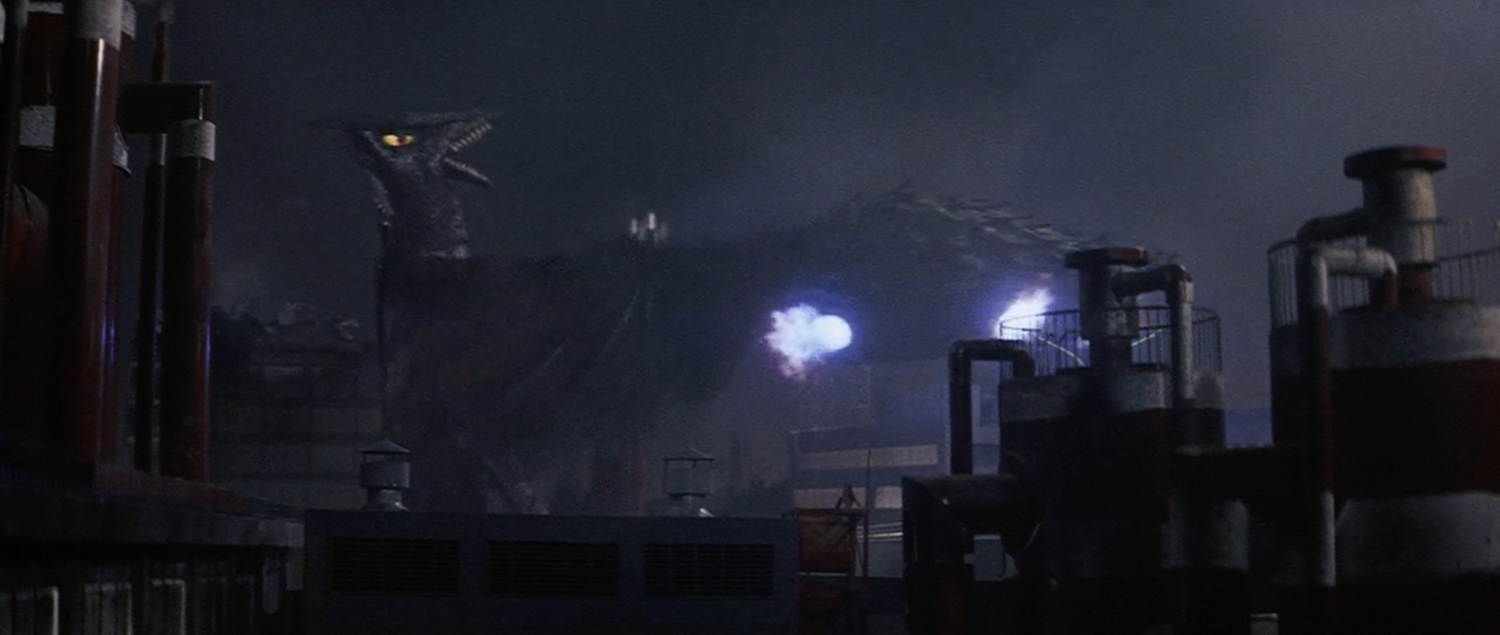
Gamera vs. Gyaos doesn’t waste time: after an intro with Gamera investigating the eruption of Mt. Fuji, it’s a mere twenty minutes until opponent monster Gyaos makes a startling appearance (eating a pesky reporter!). Gyaos immediately threatens our child hero, Eiichi (Naoyuki Abe), which brings Gamera out to save the day. Gamera rescues Eiichi and lets the boy down to safety from a ferris wheel. This whole sequence is superior to anything in either of the previous movies.
The special effects scenes are plentiful and a joy to watch. When the Japanese Self-Defense Force irritates Gyaos, the monster makes an urban attack on the city of Nagoya. Gyaos smashes apart the skyline and takes down the city’s famous castle with its supersonic ray. (This castle has had rotten luck in the past with monsters: Godzilla crashed into it and battered it to rubble three years earlier in Mothra vs. Godzilla.) Gamera shows up in Nagoya for a fine aerial duel over the city’s baseball stadium, a scene that would inspire a major sequence in 1995’s Gamera, Guardian of the Universe.

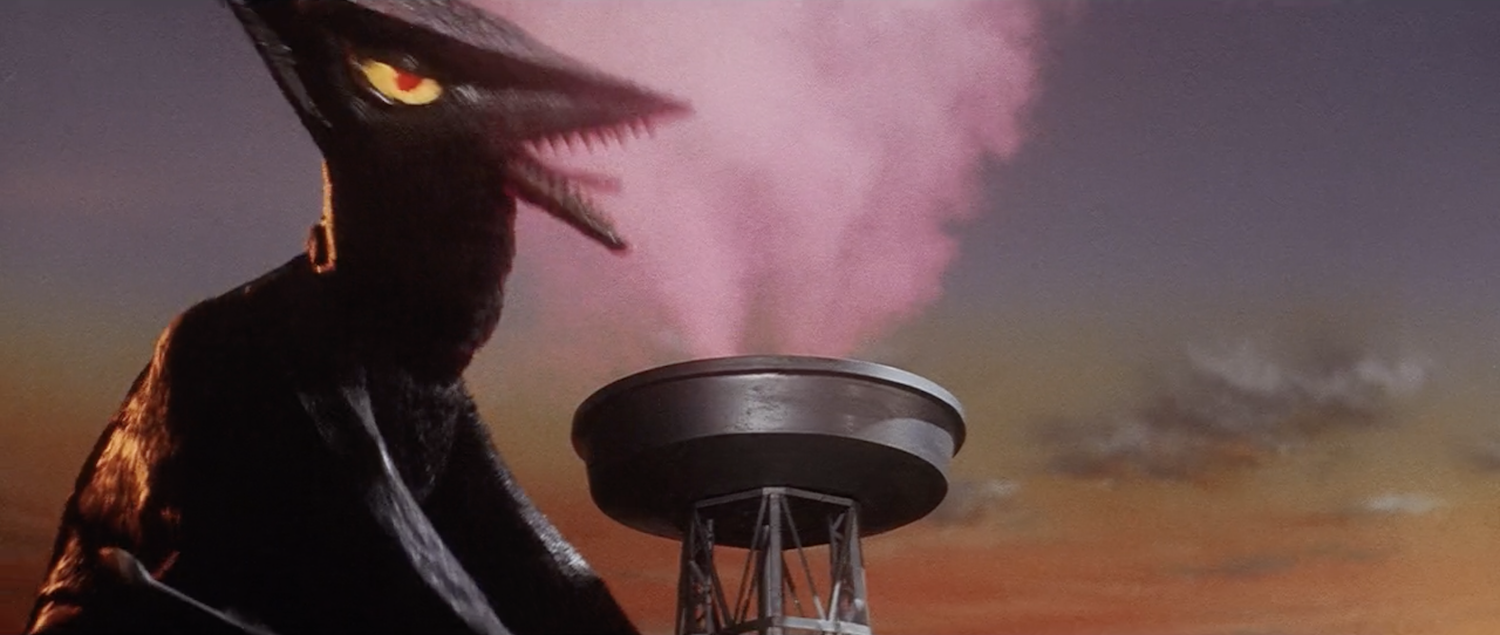
Gyaos is a wonderfully designed monster. It resembles a cross between a bat and a Pteranodon. Its mortar board head and glowing yellow eyes give it a sinister look appropriate for a villainous kaiju. The plot doesn’t really need to explain Gamera as the hero monster, because Gyaos comes across on screen as the Black Hat just thanks to how it appears. Also, Gyaos likes to eat people. That’s a bad thing.
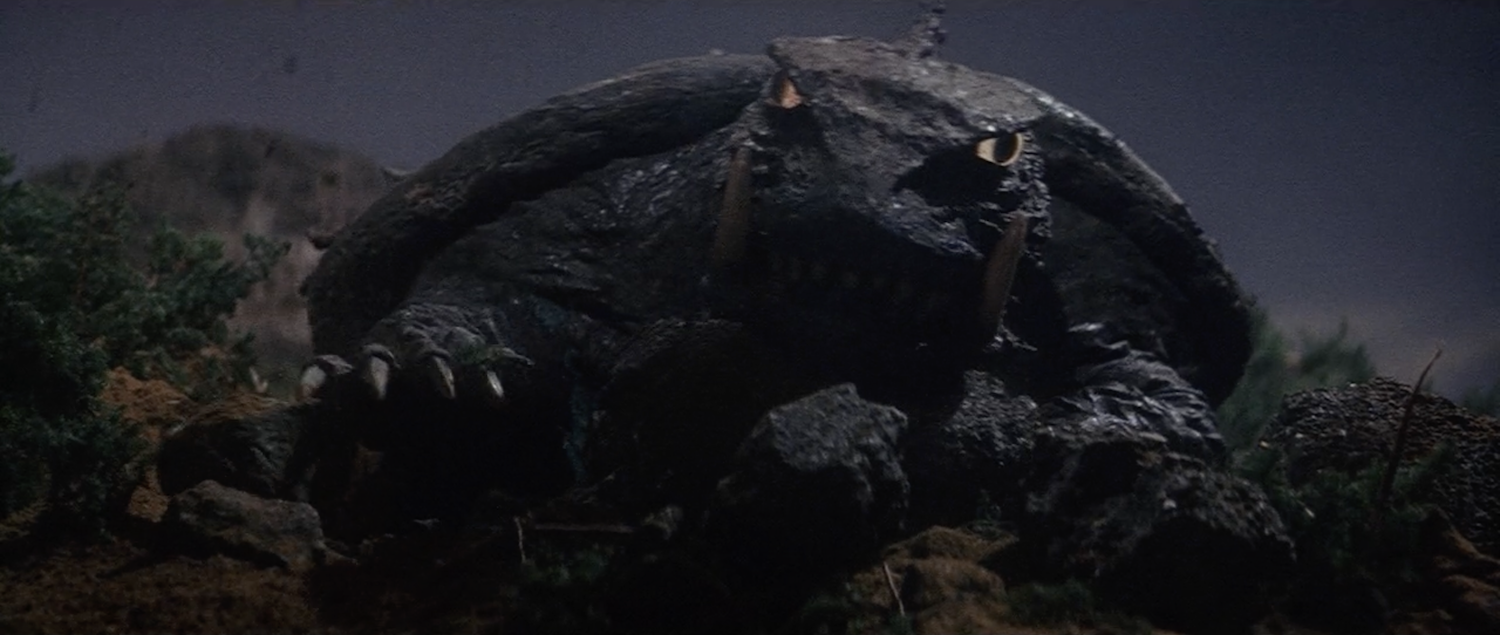
Gamera is still not fully articulated as a “friend to all children,” although when the giant turtle rescues Eiichi, it moves only a short step away from this major development in the Gamera mythology. Since Gamera commits no destruction against humans this time, Eiichi’s adoration of the monster doesn’t feel awkward and misguided. It’s easy to flow with Gamera’s gentle treatment toward the kid at the opening. Kids like giant monsters, so why shouldn’t giant monsters like kids? Makes sense to me.
The human story contains some boilerplate “military and scientists attempt to stop the monster” sequences. These superficially aren’t much different from the same material in the previous movies. However, they fold well into the other plots, include lots of Eiichi interrupting and providing the JSDF with ideas to stop Gyaos (pretty much every ploy they devise originates with the kid) and lead to a delightfully daft attempt to kill the monster. It’s a thrill just to write out this anti-Kailua scheme: lure Gyaos to the top of a rotating restaurant using a huge vessel of synthetic blood, then spin the restaurant extremely fast so Gyaos will become too dizzy to escape before the sun comes up and roasts it to death. They really try this, and it’s a highlight of the film.
The human story centers on a village near the mountain where Gyaos appears. The villagers are trying to negotiate a settlement with the corporation that’s building an expressway through the mountains. The village’s elder councilman (Kichijiro Ueda), who is Eiichi’s grandfather, pushes the other villagers to hold out for a higher price from the corporation and resist the road’s construction until the moneymen give in. The story oddly takes the side of the road crew against the villagers, with foreman Tsutsumi (Kojiro Hongo, the lead in Gamera vs. Barugon) emerging as the rational actor between the two.
The villagers eventually chastise themselves as too greedy, which is an odd development — shouldn’t they be the underdog heroes? But the movie at least shows that the president of the company back in the city is a heartless SOB: “I don’t care about the volcanic eruption and the giant monster! Get back to work!” It sounds like a punchline to a joke about the Japanese work ethic.
Except for the Nagoya battle, the entire film takes place in the environs of the mountain village, so the story about the road construction fits well with the chaos occurring around Gyaos. In the finale, everyone joins together for a last plot against the deadly monster, and Gamera appears for a terrific final fight that’s exactly what you want from this type of tokusatsu: energetic and occasionally ludicrous. Clocking in at a leaner fourteen minutes shorter than the endless slog of Gamera vs. Barugon, Gamera vs. Gyaos is fast on its turtle feet and a pleasure throughout.
Daikaiju kuchusen: Gamera tai Gyaosu (“Giant Monster Air Battle: Gamera vs. Gyaos”) first reached the US through AIP Television as Return of the Giant Monsters. After the AIP version vanished in the early ‘80s, Sandy Frank Entertainment picked it up for distribution, re-dubbed it, and gave it the title Gamera vs. Gaos, dropping the “y” from Gyaos’s name for some reason; it’s the same strategy that the Walter Reade Organization used when it turned “Ghidorah” into “Ghidra” for their release of Ghidorah, the Three-Headed Monster.
Although the best of the original Gamera films, Gamera vs. Gyaos also made for one of the finest of the Mystery Science Theater 3000 Gamera episodes. We can partially thank Sandy Frank for this, since once again his company’s dub job is horrendous and makes the movie seem far stupider because the characters all act like dim bulbs. But since Gamera vs. Gyaos is genuinely entertaining to watch, it also makes for a fun riffing subject. There’s simply so much more for the Satellite of Love crew to work with than the snoozer of Gamera vs. Barugon.
In summary: If you have children and want to show them a Gamera film, skip the first two and go straight to this one. You’ll have happier children.
Rating: Great
Previous: Gamera vs. Barugon
Next: Gamera vs. Viras
 The Ultra Project