
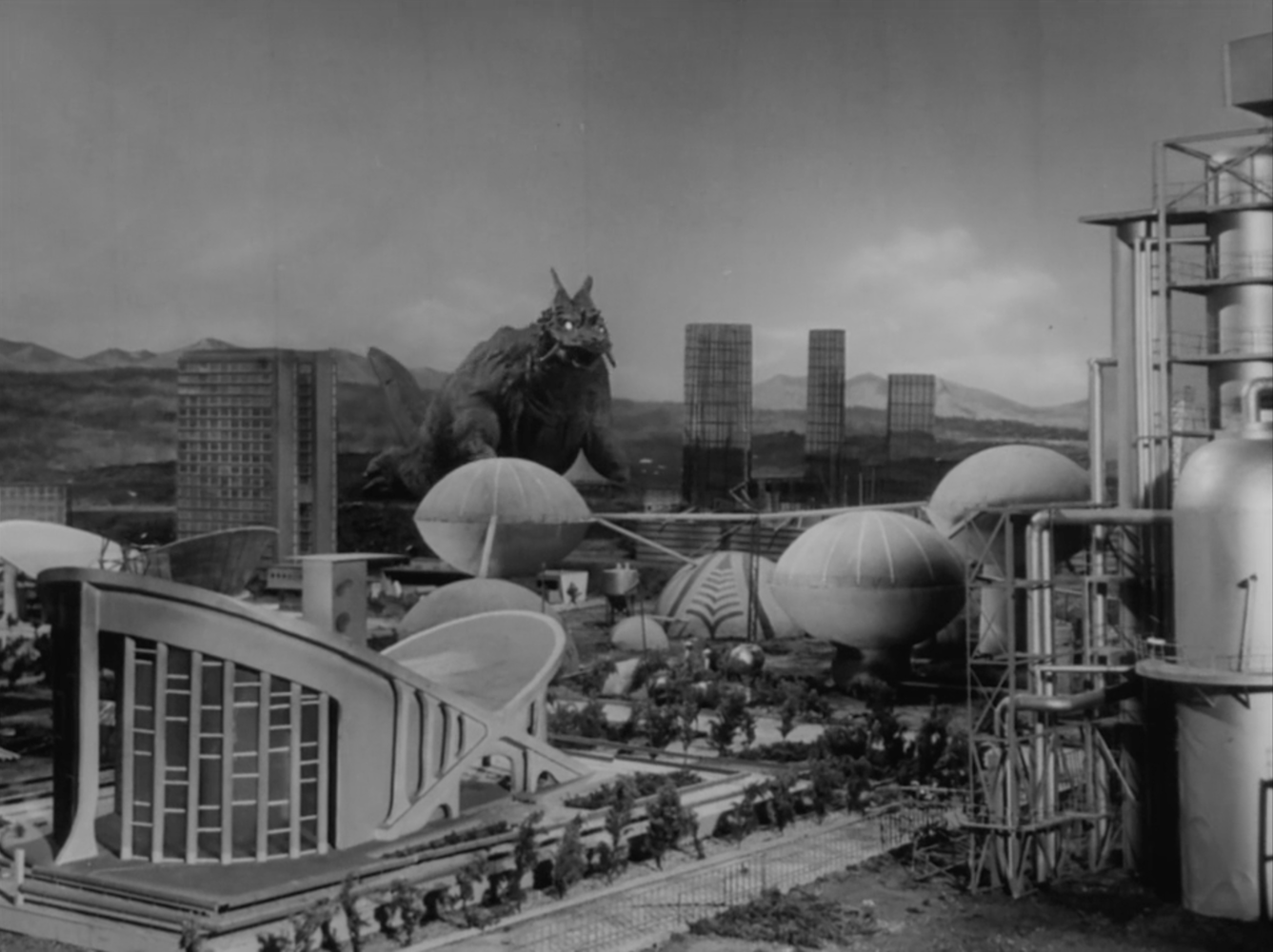
Directed by Toshihiro Iijima. Written by Masahiro Yamada. Airdate May 1, 1966.
Once upon a time, there was a giant monster movie called Frankenstein vs. Baragon (first released in the US as Frankenstein Conquers the World). Eiji Tsuburaya designed the quadruped kaiju Baragon for the film. Baragon then had a brief but busy career playing other monsters in Tsuburarya’s TV shows. The costume underwent four different redesigns through 1965–66 to help save money on building monster suits. Baragon made its makeover debut in “The Rainbow’s Egg,” where it plays the kaiju Pagos.
The episode was planned as a return engagement for Gomess, the redesigned Godzilla costume from Ultra Q’s premiere episode, “Defeat Gomess!” But Toho was using the Godzilla costume and instead sent Tsuburaya Pro the Baragon costume — “Hey, try this instead.” Baragon ended up disguised well enough as Pagos that viewers at the time might not have recognized the original monster beneath.
The episode works when it’s centered on Pagos and acts like a conventional giant monster story. The effects work of Pagos attacking an atomic power plant is excellent, and it was good training for the VFX team to later execute similar spectacles in Ultraman episodes. Pagos’s ultimate fate in the finale involves some clever opticals that have a different look from Tsuburaya’s standard style, and that’s fun to see.
However, the story of a kaiju drawn to uranium and threatening a planned industrial town is interlaced with a story about a group of children trying to help an old woman they all call “Grandmother” regain the ability to walk. This half of the plot leans heavily into the fairy-tale aspects of the show, and it turns the episode lumpy and awkward. Ultra Q’s medley of disparate elements is a large part of what makes the show fascinating and often surreal — but the trick doesn’t always work.
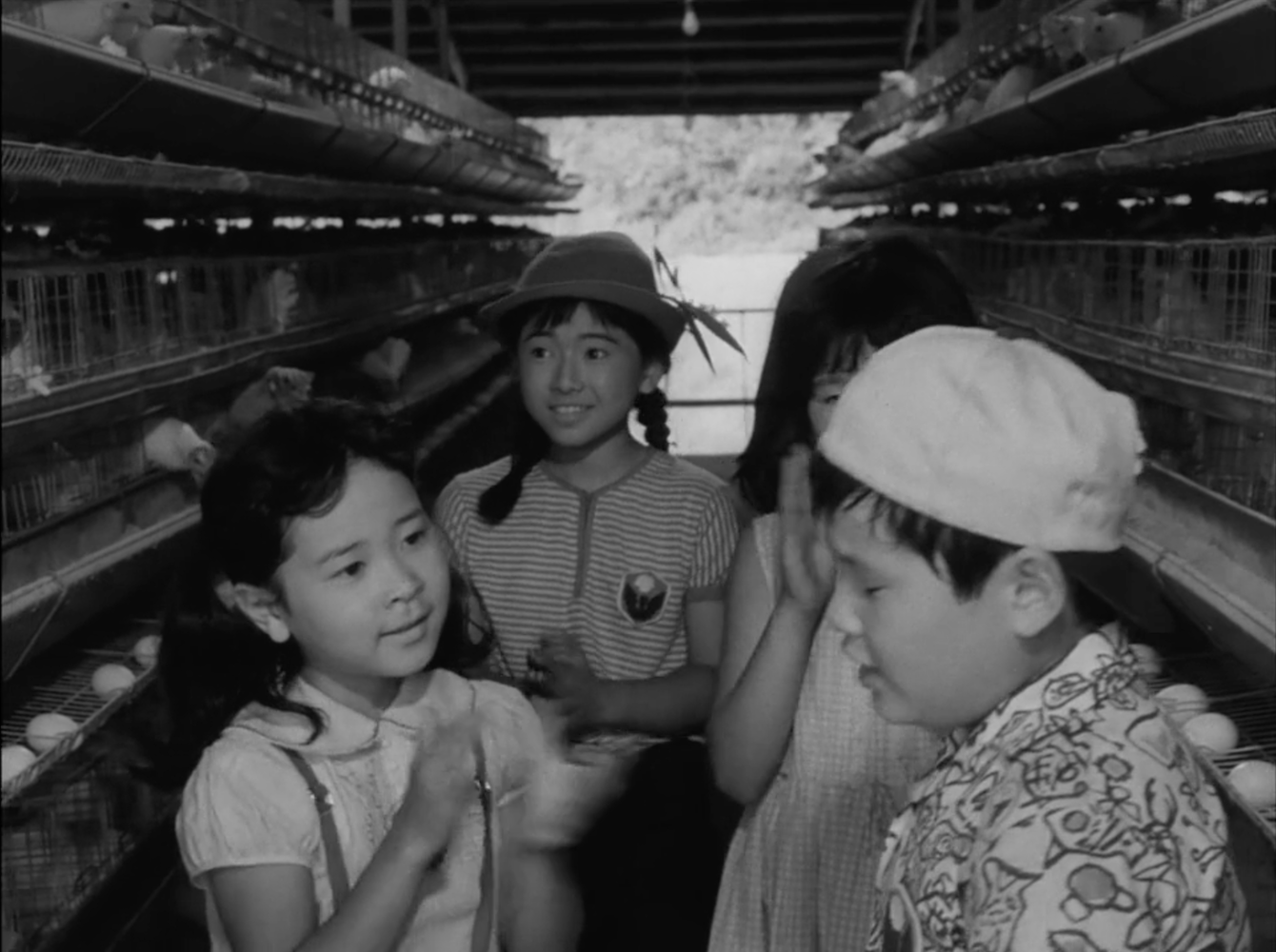
The children belong to one of those roving bands of unsupervised younglings who apparently exist everywhere in the Ultra universe, especially in the Showa era. These kids all wear badges, so maybe they’re part of a scouting troop I know nothing about. While Pagos seeks uranium, the children seek a magical “rainbow’s egg” they believe will grant them the wish they need to allow Grandmother Tamiko to walk again. Their quest crosses paths with the monster plot when the children find a lost uranium capsule shaped like an egg, which draws Pagos as well. There’s also chatter about omens, good and bad, from the discovery of Sazame Bamboo … it all feels hastily stitched together with loose mystical strands that needed some trimming.
The children provide some fun in their own way, even if it’s detached from the rest of the episode. The two main kids, Piko (Hikaru Shirakawa) and Bunta (Sojiro Uchino), are endearing enough to make me wish they had an episode dedicated to their adventures. Piko is the heroine of the children’s story, the one most dedicated to helping Grandmother Tamiko. Bunta speaks in a raspy, low voice that other children have to translate for the adults, and he can make mouth noises that cause chickens to lay eggs. This is excellent material for an episode in the key of “Kanegon’s Cocoon” or “Grow Up! Little Turtle,” but it’s too precocious here. Uchino’s performance was impressive enough that he came back for the Ultraman episode “Terrifying Cosmic Rays.”
The children’s plot wraps up in a maudlin and simplistic way, with no explanation. This undermines some of the goodwill it occasionally builds up thanks to its weirdness and the overall good performances from the kids.
But let’s go back to Pagos/Baragon to wrap up. For the record, the other kaiju Baragon played before its retirement are Neronga, Magular, and Gabora. Pagos was planned to return in the Ultraseven episode “The Strolling Planet,” but the Baragon costume was in such tatters that another monster was substituted. Baragon reappeared as itself in a brief cameo in Destroy All Monsters (1969). Decades later, a new Baragon costume had a major role in Godzilla, Mothra, King Ghidorah: Giant Monsters All-Out Attack (2001) — Baragon’s finest hour, in my humble opinion.
So I close the book on the history of feisty Baragon, the kaiju who underwent extensive cosmetic surgery in dedication to its craft. I salute you, Baragon-san.
Rating: Average
Previous: The ⅛ Project
Next: Challenge From the Year 2020
 The Ultra Project