
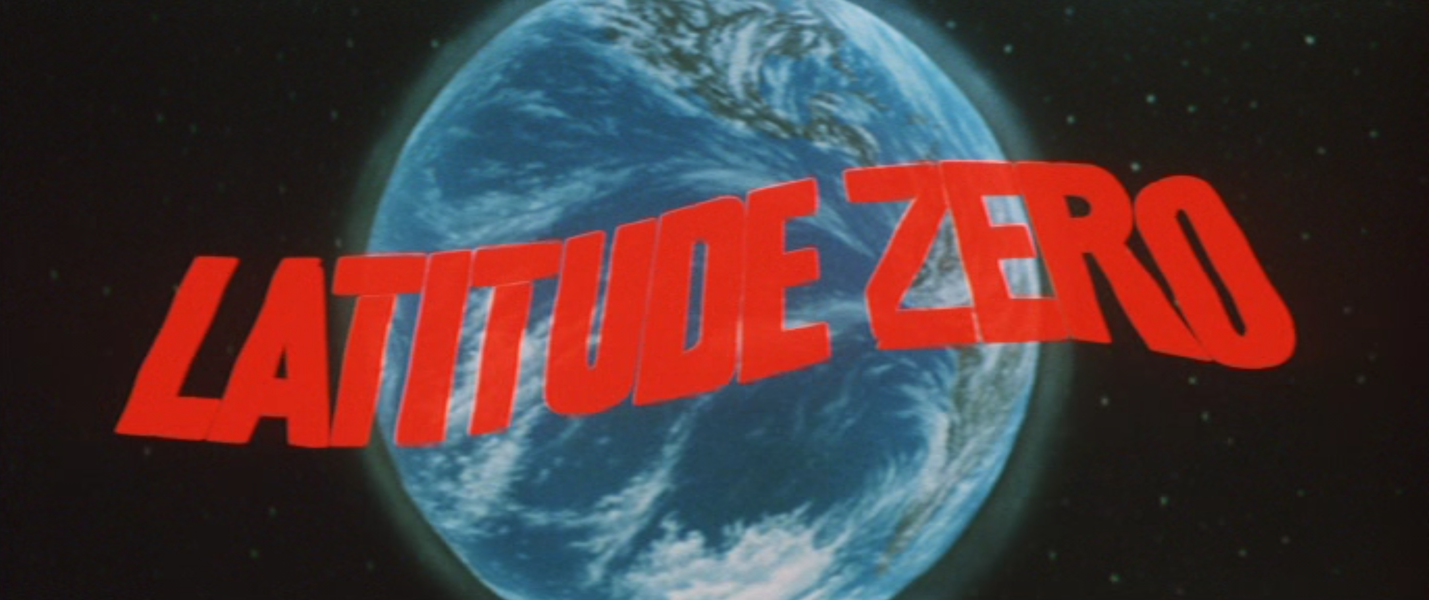
Directed by Ishiro Honda. Written by Ted Sherdeman and Shinichi Sekizawa. Starring Joseph Cotten, César Romero, Richard Jaeckel, Akira Takarada, Patricia Medina.
Latitude Zero is best known as the last science-fiction film that special effects wizard Eiji Tsuburaya worked on before his death. As final bows for a VFX artist go, it’s quite the spectacle: a science-fantasy epic with super-submarine duels, an underwater utopian city, giant rats and bats, a winged lion, laser-firing gloves, jet packs, massive pyrotechnics that blow up entire islands, and large matte painting vistas. Most of the effects are fantastic, and there are so many of them. The film is wall-to-wall with Tsuburaya’s trademark style.
Yet few people know about Latitude Zero, even though it was specifically made to attract an English-speaking audience. It has a cast of familiar Hollywood actors, and, in a rare move for Toho Studios, the entire film was shot in English. Even the Japanese actors spoke their lines in English rather than be dubbed for the US release.
Although often cheesy because of its uneven budget, there’s plenty to enjoy about Latitude Zero aside from its plentiful visual effects. It has a story that feels like it jumped out of a silver age comic book or a Saturday morning cartoon, delectably hammy villains, several excellent action set-pieces, and the enjoyment of hearing Akira Takarada speak English — quite well, too! Takarada-san had already spoken English extensively in the fun spy thriller 100 Shot 100 Killed (a.k.a. Ironfinger, 1965) and his charisma breaks through the language barrier.

Still, Latitude Zero is mostly surface and doesn’t have much drama holding together its movie-serial plotting. Describing the story makes it sound like a pulpy blast, but the first half is mostly Joseph Cotten’s Captain Nemo figure explaining the underwater SF setting while Richad Jaeckel’s reporter peppers him with one question after another. In the second half, when Cotten finally stops explaining everything, the movie is trapped with two-dimensional leads who don’t have much to do except follow Joseph Cotten’s orders.
There’s a specific production reason Latitude Zero has a low profile. Of course, it has to do with money. The project started as Toho looking for a follow up to Atragon, their hit 1965 super-sub movie. They picked obscure source material, an American radio cliffhanger serial from 1941 with a Twenty Thousand Leagues Under the Sea premise. Toho planned to co-produce the movie with Don Sharp Productions in the US, but Sharp either pulled out of the production at the last minute or ran out of money. According to actress Patricia Medina, the funding collapsed right as the American actors arrived in Tokyo to start production. Toho had to desperately negotiate to keep the movie afloat, convincing the actors to defer their salaries for six months.
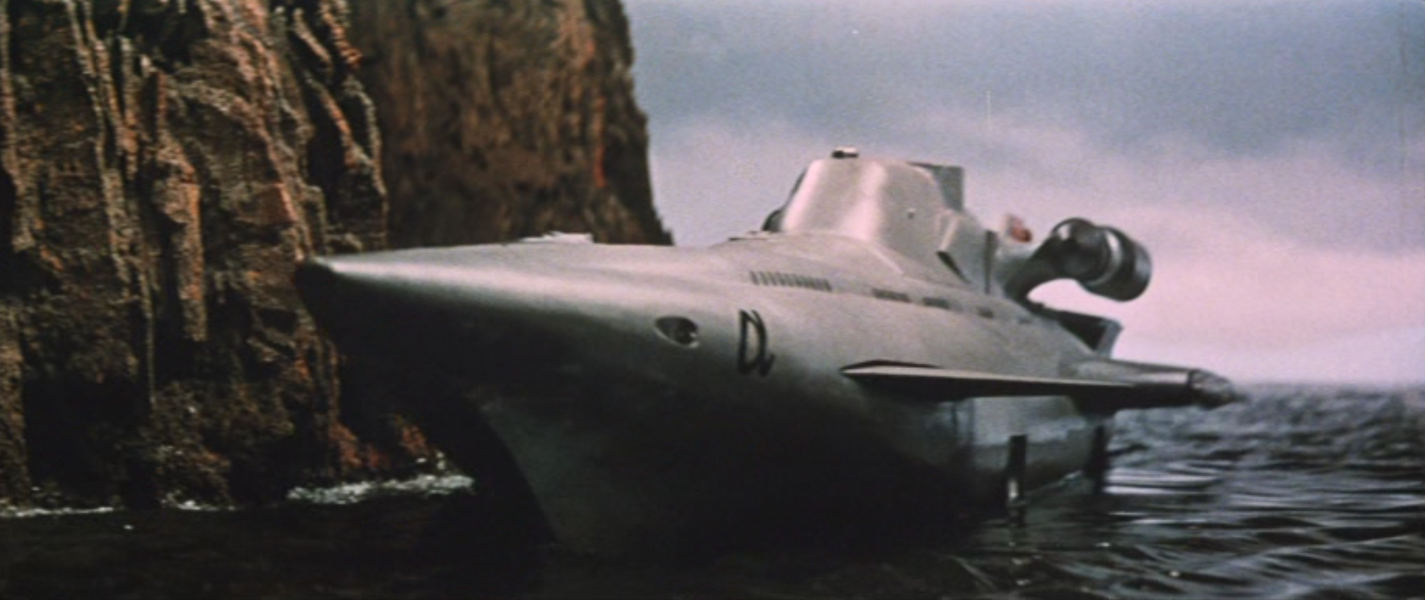
Toho ended up footing most of the bill for Latitude Zero, causing a legal snare that kept the film off television airwaves and home video for decades. The budget was whittled down, making what Team Tsuburaya was able to pull off with the effects work even more impressive. Star Joseph Cotten, who was married to Patricia Medina, fell ill during filming, further complicating a complicated production.
I don’t know why Toho decided to adapt an unknown radio serial for their big co-production, or how they even came across it. The serial’s author, Ted Sherdeman, had a long career in radio, movies, and television. His most important SF credit is the script for the giant ant classic Them! (1954), but not much else in his catalog indicates he was a good fit for science-fantasy adventure. Writing episodes of The Flying Nun, Hazel, and Bewitched doesn’t make me think of someone comfortable with Jules Verne and Edgar Rice Burroughs-inspired adventures. This probably explains why Toho brought in their resident SF screenwriter, Shinichi Sekizawa, to revamp Sherdeman’s film script. Sherdeman has sole screenplay credit, with Sekizawa listed as “script adviser.”
The story is a hodgepodge of concepts from old serials and lost world tales, tossed around without much coherence. Hidden beneath the ocean, the Captain Nemo stand-in, the ageless Captain Craig McKenzie (Cotten), has created Latitude Zero, a submerged city populated by the greatest minds on Earth. McKenzie is locked in a centuries-long conflict with the evil Dr. Malic (César Romero) and his lover Lucretia (Medina), often engaging in battles from their super-submarines, the Alpha and the Black Shark. McKenzie may spout plenty of exposition speeches about the underwater technology of Latitude Zero, but he never exactly explains the origin of his feud with Dr. Malic. Malic is just “the bad guy” who wants to ruin McKenzie’s undersea utopia.
It’s easy to draw comparisons between Captain Nemo and Captain McKenzie, as they’re both eccentric geniuses who live underwater in tricked-out subs. But McKenzie lacks any of Nemo’s fascinating traits. He’s quite boring, and there’s no drama between him and the surface visitors. They aren’t his hostages, nor do they have moral qualms about his actions. They simply tag along on his adventures and McKenzie is glad to humor them with long explanations about every bit of technology. Joseph Cotten doesn’t bring anything special to McKenzie, although his poor health at the time may be partially at fault.
The ostensible protagonists are the trio of surface explorers who end up aboard the Alpha after their diving bell crashes: journalist Perry Lawton (Jaeckel), oceanographer Dr. Ken Tashiro (Takarada), and geologist Dr. Jules Masson (Masumi Okada). They don’t have much to do other than observe McKenzie’s oceanic marvels and follow his orders. Masson spends a long stretch of the film unconscious, which doesn’t help his romance subplot with Latitude Zero physician Dr. Anne Barton (Linda Haynes). Dr. Barton doesn’t have much to fill her time either: her job appears to be wearing skimpy Star Trek-inspired clothing. There’s nothing wrong with these performances, but the actors have no material that gives them a chance to rise above the SF spectacle.
The movie features one of director Ishiro Honda’s favorite themes: humanity uniting for the greater good. The city of Latitude Zero is an expression of the best of the human race working for a brighter future. But like the main characters, Honda doesn’t have much space to add personal directorial touches or exercise the skill at human drama he showed in his best films. He’s corralling a big show. He does it well, but it’s showmanship flash and not that deep.
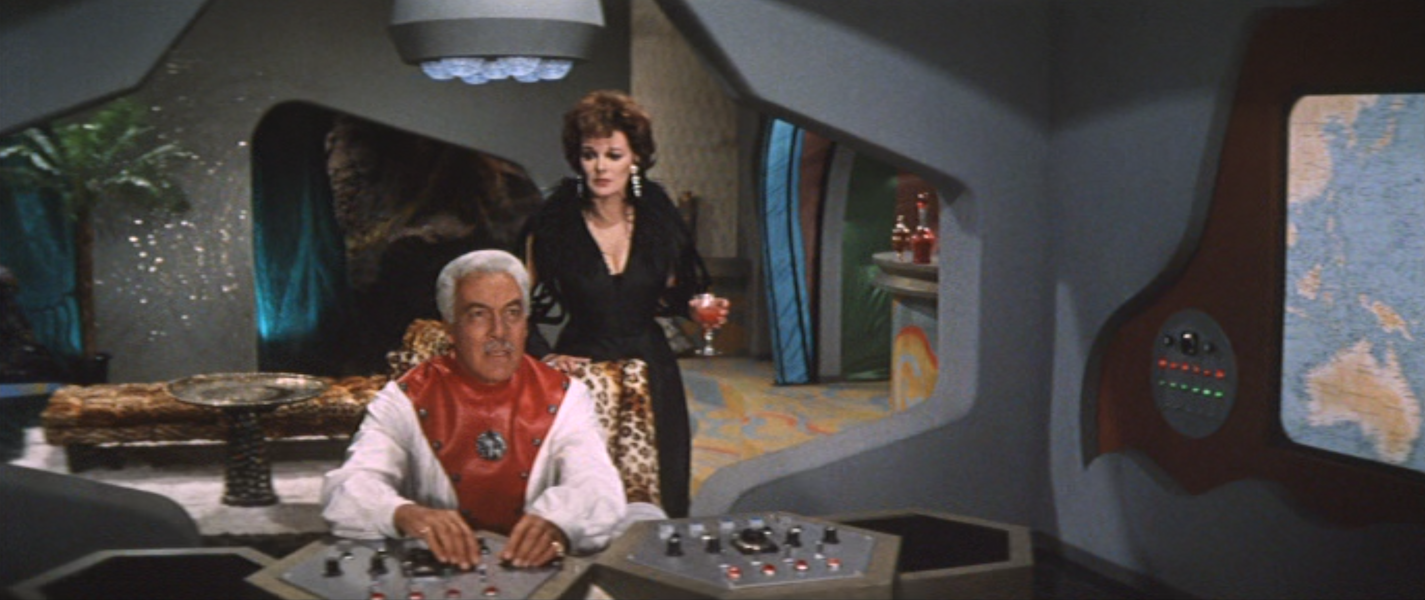
The bright spot among the human action is Romero and Medina as the villainous Boris-and-Natasha couple Dr. Malic and Lucretia. They rip into their parts and seem to be having a grand time playing to the cheap seats. Romero was coming off playing the Joker in Batman ‘66 and has the comic book villain groove nailed down. Watching him here, it’s hard to imagine that at one time Romero was stereotyped as a “Latin Lover” in Hollywood. The man is a born supervillain. He eats scenery with refinement.
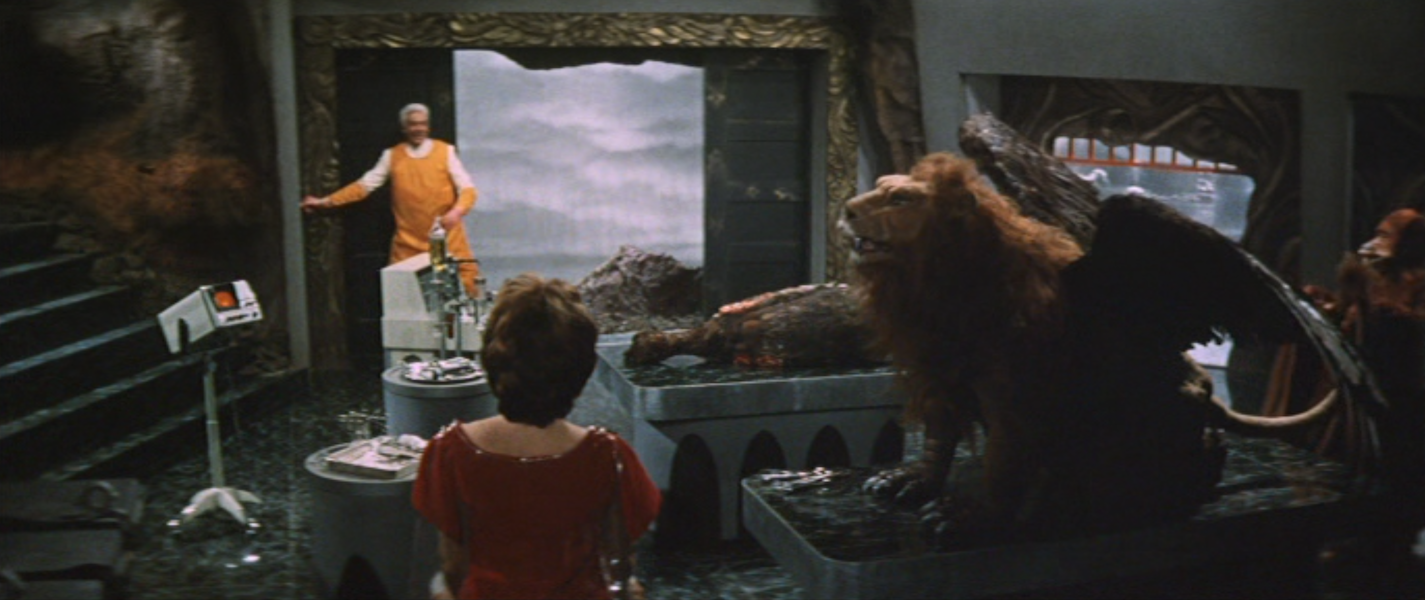
Malic’s scheming is generic mad scientists business, but he does create the film’s most memorable obstacle: a winged lion with the implanted brain of his former favorite henchperson, Kuroiga (Hikaru Kuroki), in its cranium. Famed suitmation performer Haruo Nakajima plays the flyin’ lion, and there’s almost a “Wizard of Oz” quality about its scenes. It’s charming and deserved more screen time.
After Eiji Tsuburaya completed work on Latitude Zero, he turned to Tsuburaya Productions’ new project, an anthology series called Unbalance: Horror Theater. Then illness forced him to cancel work on any upcoming Toho projects. His son Hajime officially took over as president of Tsuburaya Pro in November 1969 while his father was convalescing. Tsuburaya, however, did not recover and died on January 25, 1970. That’s the sad coda to Latitude Zero, but as I’ve said, it wasn’t the worst way for the Old Man to say sayonara.
Rating: Average

 The Ultra Project