Directed by Akio Jissoji. Written by Mamoru Sasaki. Airdate Oct. 23, 1966.
Akio Jissoji returns with a fantastic episode that goes to a stranger place than his first, “The Pearl Defense Directive.” It’s another humorous outing, with similarities to “The Rascal From Outer Space.” Both feature enigmatic alien forces that cause comical monsters to materialize. But “Two-Dimensional Kaiju Gavadon” is a different type of comedy kaiju than the bratty Gango. Gavadon a lazy monster. Or maybe it’s just too peaceful.
In the 1960s, fuzzily defined “cosmic rays” were frequently used in science fiction as story catalysts, similar to how atomic radiation in the ‘50s was the magic method to create monsters or mutants. The magic of cosmic rays this time transforms a two-dimensional drawing into a three-dimensional object. In other words, a child’s chalk picture drawn on a clay pipe in an industrial yard manifests as a giant monster.
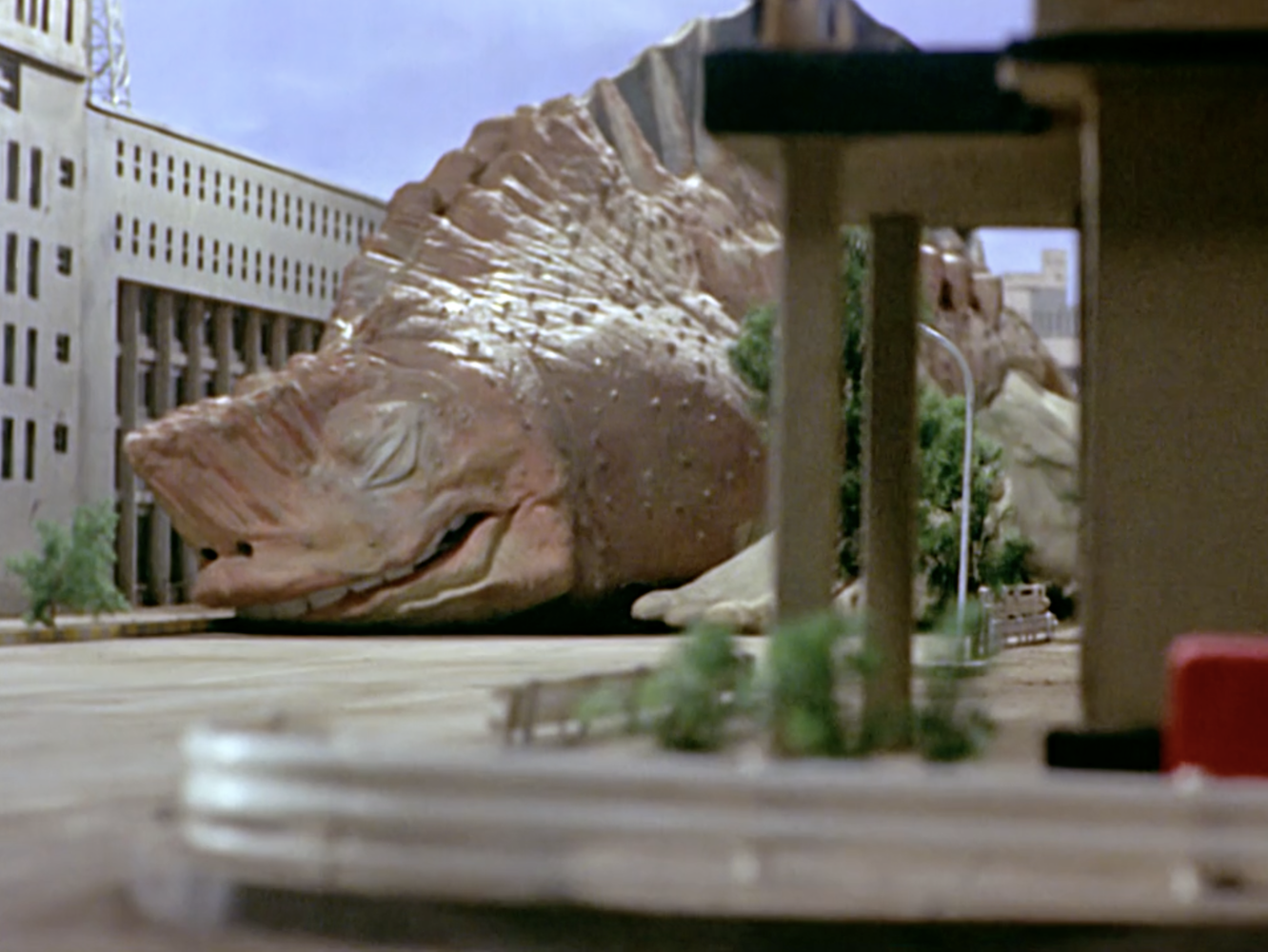
This is odd, but not too odd for an Ultra show. This franchise has many even nuttier excuses for its monsters of the week. What makes “Terrifying Cosmic Rays” different is that the monster created from the graffiti is … lame. Gavadon first materializes as a tadpole thingy that can barely wiggle around. When it reappears with a dimetrodon-like upgrade, all it wants to do is sleep.
Gavadon is still a problem, but different from a kaiju that wants to bash everything in its path. The SSSP must deal with a monster whose main threat is that it snores too loudly. A monster snoring in the middle of Tokyo and forcing an evacuation is bad for the economy. But what to do about it?
The Science Patrol is in a bind over whether to attack Gavadon and risk rousing it to destructive anger, or to let it sleep. Ide and Fuji think letting it sleep is better, or just erasing the graffiti and hoping that will make it vanish. Hot-headed Arashi, of course, wants a full-on attack. Captain Muramatsu takes Arashi’s side, which is an atypically bloodthirsty stance for him. He agrees with Arashi that the reason they shouldn’t just go wash off the graffiti is because it’s an undignified job for the Science Patrol. We don’t usually see Muramatsu ignore sane advice because he’s a stickler for protocol.
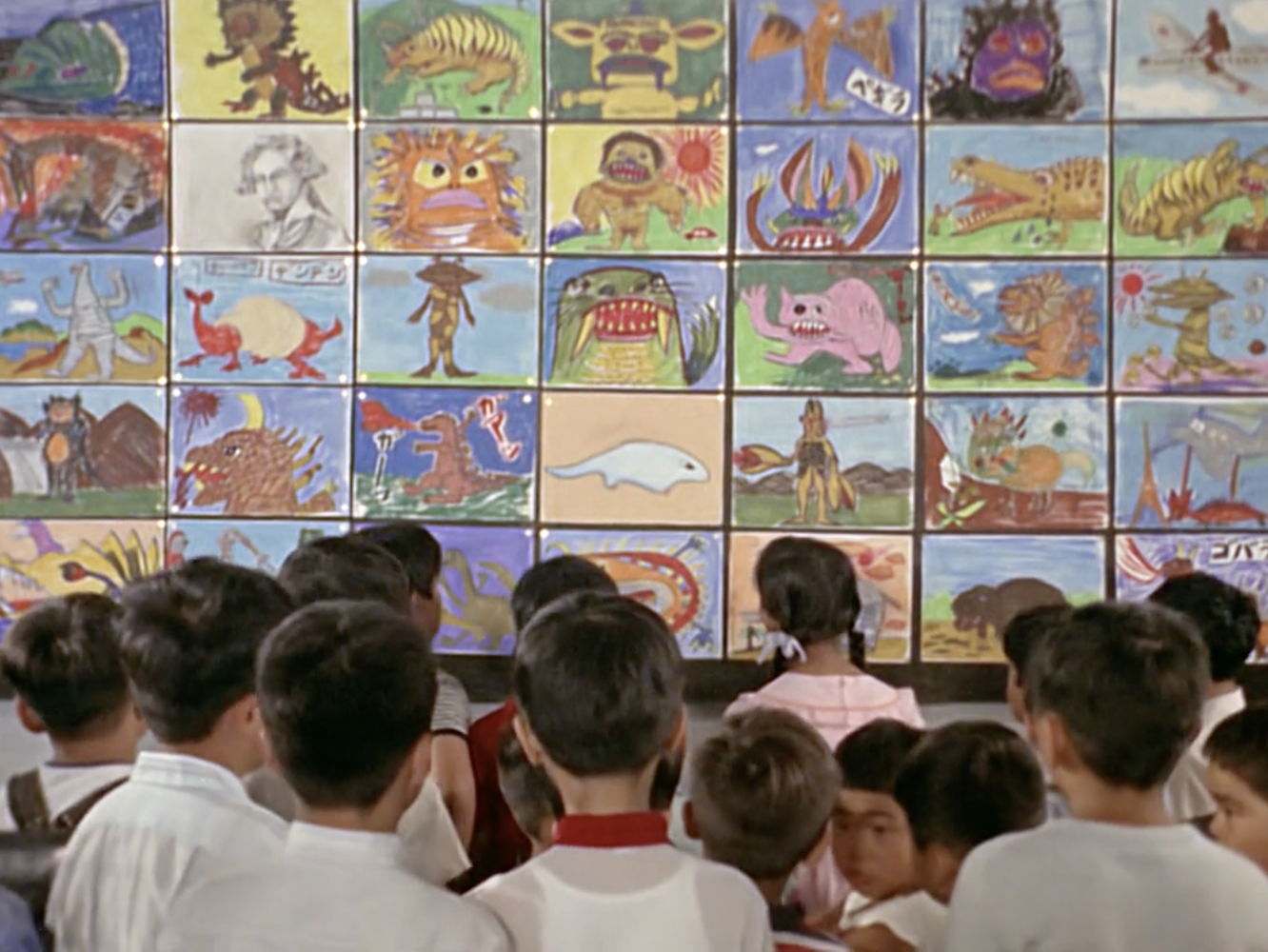
The episode isn’t really about the SSSP, even though we get some amusing moments as they cope with an exasperating problem. It’s about the children who draw monsters and cause the trouble in the first place — and keep causing it. The opening scene has elementary school children showing off their crayon drawings of various kaiju. One boy, Mushiba, draws a kaiju he invented, Gavadon. The other kids tease him that Gavadon looks too simple. Mushiba then draws the rudimentary kaiju on the clay pipe, which is where the cosmic rays find and animate it.
In many episodes, the children’s role would end here and we wouldn’t see them again. Something similar occurred in “The Rascal From Outer Space.” But the kids remain present throughout, and they actively make the kaiju problem worse. The other children feel bad for teasing Mushiba over his drawing and decide to dress up Gavadon’s picture on the pipe to make it fiercer — leading to a more dangerous actual monster when the cosmic rays do their thing again. Later, the little ruffians encourage Gavadon to be more aggressive. During the final fight, they root against Ultraman, begging him not to destroy Gavadon. Ultraman listens to the calls of children, leading to a bittersweet and emotional closing for such a lightweight episode. It’s another hint of the show developing a sense of responsibility toward the fate of possibly innocent giant beasts that will culminate in the episode “The Monster Graveyard,” also directed by Jissoji.
The message of the episode, as the narrator helpfully tells us in the coda, is that children need the freedom to express themselves. It’s why they like to draw monsters. That’s a wonderful message, even if, as the narrator points out, it may result in a giant monster coming to life on occasion. However, these kids aren’t innocent. They knew what they were doing. They wanted a stronger Gavadon and did what they could to make it happen. They’re lucky Gavadon was so slovenly that nobody got hurt, but encouraging a bigger and more dangerous monster isn’t commendable behavior.
I’m not critical of the episode’s odd approach to the children. It’s the sort of story Jissoji enjoyed telling, and this warping of the clichés of kids’ stories to create humorous anti-morals is key to classic Ultra episodes like “Kanegon’s Cocoon.” Episodes like this make the Ultra shows stand out and reward multiple viewings.
The children’s kaiju drawings raise interesting questions about continuity. Among the pictures are several Ultra Q creatures, but that show wasn’t intended to be connected to Ultraman. One kaiju, Todola from “The Disappearance of Flight 206,” never even appeared to the public. (There’s also Beethoven among the kaiju, because why not? Biggest laugh of the episode.) The suggestion may be that Ultra Q exists as a TV show in this universe. That doesn’t explain the drawing of Bullton, an Ultraman kaiju that won’t appear until the next episode. Maybe we shouldn’t read too much about continuity into the kid’s pictures. Although I just did.
Jissoji revisited the “monster that doesn’t do anything” dilemma in “The Gift From the Sky,” where he pushed the comedy and surrealism further. That’s an even better episode, but “Terrifying Cosmic Rays” is a fun, weird time that encourages children to draw harmful graffiti.
Rating: Great
Previous: The Pearl Defense Directive
Next: Science Patrol Into Space
 The Ultra Project