
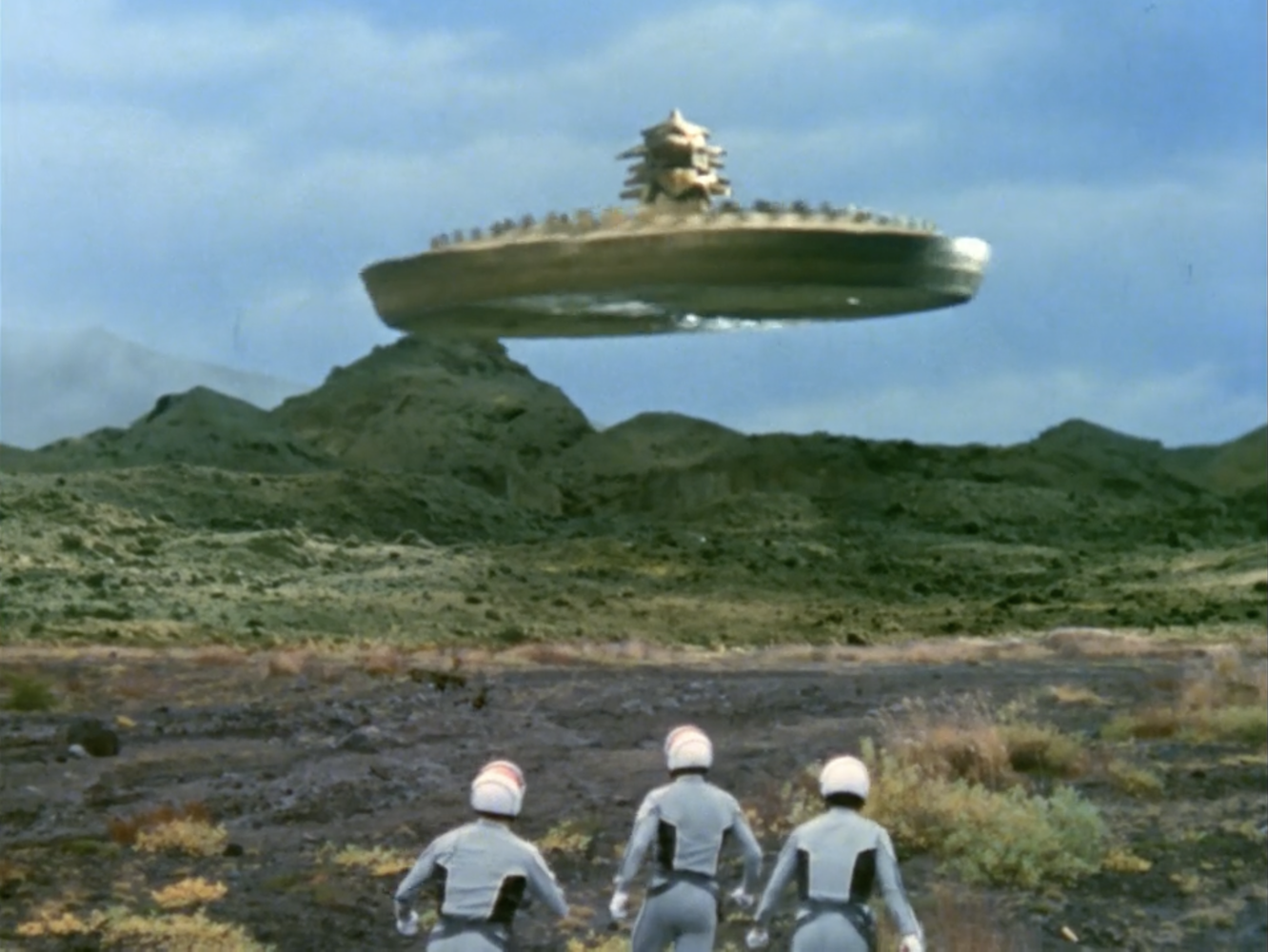
Directed by Kazuho Mitsuta. Written by Tetsuo Kinjo. Airdate Dec. 10, 1967.
Captain Kiriyama sends the Ultra Guard to investigate a series of unexplained deaths, mostly of young vacationers, around Mount Iwami. While Dan and Soga are scouting the area, the alien raygun used on the victims zaps Dan, apparently killing him. We know Dan isn’t really dead — he’s the lead of the show, after all — but this opening immediately moves the episode into new territory. The series protagonist is out of the action, and the Ultra Guard has to figure out what happened without him until the finale, when we know that Dan turns into Ultraseven and squares off against the alien menace.
On the surface, this sounds like another writers’ tactic to prevent Dan from transforming into Seven and solving the episode conflict too early. But “Fly to Devil Mountain” feels more like the creative team attempting something similar to what they tried in “Space Prisoner 303”: a leaner, investigative tale where an alien villain is out to murder a few people rather than conquer the planet. The difference is this that this time, the episode works. The stakes rise once Dan gets zapped with the alien ray, and the other members of the Ultra Guard have the opportunity to step into the spotlight. (Except for Anne, who’s absent for some reason.) Tetsuo Kinjo wrote both episodes, so maybe he was trying to correct the problems with “Space Prisoner 303.” Kinjo’s ability to create emotional tension among the characters is here in a way the earlier episode missed.
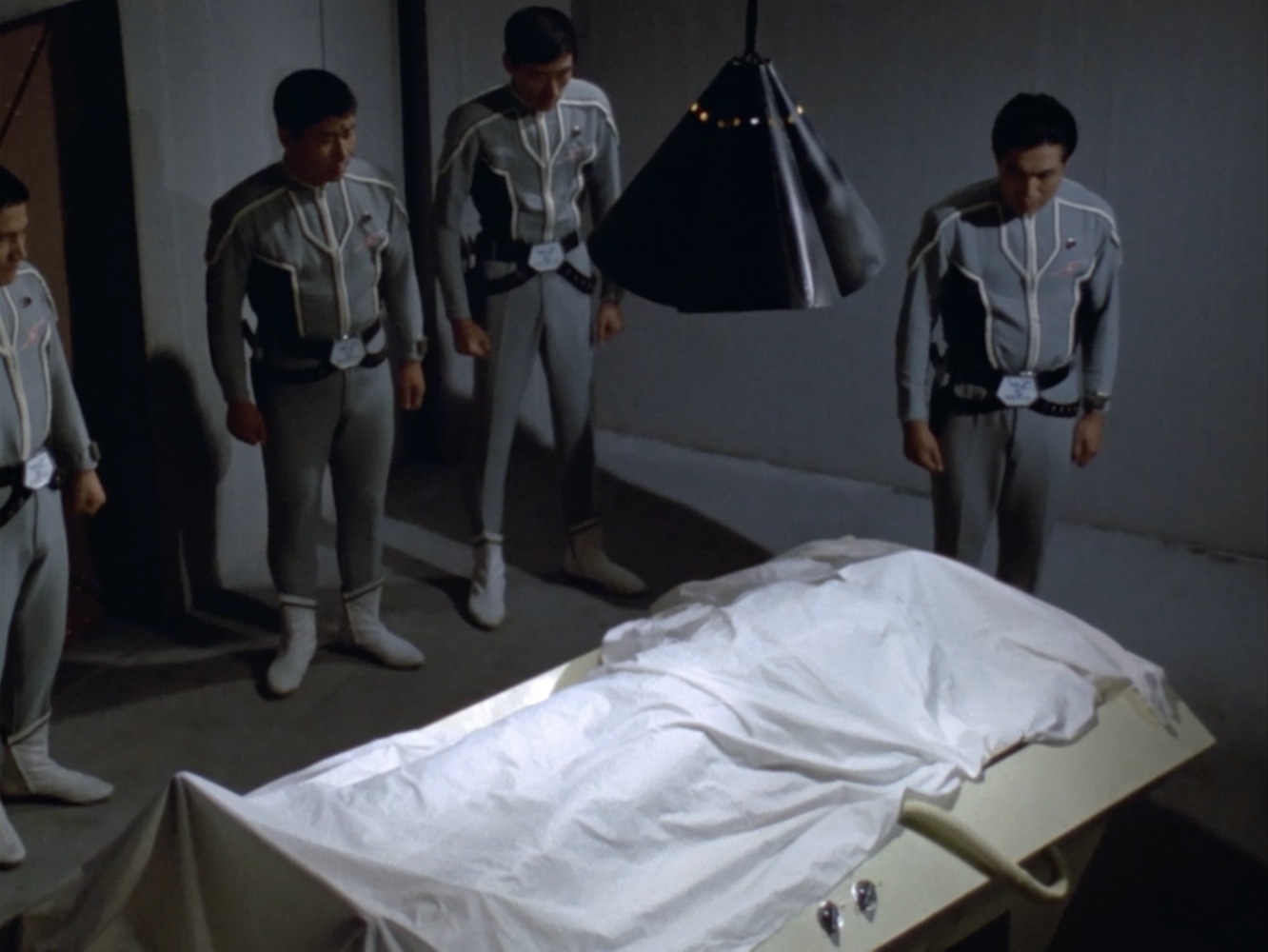
Soga is the principal character. He feels guilt over Dan’s apparent death and has an intense breakdown over his comrade’s body in a surprisingly emotional scene. All the Ultra Guard members are ripped apart and in tears over the loss of Dan Moroboshi. It’s a display that’s especially charged in the setting of stoic Japanese professionals. Soga’s actor, Shinsuke Achiha, sells the pain and feeling of failure; he reveals a depth to Soga, superficially the brash hotshot of the Ultra Guard, not obvious before.
Amagi eventually figures out what’s happening, giving the least developed UG member more to do: the victims aren’t dead — they’ve had their life forces pulled from them and trapped in a two-dimensional space. Soga discovers the alien behind the attacks, Alien Wild, hiding in a cavern beneath Mount Iwami.
Alien Wild is the one weak point of the episode: they have an interesting scheme, which is to slow down the senescence of their race by stealing young lives from Earth. “Hey, Earthlings, we just want a couple of life forces. Why can’t you be more flexible?” It’s almost understandable. But the design of Alien Wild falls too much on the silly side: a cuddly gray Yeti with a human face and short antennae. It’s a costume for the host of a children’s TV show, not for a desperate, dying alien species. Maybe the gray fur is supposed to indicate Alien Wild’s age, but the look is too “teddy bear” for my tastes.
Making up for Alien Wild’s deficiencies is their robo-monster/spaceship, Nurse. (Yes, Nurse. Although nobody says the name on screen.) Nurse is a mechanical dragon that can coil into a flying saucer form, and it’s a thing of beauty. It feels like a mecha version of Manda, the sea dragon from Atragon and Destroy All Monsters. Like Manda, it’s operated as a marionette, giving it a unique look for a kaiju. I think the design team was proud of their golden dragon, since Nurse is the first thing we see in the episode.
The final fight between Ultraseven and Nurse is exactly what you want. Dan may not appear in much of the episode (even his transformation into Seven occurs off-screen), but Seven has one of his best kaiju confrontations, battling Nurse in both its serpent and saucer form.
Along with the monster and model effects, the VFX team whips out some cool optical tricks. The two-dimensional zone where Alien Wild’s gun banishes the life forces of its victims is creatively strange. There’s a visual where Amagi uses the gun to “erase” Dan’s physical form from a table to reunite him with his life force, and the execution is seamless.
At this point, 11 episodes in, Ultraseven is rapidly rising in quality. The new formula is generating strong results as Tsuburaya Pro discovers the best balance between kaiju action for Ultraseven and SF adventures for the Ultra Guard. Unfortunately, the next episode is … kind of missing. We’ll get to it when we get to it.
Rating: Great
Previous: The Suspicious Neighbor
Next: From Another Planet With Love
 The Ultra Project