
Directed by Samaji Nonagase. Written by Tetsuo Kinjo. Airdate April 17, 1966.
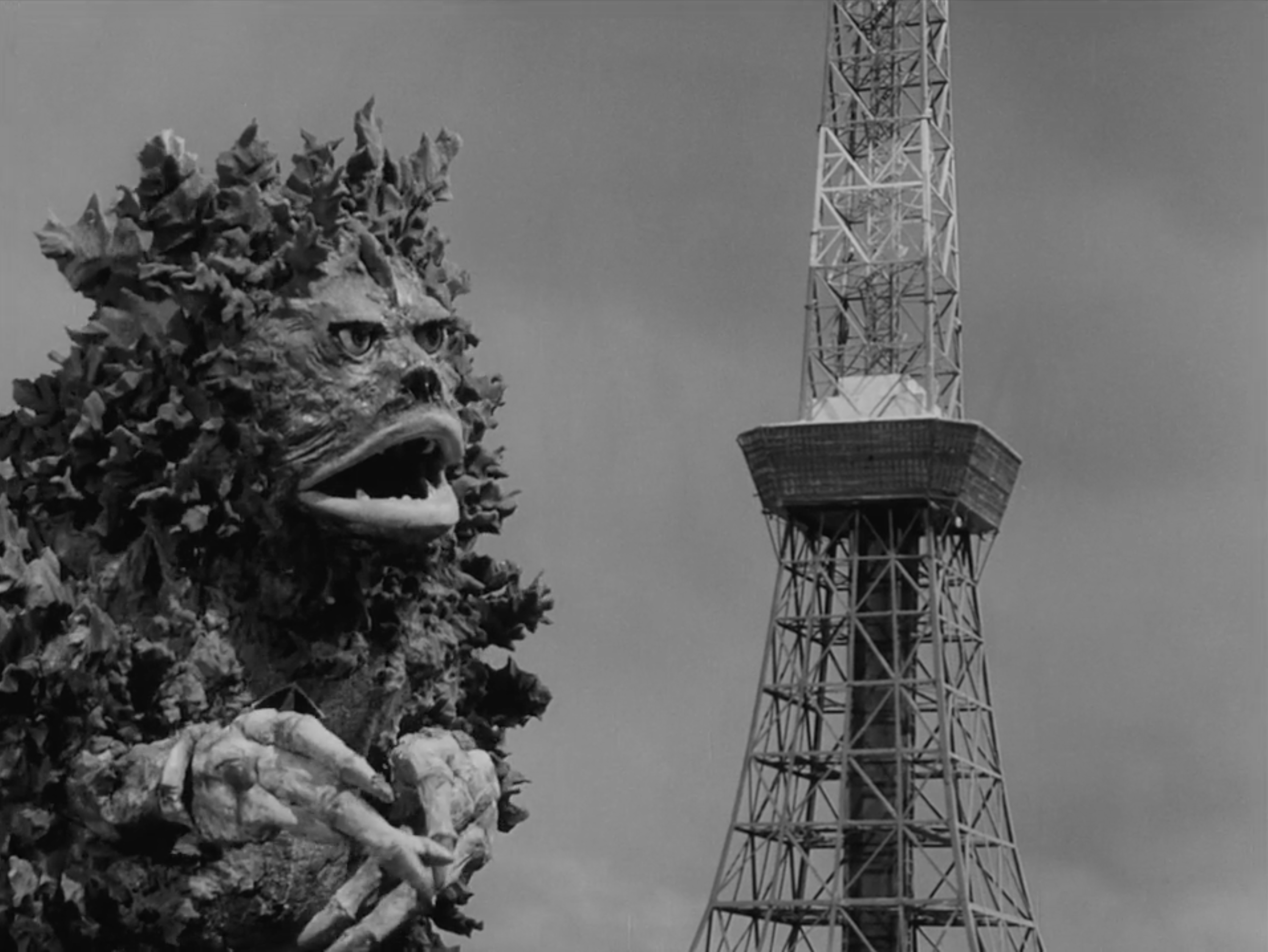
At this point in the timeline of the Ultra universe, the people of Tokyo have got to be fairly terrified, right? In the past few months, their city has almost been destroyed by 1) a humongous alien floating blob that nearly drained all of Tokyo’s energy; 2) a giant penguin-walrus thingy that brought along its own Ice Age; and now 3) multiple alien constructs half the size of Tokyo Tower that look like frazzled Pokémon characters with skeletal hands and legs.
Oh, you poor Edokko,1 you have no idea what’s coming. There are eight more full shows of this monster-and-alien mayhem ahead (in this Ultra universe at least), and much of it will occur in your downtown.
Anyway, it’s sequel episode time, following up “Garadama,” and thankfully giving viewers a feeling of a more complete story. That first episode fell flat at the conclusion because it seemed like not much was resolved: a cliffhanger, but without the conclusion coming next week. “Garamon Strikes Back” has a resolution that’s bigger and goes places with interesting implications for the franchise — even if nobody making the show at the time knew there was a franchise brewing.
With the setup work already completed in “Garadama,” the action starts immediately: a mysterious man in black (Michio Gan) steals the Tilsonite stone used to control the giant alien constructs known as Garamons. As meteorites start to fall on Earth to unleash multiple Garamons in a full-fledged invasion — with four aimed at Tokyo alone — the mystery man attempts to elude capture while using the control stone to orchestrate the mayhem.
The action with the Garamons is pretty fun. They look oddly cute as they bungle around Tokyo and sometimes bop themselves on the head with falling buildings, like Tokyo Tower. But even though we see some spectacular urban destruction, the episode isn’t centered on the Garamons and their rampage. Tetsuo Kinjo’s script focuses the tension on chasing the mystery man, who, of course, turns out to be a member of the alien species responsible for the Garamon attacks in the first place. Our main trio leads the chase along with guest star Akihiko Hirata, who plays the chief of the radio wave office that first detected the alien’s control signals. This is Hirata’s first Ultra show appearance. It’s always great to see the most famous acting icon of the Godzilla franchise, Dr. Serizawa himself, swing by.
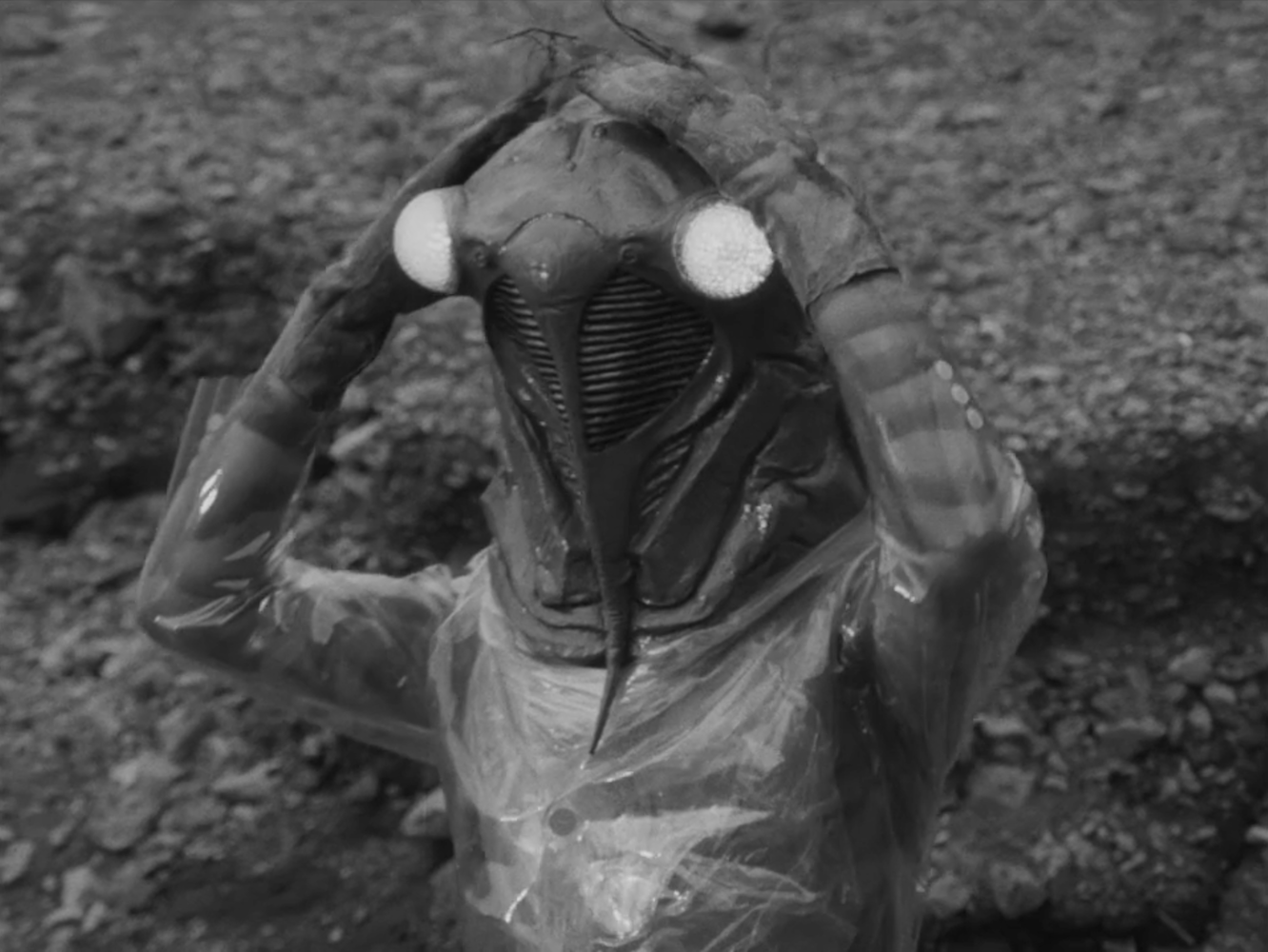
As with “Garadama,” the defeat of the Garamons arrives as a bit of an anticlimax. This isn’t a problem, however, because stopping the kaiju is only the build-up. The real climax involves the reveal of the first intelligent alien (seijin) in an Ultra show: Cicada Man. Earlier episodes hinted at the existence of hostile intelligent extraterrestrials, but now we actually have one on screen.
This is a significant milestone, and not just for the creature design department. It closes the episode with the ominous sense that the alien terror has only started. “Gift From Space” had a similar theme, but now the alien menace has a face, voice, and personality. The invaders are already on Earth, and they aren’t done with us. This seems like a direct lead-in to Ultraman — Earth is going to need a set of defenders against intelligent alien threats. A line has been crossed: aliens have revealed themselves and their schemes.
“Garamon Strikes Back” was one of the last episodes of Ultra Q produced, and TBS should’ve saved it for the series finale. But the ratings for “Garadama” were the highest yet for the show, and the network wanted to grab viewers with the sequel while interest was still hot. If I were to create a personal order to watch Ultra Q episodes, this is the episode I’d pick for last.
The Cicada Man outfit will be used to make the Alien Baltan costume in Ultraman, leading to a fan theory that these two species may be related. I know it wasn’t planned this way, but I like to think that the Cicada Men are a set-up for the first aliens to appear in the next show — it fits the sense that the Ultra universe is about to crack wide open into something cosmic.
Rating: Great
Previous: Kanegon’s Cocoon
Next: The ⅛ Project
- Edokko means natives of Tokyo. The term was already used in “The Underground Super Express Goes West,” so I felt like bringing it up. Edo is the former name of Tokyo before it became the Imperial Capital in 1868. ↩︎
 The Ultra Project