
Directed by Akio Jissoji. Written by Mamoru Sasaki. Airdate Oct. 16, 1966.
And now, the first regular Ultra show episode directed by Akio Jissoji. I’ve already looked at Jissoji’s style in one of his best episodes, Ultraseven’s “The Marked Town,” but I didn’t spend much time on the man himself. Time to fix that.
Akio Jissoji (1937–2006) has a long history with the Ultra franchise, starting with writing two unproduced scripts for Ultra Q and directing the quickie Ultraman promo “The Birth of Ultraman,” which Jissoji asked not be credited for. Jissoji’s original background was studying French literature, and when he started directing shows for TBS, he brought his love of French cinema to his approach — something that seems ridiculously obvious once you learn about it. TBS wasn’t enamored of his quirkiness, so they shipped him to Tsuburaya Productions to see if they knew what to do with him. They certainly did.
Jissoji’s unique visual style and his interest in dream-like storytelling with elements of stage productions were a perfect fit for the world of Ultra, which embraced weirdness in a way I doubt anyone at TBS expected. Like Brian De Palma, Jissoji rarely shot anything the “normal” way, opting for unusual angles, switches between extreme close-ups and distant shots, unrealistic but atmospheric lighting, and soft diffusion that creates halo effects. Other Ultra directors noticed Jissoji’s style and adopted elements of it until they became part of the visual language of the series.
Jissoji’s visual style complemented his odd storytelling approach that bent the nature of reality. This became more pronounced in his later episodes, where his style became so odd it turned off some viewers as too obtuse. (I am not one of those viewers, by the way.)
Jissoji directed episodes across the span of Ultraman, Ultraseven, Ultra Q the Movie, Ultraman Tiga, Ultraman Dyna, Ultra Q: Dark Fantasy, and Ultraman Max. He also worked on several other Tsuburaya shows. He left tokusatsu for many years, directing several erotically themed New Wave films for the Art Theatre Guild (ATG), before he returned to Tsuburaya Pro to direct Heisei Era Ultra shows.
“The Pearl Defense Directive” isn’t one of Jissoji’s great outings, but it’s a fun and funny episode that shows his slanted approach and flair for interesting visuals. It’s a good introduction to his work.
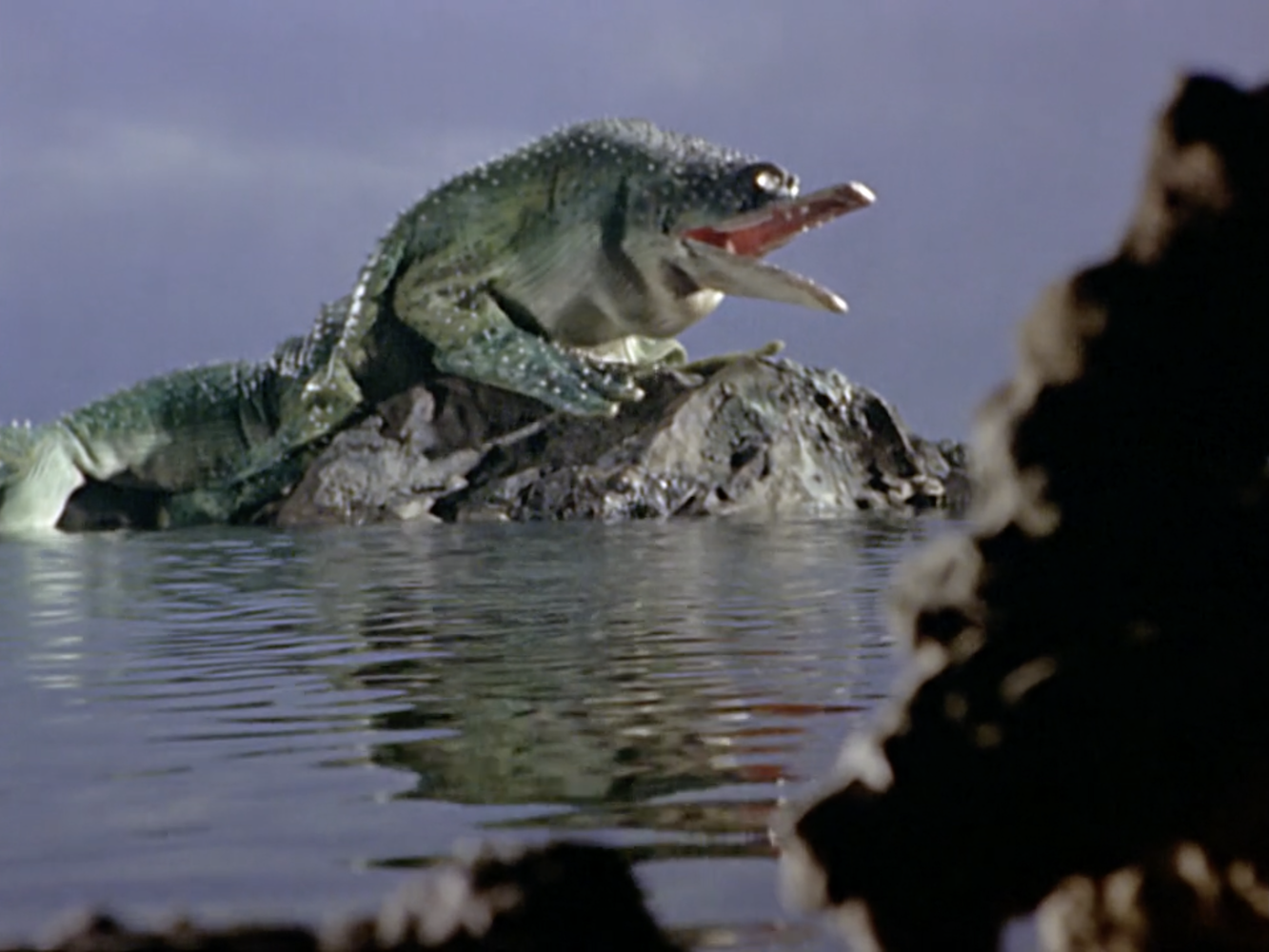
The episode has a by-the-numbers “stop the monster” story where the SSSP tries various methods of destroying the kaiju of the week, the pearl-eating Gamakugira. But it doesn’t feel ordinary thanks to its stylized visuals and character-based humor centered on Akio Fuji. At the very least, it’s a memorable, lesser episode.
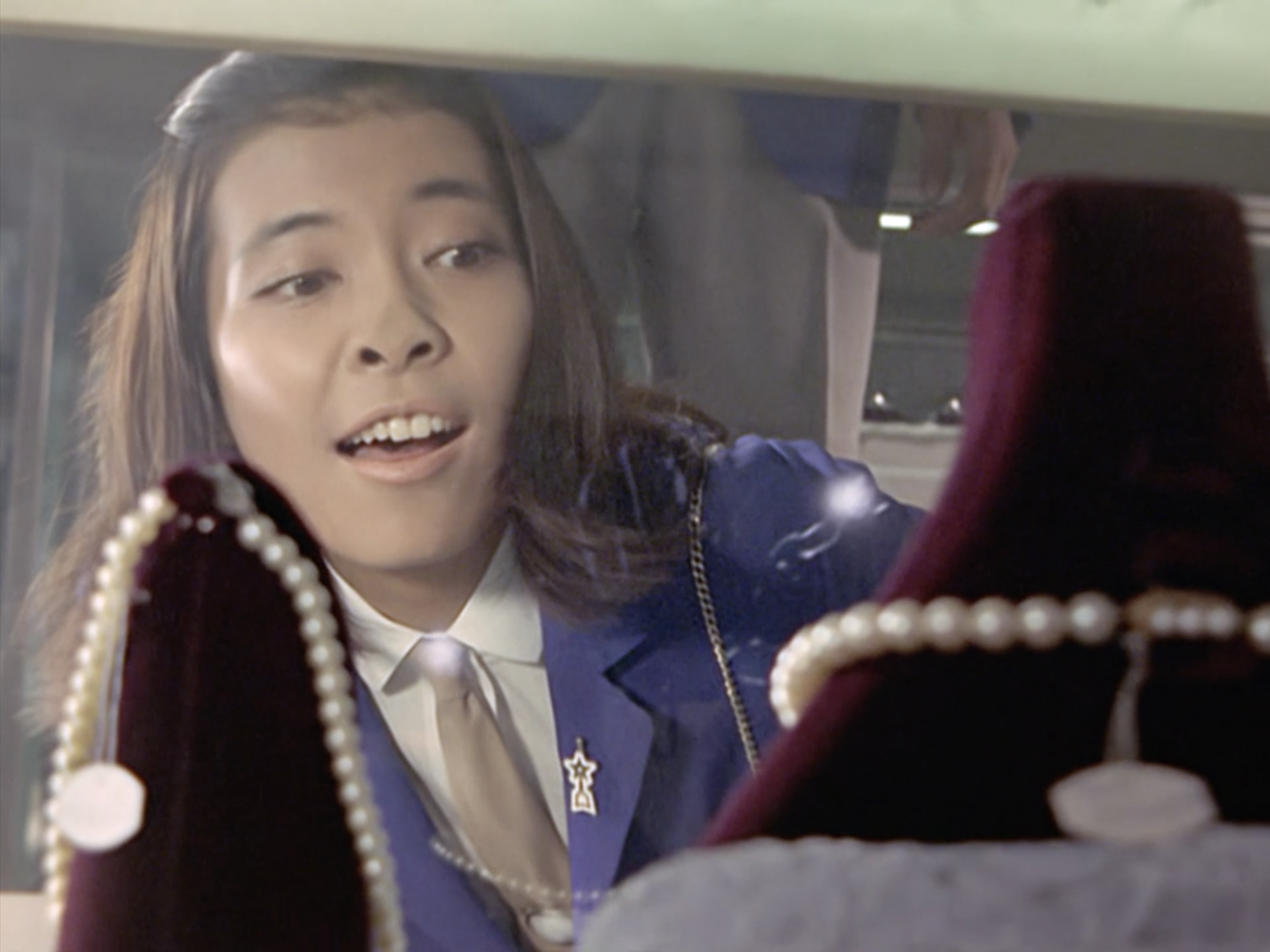
It also looks fantastic, even if it’s not at the extreme end of Jissoji’s idiosyncratic style. The episode has a different appearance from other episodes, with regular locations photographed in unexpected ways. The opening in the Ginza is striking, with characters frequently shot from reflecting surfaces.
Gamakugira is an awkward and goofy-looking creature that lives up to its name, which is a portmanteau of the Japanese words for toad and whale. It slaps around clumsily on land and water and makes noises like a sick sea lion. Appropriately, this “Toad-Whale” gets a comical send-off when it faces Ultraman. (Ultraman, however, has never looked better. This episode debuts the Type-B mask, an improvement over the lumpy first Type-A mask.)
Gamakugira is a low-stakes threat. It’s jeopardizing the luxuries industry by eating pearls from pearl beds. But this is high stakes to someone: Fuji. She’s enraged and personally insulted that Gamakugira is destroying pearls and driving up their cost. She loves pearls, like all women love pearls! Men just don’t understand the rage she feels, the wrath of a woman!
This sounds like standard ‘60s sexism, some of which we’ve already seen on the show. However, I think all this is meant to be ironic. It matches the light tone, and actress Hiroko Sakurai puts the right amount of exaggeration into her performance to sell all of it as a joke. It’s unfortunate that the first episode centered on Fuji plays up that she’s “the girl one” on the team, but Sakurai steps it up and makes it fun. She has a great time with melodramatic deliveries of lines like, “What a waste! Don’t take the glow of pearls from humanity!” and “What a monster! Lusting after the glow of pearls like a lady!”
Fuji doesn’t get the episode’s best line, however. Arashi does: “Oh no! The monster’s begun targeting women’s accessories!” I wonder if this line just comes across as funny in English translation or if it also gets a laugh in Japanese.
For viewers looking for hints of a hovering Fuji/Ide romance, this episode is the pearl motherlode. The coda has glamorous images of Fuji decked in pearls — shot with Jissoji’s trademark soft focus and glittering highlights — while Ide’s voiceover tries to insult her looks. But Ide’s voice is too breathy, too overcompensating, and the images are too lovely … Yeah, Ide-kun, we all know what you really think about Fuji-chan.
Rating: Good
Previous: Oil S.O.S.
Next: Terrifying Cosmic Rays

 The Ultra Project