
Directed by Shigeo Tanaka. Written by Niisan Takahashi.
The second of the Showa Era Gamera films (Daikaiju Ketto: Gamera Tai Barugon, “Giant Monster Duel: Gamera vs. Barugon”) is a case of trying to change course but instead heading in a different wrong direction.
The previous year’s Gamera the Giant Monster was an out-of-date retread of 1950s kaiju films, but it had some interest because of a smattering of bizarre ideas and a child main character. Gamera vs. Barugon adds a monster opponent for Gamera, but drops the child star and instead forges the dullest and most time-consuming human subplot possible. Gamera doesn’t even have much screen time. The filmmakers are all adrift, with no vision of what these movies are supposed to be. It wasn’t until Noriaki Yuasa, who directed the first film, returned to the director’s chair that the series at last found its path of unabashed monster action and kid-centered stories.
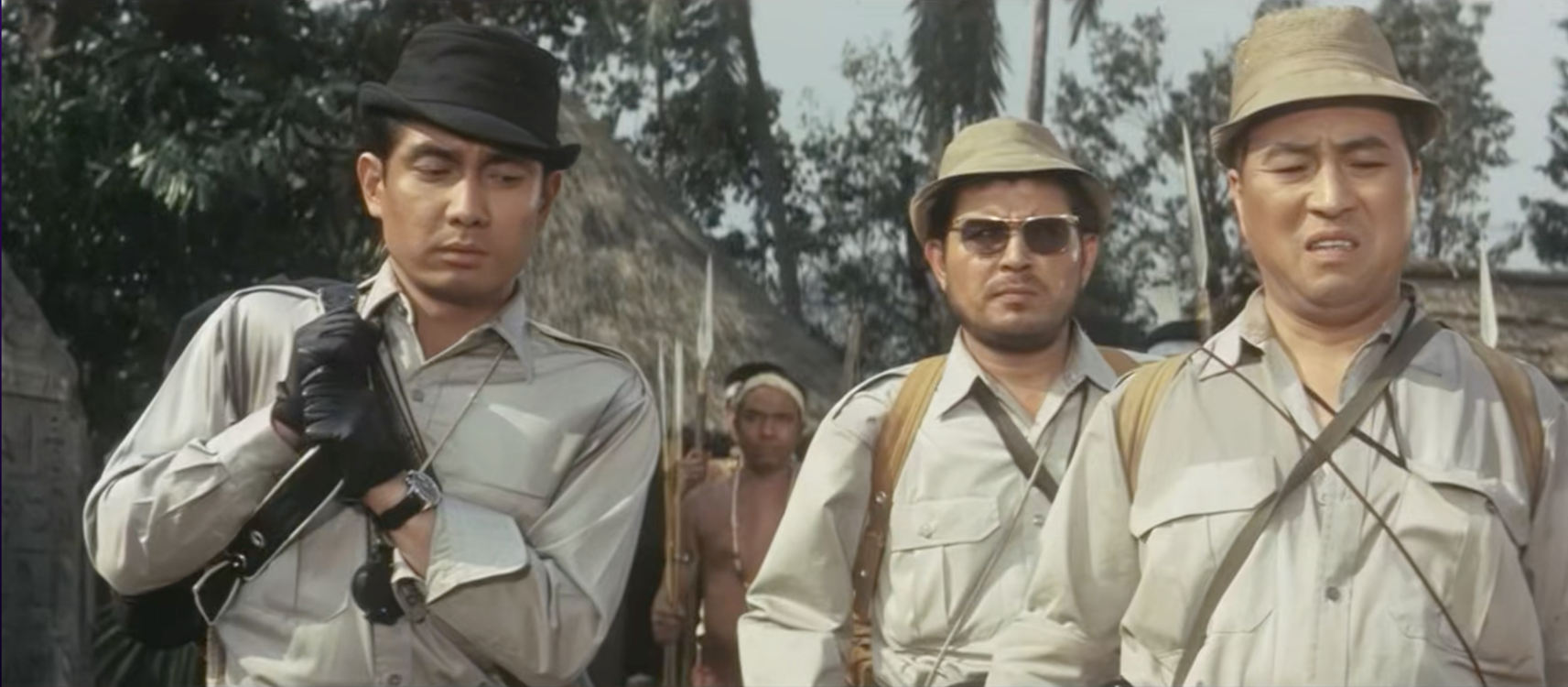
This is a tedious film, lasting 22 minutes longer than Gamera but with far less to fill the time. It’s low on Gamera and high on filler about four crooks trying to retrieve an opal from a cave in New Guinea that one of them hid there during the war after he stole it from the natives. The opal turns out to be the egg of the enemy monster, Barugon, although it won’t hatch until 45 minutes into the movie.
The four thieves are an insipid lot, even the devious traitor character. Their scenes have no tension, humor, or personality. The opal plot is a path toward getting Barugon into the movie, and it seems to take forever. The most decent of the opal thieves, Keisuke, becomes the default hero, but he does little more more than stand around and wonder why nothing works at stopping Barugon.
When the monster action finally gets underway, the opal thief gang is still worrying about their stupid scheme. A falling out results in a clumsy fight in an apartment right at the point when everybody should be a bit more concerned about the giant monster loose in the city. There’s another thieves’ fight later, this one extremely violent. It’s the point where the film declares that it isn’t for children. This is the only of the Showa Era Gamera films I suggest parents screen before permitting youngsters to watch it — although most kids will probably fall asleep before anything violent happens.
Gamera appears at the opening, first in blue-tinted stock footage from the first movie and then in an attack on the Kurobe Dam. Clearly, Gamera is still far from being the Friend to All Children of the later movies. Gamera crashes into the dam and destroys it — an impressively detailed piece of model work — and flies off to a volcano below the equator to search for more food. The movie then forgets about the title character for a long time.
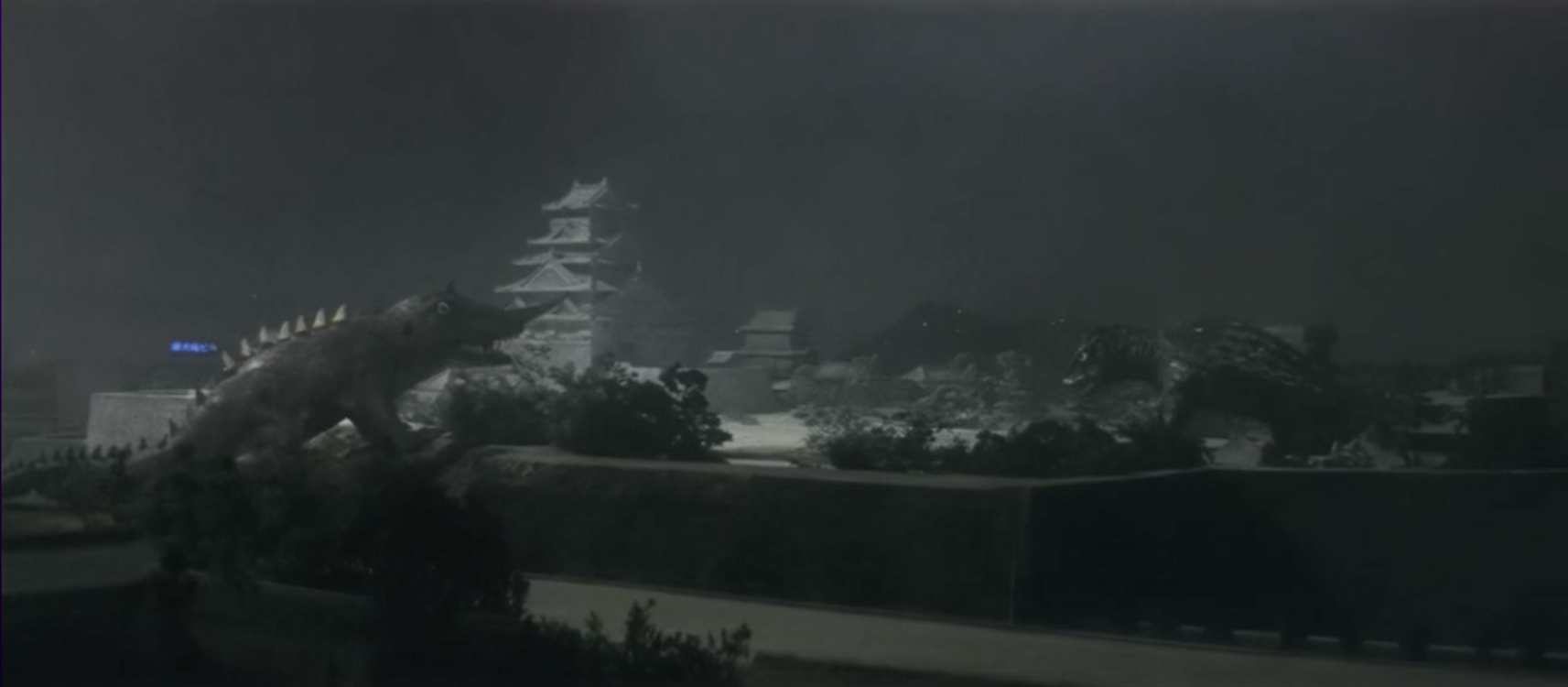
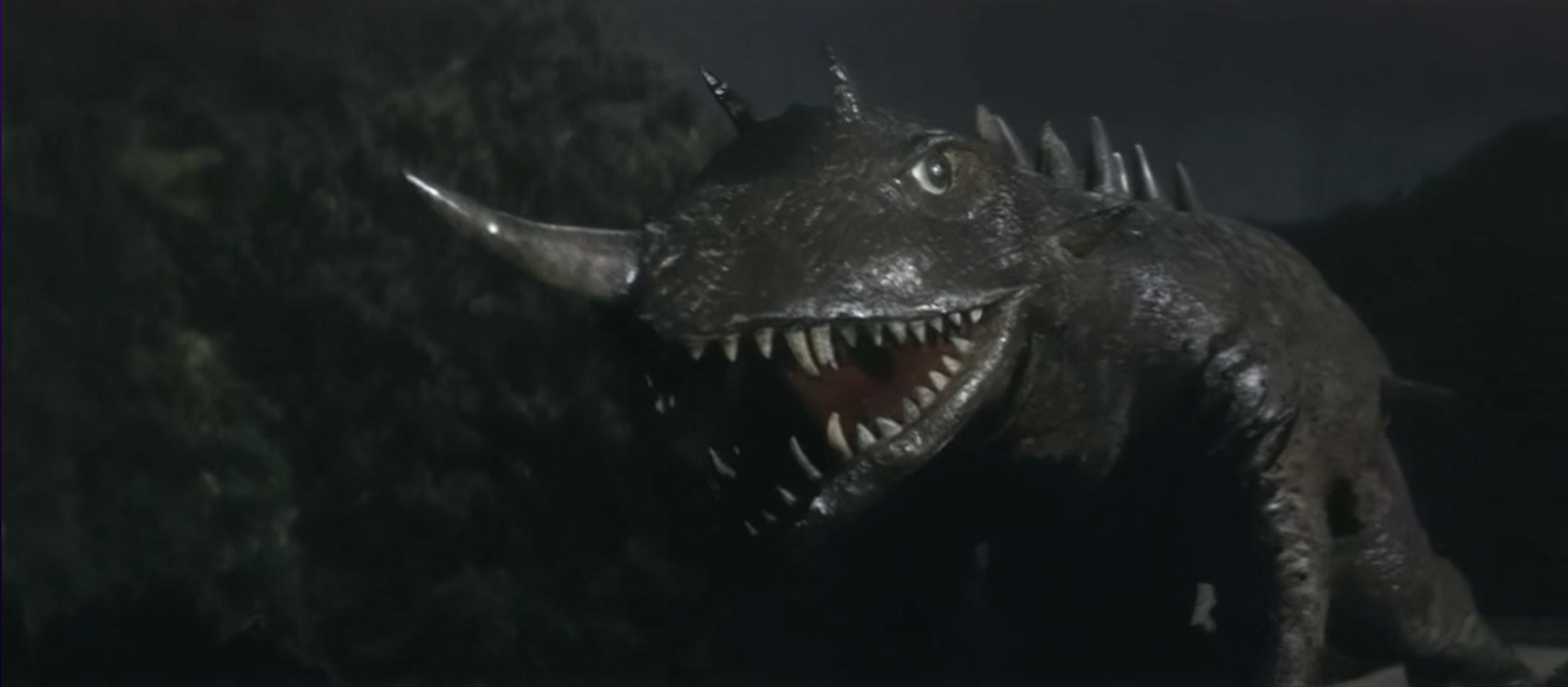
Main monster Barugon — Gamera is only the supporting monster — is the baseline of “strange” for this series. A quadruped reptilian thingamajig with a rhino horn and a sort of friendly puppy look, Barguon is equipped with a ram-action tongue and a cold blast that makes for some good effects work of castles, tanks, and planes freezing. There’s one shot of a plane frozen in flight that then breaks apart into chunks, which is more interesting than any of the effects in Gamera the Giant Monster. Barugon has a second special attack: a rainbow-ray shot from its back that can vaporize anything, producing nice optical visuals. We can give Yuasa the credit for this. He isn’t the director, but he’s still the head of visual effects.
Gamera finally returns to action, 52 minutes into the film, for the flimsiest reason: Barugon’s rainbow ray draws the spinning turtle to Osaka to investigate. This is the point where the film should at last pick up and feed off the promise of the Barugon attack scenes. Alas, it is not to be.
Gamera vs. Barugon establishes the kaiju fight pattern for the remainder of the series: Gamera and Guest Kaiju have a mid-movie confrontation where Guest Kaiju incapacitates Gamera with a special attack. The Guest Monster rampages on its own for a spell, Gamera recovers, outwits whatever weapon Guest Monster used, and is victorious. The difference with this film is that the audience doesn’t know which monster to root for: Gamera isn’t established as heroic, and there’s no little kid doing a rah-rah routine in support of the giant turtle. Even if audiences did want to root for Gamera, the fight scenes have bland and slow blocking that drains them of any excitement.
Once Barugon puts Gamera on ice, the movie turns into a picture that might as well be titled just Barugon. Viewers endure standard scenes of scientists and military men trying to devise a way to kill or stop the monster, failing each time. The tactics used against Barugon are boring and involve either luring the monster slowly toward water or making it stop because of rain. Not only does Gamera do nothing during this stretch, nobody even gives a thought to the immobilized turtle. At least in later movies during Gamera’s time trapped in the penalty box, some kids would pay attention and try to revive the monster.
When Gamera at last returns for the final showdown, the battle is over quickly and ends an unsatisfying film on an unsatisfying note. None of the characters even has anything to say about Gamera saving the day. The whole movie is a glum affair with a few splashes of good effects here and there. So thank you to Noriaki Yusasa for putting in the effort. No surprise that Daiei gave him back the directing reins for the next movie.
Gamera vs. Barugon went direct to TV in the United States via American International Pictures, who would also distribute the next four movies to television. AIP titled the movie War of the Monsters. When Sandy Frank purchased the rights to the movie and gave it yet another rotten dub, the film went to its now standard title of Gamera vs. Barugon. I’d recommend only watching the riffed MST3K version, although even that is the least interesting of those episodes.
Rating: Poor
Previous: Gamera the Giant Monster
Next: Gamera vs. Gyaos
 The Ultra Project