
Directed by Shingo Matsubara. Written by Masakazu Migita. Airdate Sep. 7, 1996.
The first episode of an Ultra show has a heavy burden. It must establish the global situation, introduce a new defense team, merge the human hero with the Ultra Warrior, and then have enough time left over to celebrate with the action goodies. “Inheritance of Light” is one the best premiere episodes thanks to its efficiency, action, and visual effects that get the job done. It’s an impressive start, especially considering how fast the show had to come together. For viewers who may not have tuned into an Ultra show since the 1970s, Ultrman Tiga’s first episode was a reminder of why they loved Ultraman in the first place.
The episode wastes no time. The narrator explains the background in the opening minutes: In the 21st century, Earth is moving toward the peaceful paradise of the Star Trek universe. The Terrestrial Peace Consortium (TPC) protects humanity from strange phenomena, though it’s not specified what kind of trouble has been happening. (Keep in mind this isn’t a sequel to any previous show.) The seven-member Global Unlimited Task Squad (GUTS) handles the special paranormal missions.
Before the narrator can catch his breath, a giant monster named Golza appears in Mongolia. Then a second monster, Melba, appears on Easter Island. A time capsule in a meteorite delivers GUTS a message — Princess Leia hologram-style — from humanity’s ancient ancestors. The AI in the time capsule explains that a time of great catastrophe is at hand. To defeat these two monsters and the threats to come in the future, Earth’s guardian, the Giant of Tiga, must be awakened.
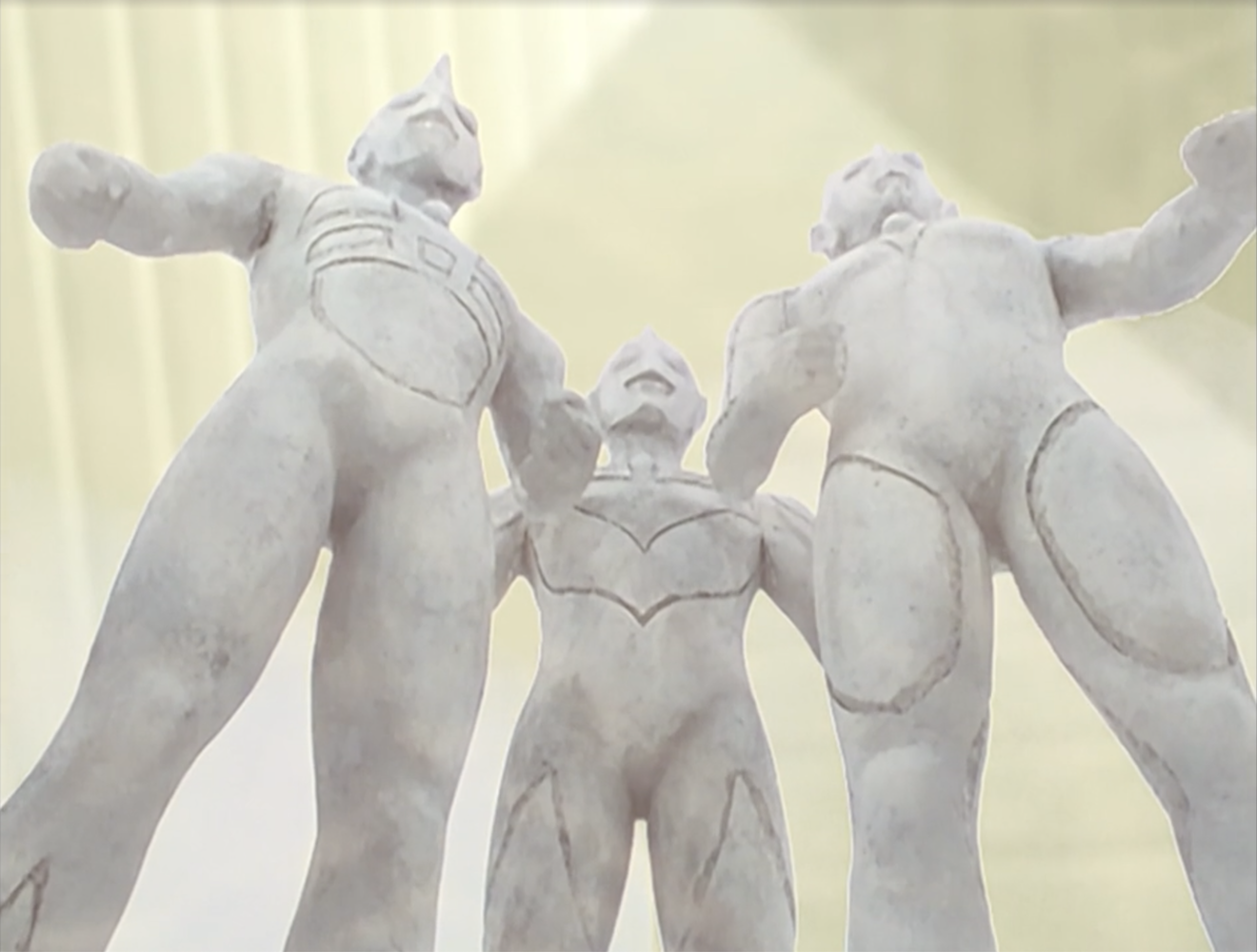
And that is just what GUTS sets out to do. Member Daigo Madoka receives the power of Ultraman Tiga from its statue in a pyramid in Japan. (A pyramid apparently nobody bothered to investigate before, but we need to get this going.) The newly revived Tiga faces the tag team of Golza and Melba, and a good ol’ tussle ensues. Daigo returns to his teammates with no one aware he’s Tiga, and we’re ready for more monster-filled episodes ahead.

With seven members of GUTS to introduce, there’s no time to spend on any individual aside from Daigo. But we get a sense of how the team operates and their commitment to each other. Their reaction to Daigo’s apparent death feels genuine, as if we’ve been watching GUTS in action for several episodes. Horii is already showing that he’ll emerge as one of the most memorable of the team. The GUTS members all have their names on the backs of their uniforms, and I want to thank whoever came up with that idea. It makes it much easier to distinguish the characters in the early episodes as you get settled with their personalities. They turn out to be a fun, memorable bunch once they’ve had time to establish themselves.
Golza and Melba are a strong kaiju duo to get the show going. They cover a good spectrum of Ultra designs: Golza is the heavy, stomping kaiju while Melba is the flying kaiju with a streamlined design. Golza has joined the ranks of classic Ultra monsters and would reappear in Ultraman Tiga as Fire Golza in ep. 18, “Golza Strikes Back!” as well as many future series. The monsters show promise for the designs ahead in the Heisei Era.
The final fight with Golza and Melba is an exciting one that gives Tiga a chance to show his specific fighting style and abilities. We don’t have too many annoying digital effects yet; most of the action with the GUTS Wings is done with competent model work.
Ultraman Tiga is a monster-of-the-week show, but it does allow for more overarching developments than the Showa Era shows. This removes some of the strain of trying to explain everything in the first episode. Tiga uses his three different battle modes, but there’s no discussion of this ability yet. That can wait until the next episode. The same applies to the mysterious shaman Yuzare (Minako Osanai), who delivers the holographic AI message from 30 million years ago. We’ll learn more about her later. The script explains just enough to engage viewers without frustrating them.
Thus starts the “official” Heisei Era of Ultraman, since nobody really counts Ultraman Zearth or the foreign-produced shows. Ultraman Tiga already knows how to show us a good time.
Rating: Great
Previous: Ultraman Tiga: An Introduction
Next: Legend of the Stone

 The Ultra Project