
Directed by Kazuho Mitsuta. Written by Tetsuo Kinjo and Masahiro Yamada. Airdate Oct. 22, 1967.
For the second episode in a row, Dan loses the Ultra Eye he needs to transform into Ultraseven. To lose one Ultra Eye may be regarded as a misfortune, to lose two looks like carelessness. And it’s going to happen a few more times.
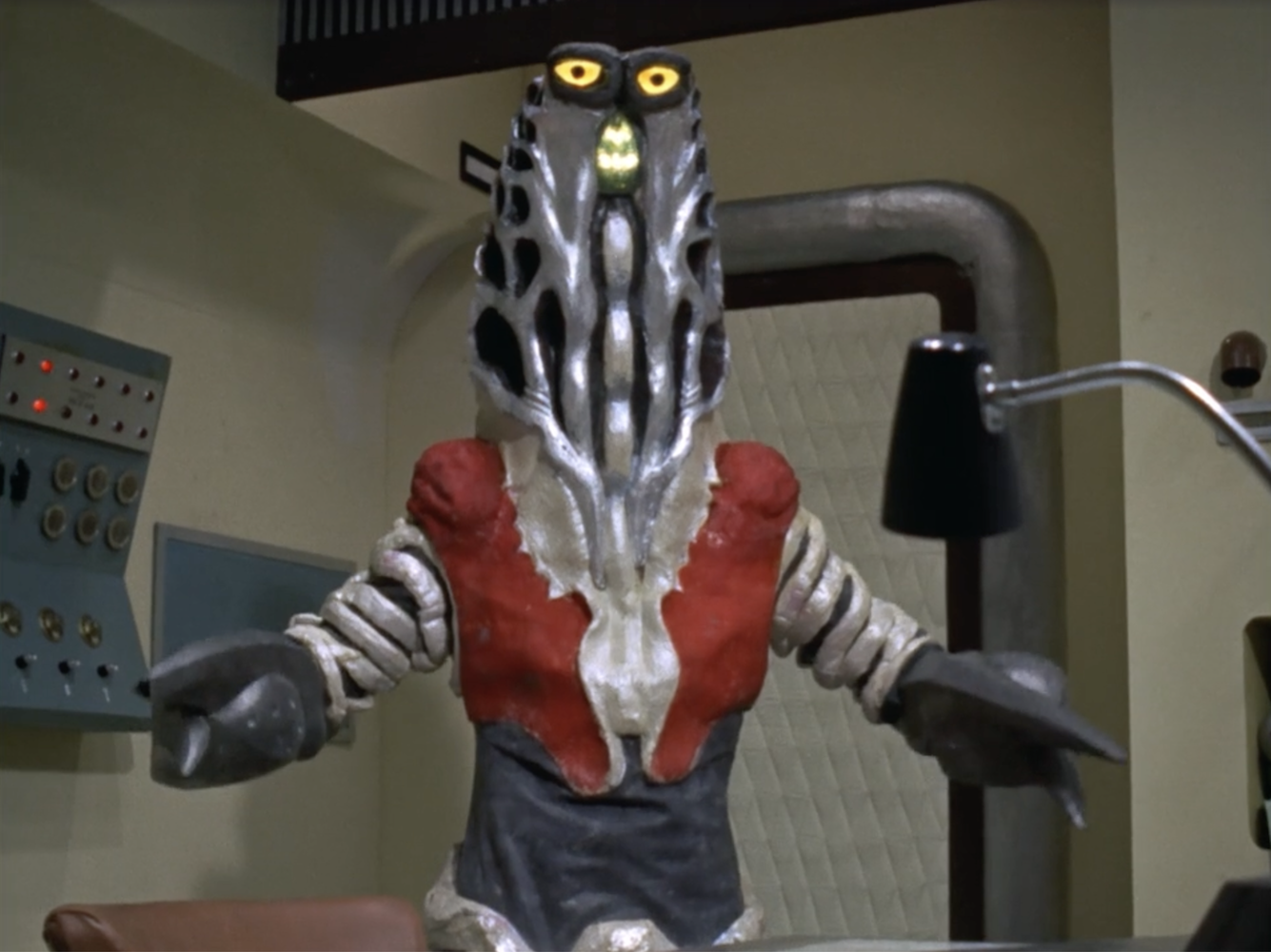
Stealing the Ultra Eye is part of the plot of the invaders of the week, Alien Godola, to destroy Earth’s defenses. Their big move is kidnapping the TDF’s new nuclear-powered battleship, the NS Max, by floating it up into space, with Soga, Amagi, and Staff Officer Takenaka (Kenji Sahara) trapped aboard. The plan is to use the Max emergency as a distraction, tricking the TDF into concentrating its forces in one area. Alien Godola can then infiltrate the defense force headquarters in human disguise and explode it. If this sounds familiar, it’s because Alien Pitts tried the same plan in the last episode — except they used a giant monster as their big opener rather than a stolen ship. Alien Godola is cleverer with its impersonation tactics, however.
Aliens again stealing the Ultra Eye feels like the writers were attempting to figure out how to handle the direction of the new show. They wanted to limit Seven’s screen time so episodes wouldn’t always center on monster fights and Seven couldn’t rapidly solve a tricky scenario. The writers soon discovered it wasn’t necessary to artificially restrict Seven’s appearances: stories developed a natural flow that focused on the Ultra Guard in action, unusual alien races, and creative story ideas. Once the writers got more confident with their available storytelling tools, Dan’s transformations slotted easily into the finales.
Awkward repetitive plot device aside, “Max, Respond!” is a fun action-filled half hour, with some big-scale space adventure set-pieces. The situation around Max trapped in space heightens the stakes early, and Alien Godola keeps several schemes going to force a variety of counter-actions from the Ultra Guard and, eventually, Ultraseven. There are several good character moments, such as Anne making her first overt romantic motion toward Dan when she gives him a gift of a pendant. Kenji Sahara has a significant part as Takenaka, essentially playing the protagonist of the first half. Sahara carries himself with movie-star confidence that elevates all his scenes. He’s an Ultra Show Pro by now. He even gets his own musical introduction when he first appears: the “sting” sound from the opening title music of Ultra Q.
Seven appears for longer than usual, and most of the time he remains at human size and engages in different types of action-hero activities. The actual kaiju showdown is disappointing (brief and set in a boring open field), but elsewhere Seven proves his superhero skills are solid even when he’s not 15 stories tall.
Alien Godola has an eye-catching design and some of the mocking energy of Alien Baltan, so it’s surprising the race didn’t come back as recurring foes. They use interesting deception tactics against the Ultra Guard, disguising themselves as Furuhasi and Dan in order to infiltrate the base. Alien Godola can also look like a beautiful woman (Ryuko Mizukami), which is how Dan gets suckered into having the Ultra Eye snatched from him in the first place. Like Alien Pitts in “Secret of the Lake,” Alien Godola figured out that 1960s television gender roles are effective weapons against male Earthlings.
This marks the first appearance of a secondary musical theme, “ULTRA SEVEN,” which often plays under scenes of the Ultra Guard in transit. It’s a smooth pop-jazz number and a nice alternative sound to the show’s big orchestral music.
Rating: Good
Previous: Secret of the Lake
Next: Vanished Time

 The Ultra Project