
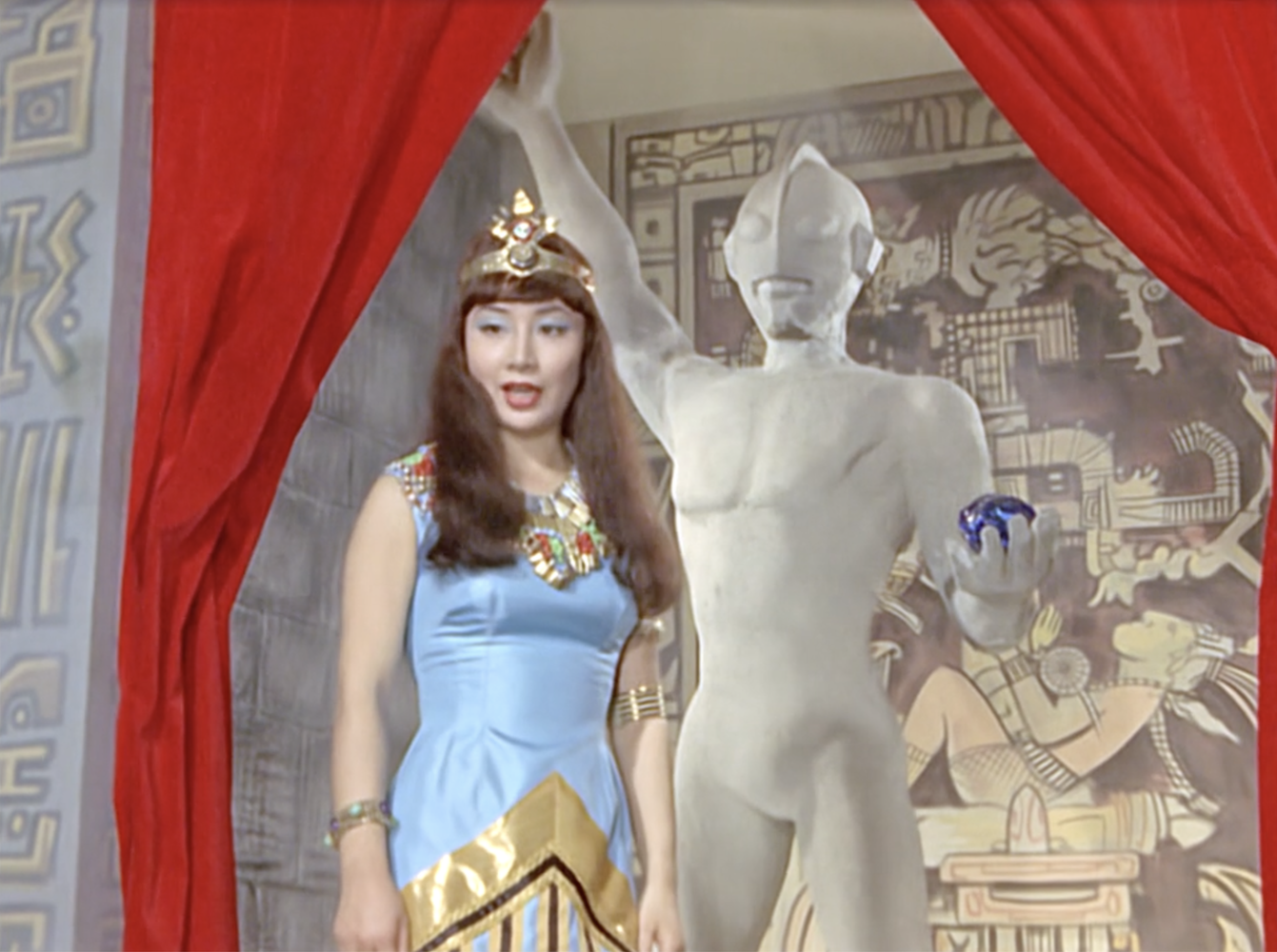
Directed by Samaji Nonagase. Written by Tetsuo Kinjo and Samaji Nonagase. Airdate August 28, 1966.
We pop out of the slump of middling episodes with a mini-epic that sends the Science Patrol to a lost city in the Middle East and expands upon the mythos of the Ultras. The mixture of 1930s pulp adventure and giant monster movie makes for a stand-out half hour. I also just enjoy it when an Ultra show sends its defense team outside of Japan to soak up some different backdrops.
The international expedition gives us a broader view of the SSSP as a global organization. We mostly see the Far East Branch in Japan in action, but the Science Patrol’s main headquarters are in Paris. It’s the Paris HQ that gets the story moving when they approach the Far East Branch to ask for assistance. Two other SSSP teams from different branches have vanished in the Middle East while tracking down a recent meteorite fall. What’s going on, and does it have a connection to the meteorite? The Japanese SSSP team is on the case!
One tiny irritation: when the Science Patrol jets off, Fuji gets left at home to babysit the base to make room for the guest star, Jim (Edgar Kaiser). Yes, thrilling Jim! Some guy from SSSP headquarters in Paris. A caucasian guy forces Fuji, a sparkling member of the Science Patrol’s lineup, to sit out most of the episode. Jim ends up useless: his only contributions are failing to communicate with some natives and adding some international variety to the Science Patrol. Grounding Fuji was a mistake and feels a bit chauvinistic. Get Hoshino to watch the base. He’s a capable kid and it would make his week!
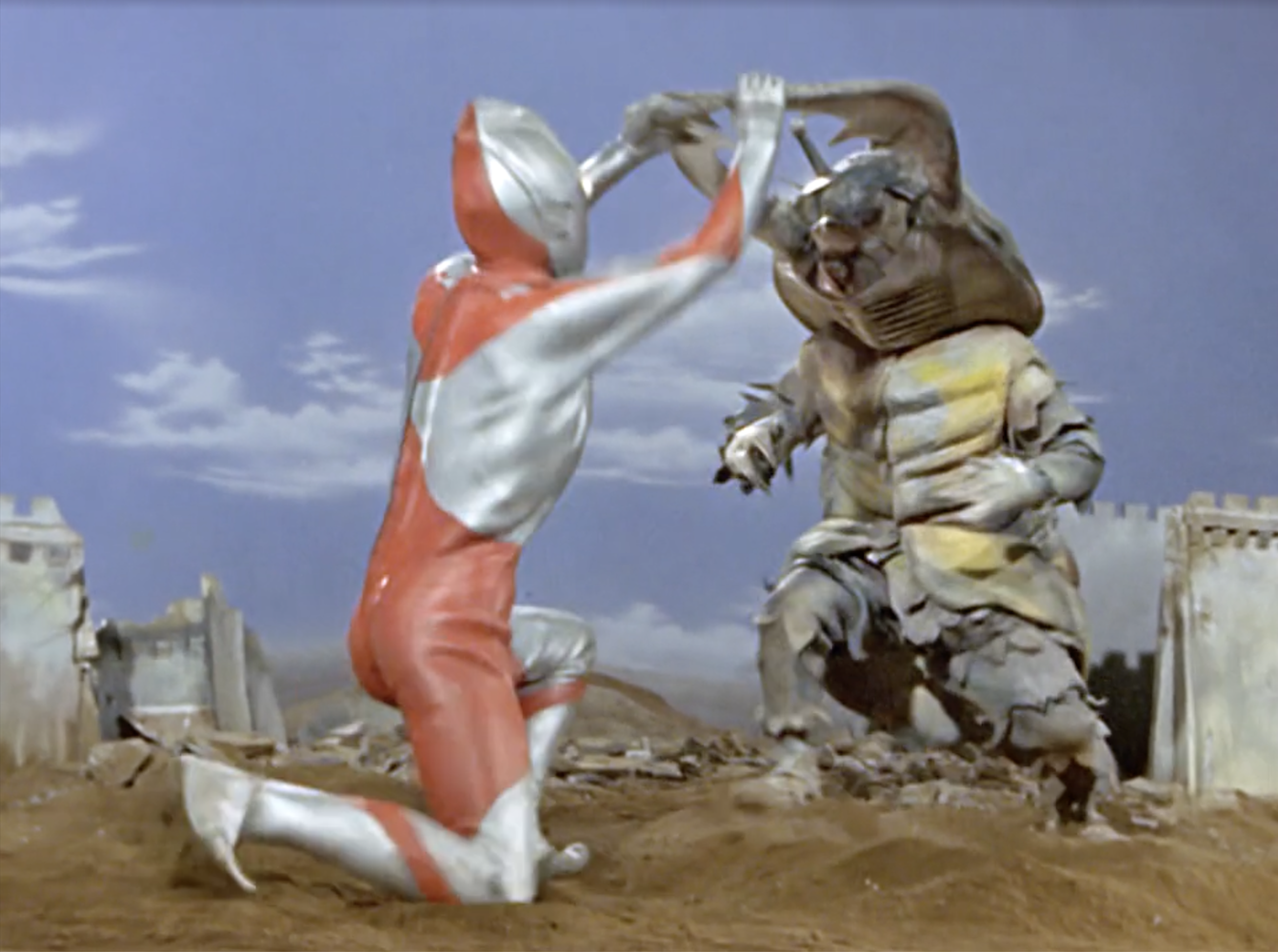
The destination for the SSSP is a “mystery site” in the Middle East, within sight of Mount Ararat, placing it somewhere in Eastern Turkey, Northern Iran, or Armenia. Ararat is often identified with the location where Noah’s Ark came to rest in the Genesis account — and its appearance here has purpose. The Science Patrol discovers the lost city of Baradhi near the meteorite impact location, and its inhabitants worship a statue of an Ultra Warrior they call “Noa.” Noa’s blue stone has protected the city for centuries from the monster beetle Antlar that hides in the sands outside Baradhi. Antlar’s magnetic beam was responsible for downing the other SSSP expeditions.
We can read plenty into the brief amount of mythology put into the script. It seems an Ultra, possibly more than one, came to Earth in the distant past with the goal of protecting humans. Perhaps the Ultra Warriors have a long history of fighting for justice across the universe.
But who is “Noa”? Is he the Ultraman now on Earth? Have other Ultras who came to Earth inspired a range of legends and religions? The episode leaves the details ambiguous, although an Ultra named Ultraman Noa would appear much later in the franchise, presented as one of the oldest of the Ultra Warriors. But since Noa debuted in Ultraman Nexus, which is unconnected to any other show, there’s no reason to assume the Noa of the Baradhi legend is the same. On the other hand, Ultraman Noa was active in the multiverse…
Ah, I’m getting into the continuity weeds decades down the line. None of this applied at the time the show aired. This intriguing glimpse at a greater Ultra universe works with the mythic and fantasy aspects of the episode and makes promises for what viewers can expect to see later.
Ultra shows often pack in more ideas than a half-hour running time can easily accommodate. This doesn’t have to be a major flaw, and the writers manage the deft sleight of hand to streamline all the elements by letting viewers imagine the larger story. The telepathic abilities of Baradhi’s queen, why Antlar is suddenly able to overcome the blue stone and attack the city, and the purpose of the meteorite are left unaddressed. The pulpy vagueness of a hidden city like Baradhi creates a fantasy feel that makes it easy to skim over these gaps.
Along with the pulp adventure milieu, this episode has a classic Star Trek aura. The Science Patrol crashes their ship near a strange civilization where the residents have special powers and a history with unusual parallels to Earth’s own. Plenty of Trek episodes follow similar outlines. The original Star Trek wouldn’t begin its television run for another two weeks, so we can call this a parallel development in late-‘60s science-fiction TV.
(I wish Jim had gotten the “Red Shirt” treatment, but the SSSP doesn’t have red shirts. They’re a smaller operation.)
Except for Fuji getting shoved aside, everything in the episode works. It’s an exciting adventure with high production values (the sets and matte paintings for Baradhi look great), a strong monster fight climax, a few funny lines for Ide, and the right amount of enigmatic details for fans to chew on.
Rating: Great
Previous: The Coast Guard Command
Next: The Monster Anarchy Zone
 The Ultra Project