
Directed by Noriaki Yuasa. Written by Niisan Takahashi.
Now for another movie break, this time for a “classic” of Japanese kaiju cinema. It’s a short hop from Ultra Q’s “Grow Up! Little Turtle,” a tale about a boy and his affection for a giant turtle who takes him to see a princess underwater, to Gamera the Giant Monster, a tale about a boy and his affection for a giant turtle who is causing mass destruction and death.
The original Gamera series from Daiei Studios spanned eight films from 1965 to 1980. It was successful enough with an audience of children for it to cross-infect the Godzilla films that inspired it. All Monsters Attack (1970) was Toho’s copy of the Gamera movies’ low-budget formula of kids, monsters, and stock footage.
Gamera never enjoyed the respect that Godzilla received until the fantastic trilogy of films in the 1990s from director Shusuke Kaneko. The original Showa Era films have a reputation for being cheap and bizarre, although this constitutes a large part of their charm and the reason Mystery Science Theater 3000 had such a great time with them. (MST3K used the Sandy Frank dubs from the mid-1980s, which are among the worst dubs ever for any Japanese film. This boosted their hilarity, and it’s all on Sandy Frank, not the filmmakers.)
The first Gamera film, Gamera the Giant Monster (“Daikaiju Gamera”), is much less strange than its sequels. The filmmakers designed it as a mostly serious monster picture — which is why it’s not much fun.
Gamera the Giant Monster was about twelve years behind the times. In 1965, the kaiju craze was reaching its height in Japan with colorful monster adventures everywhere. But Gamera was shot in black-and-white in a dry documentary style to imitate the 1954 Godzilla. It was a strange approach for Daiei Studios to take to compete with Toho, which was in one of its most vibrant phases with monster-and-alien epics like Invasion of Astro-Monster. I’m uncertain what Daiei was trying to do with this approach except save money.
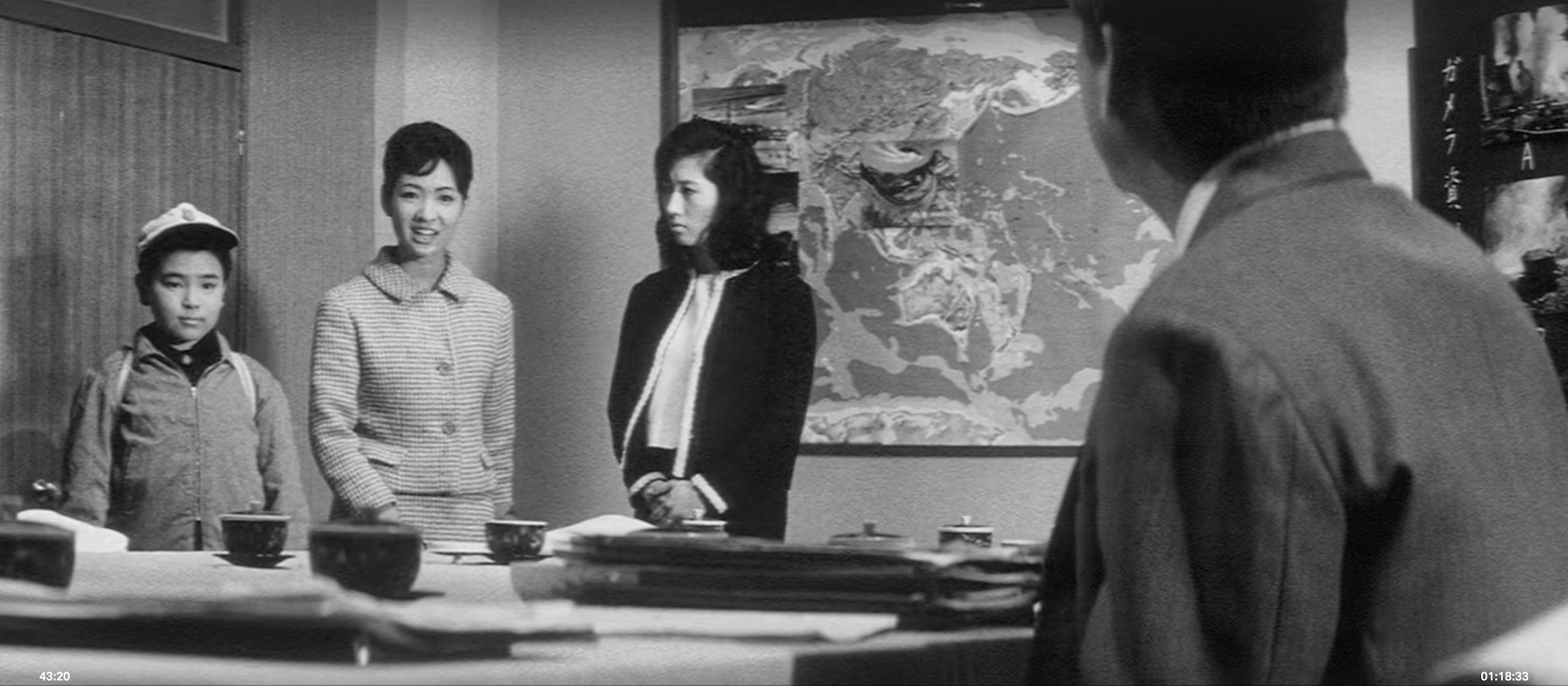
Gamera contains the seeds of the rest of the series because it makes a child one of the principals. But the story of young Toshiro (Yoshiro Uchida) and his adoration for a giant monster demolishing Japan is so incongruous with the rest of the movie that again I have to wonder what Daiei was trying to accomplish. Maybe this is a time-travel scenario: the filmmakers of the later Gamera movies zapped back to 1965 and inserted new footage of a child into the movie to align it with the rest of the series.
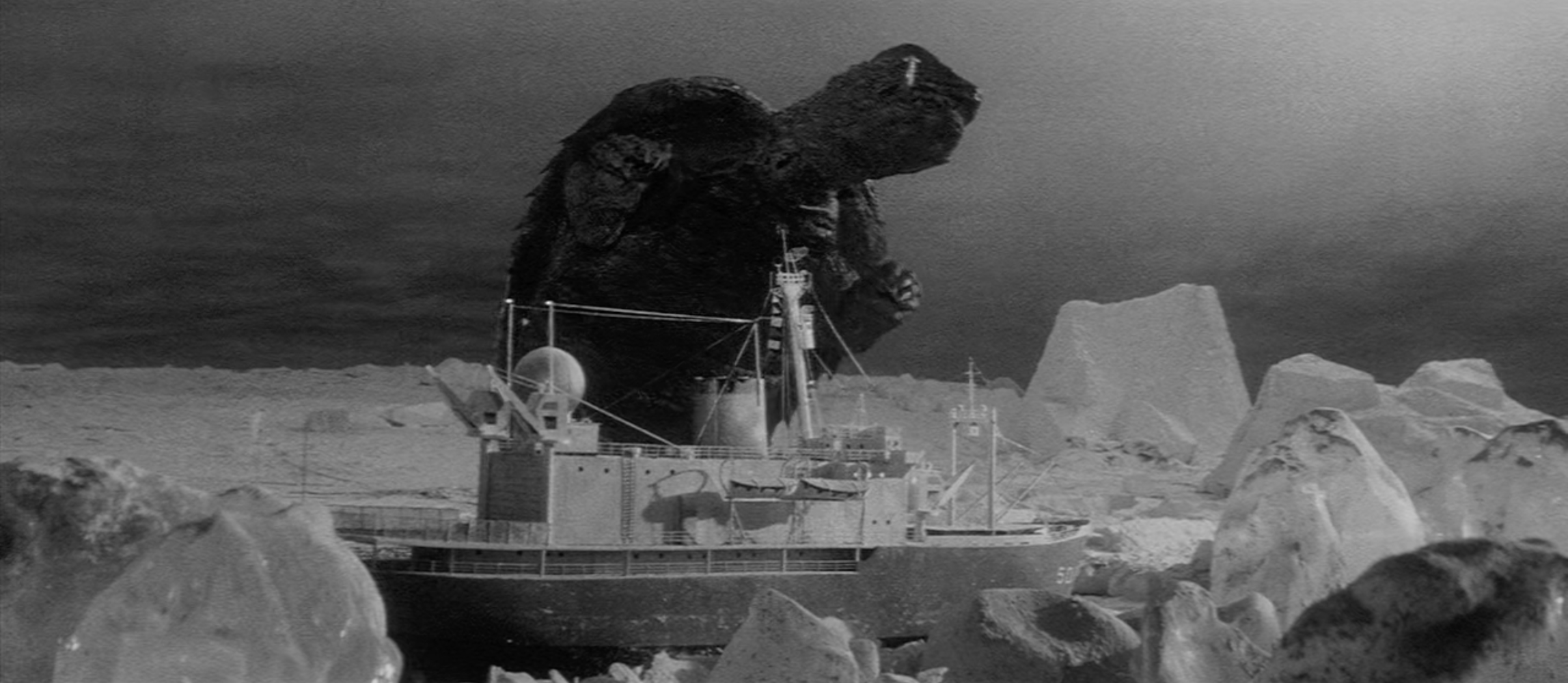
Toshiro’s story aside, Gamera is a routine kaiju movie stuck a decade in the past. A Cold War fracas between the US and an unnamed adversary (go ahead and guess) in the Arctic wakes up a giant turtle from the ancient continent of Atlantis. The monster comes ashore in Japan and begins wrecking things. Scientists and military types try to figure out what to do. After a few unsuccessful attempts to destroy Gamera, they at last defeat the monster by trapping it in a rocket and blasting it out to land on Mars. The final scheme is outrageous, but this is otherwise the formula of 1950s Hollywood science-fiction movies. Toho Studios had already abandoned this formula by the time of Mothra in 1961.
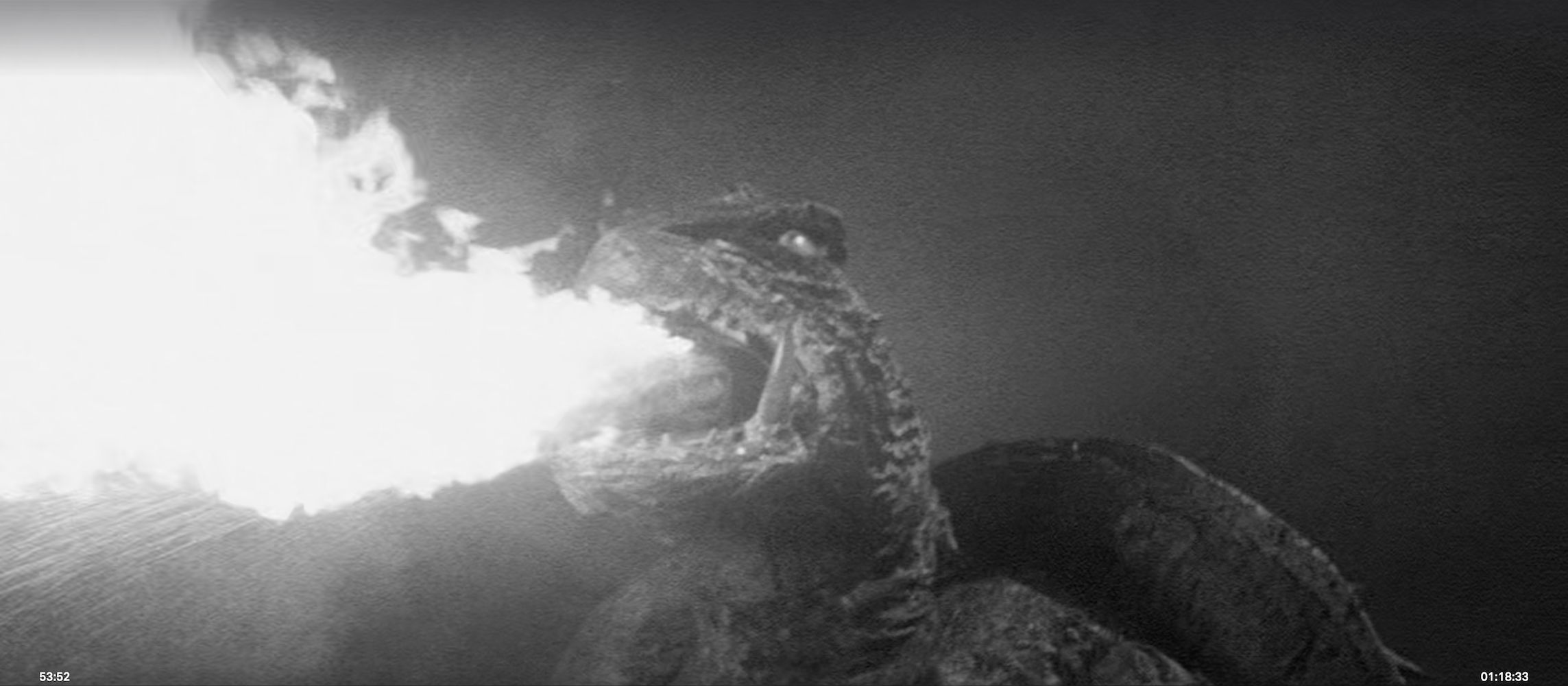
What Gamera does have going for it are brief touches of the bizarre that would blossom in the later movies. Gamera’s ability to fly by pulling in its head and legs and blasting out fire jets to make it spin through the air like a Frisbee is delightfully weird. The “Z Plan” of tricking Gamera into the nose cone of a super rocket is also so daft you have to applaud it. These are the exceptions in a stodgy film that is more akin to Godzilla Raids Again than the original Godzilla. The one influence it picks up from Toho’s later films is the theme of international cooperation.
Regarding our young hero, Toshiro (the notorious “Kenny” of the Sandy Frank dub): his story doesn’t make the least lick o’ sense. Gamera saves his life, catching the boy when he falls from a lighthouse and gently placing him down. This is the only kind action Gamera does during the movie. At no other point does the fire-breathing turtle show benevolence toward or even regard for human beings. Gamera trounces cities like a standard kaiju. This makes Toshiro running around military headquarters and irritating people with his insistence that Gamera is actually a gentle creature feel like sloppy writing from a second screenwriter who didn’t know what the first one was writing.
I can’t offer any better criticism of Toshiro’s scenes than the snubs the MST3K crew lobbed at the film: “Yep, what Gamera’s done today has been a benefit to all, Kenny,” spoken over footage of Gamera leveling a power station. It’s so jarring.
The same way that Joel and the ‘Bots had such a grand time lancing into the film for the Toshiro/Kenny plotline, I enjoy Toshiro’s odd scenes more than the rote ones with Dr. Hidaka, Other Scientist, Boring Reporter (“News Stud”), and Insipid Love Interest. In fairness to Toshi-chan, the character is less grating in his original Japanese performance than the horrendous dub Sandy Frank crammed in his mouth. Yoshiro Uchida is a fine child actor, and I feel for the character considering what a louse he has for a dad. (Come on, what’s his problem with the kid keeping a pet turtle?)
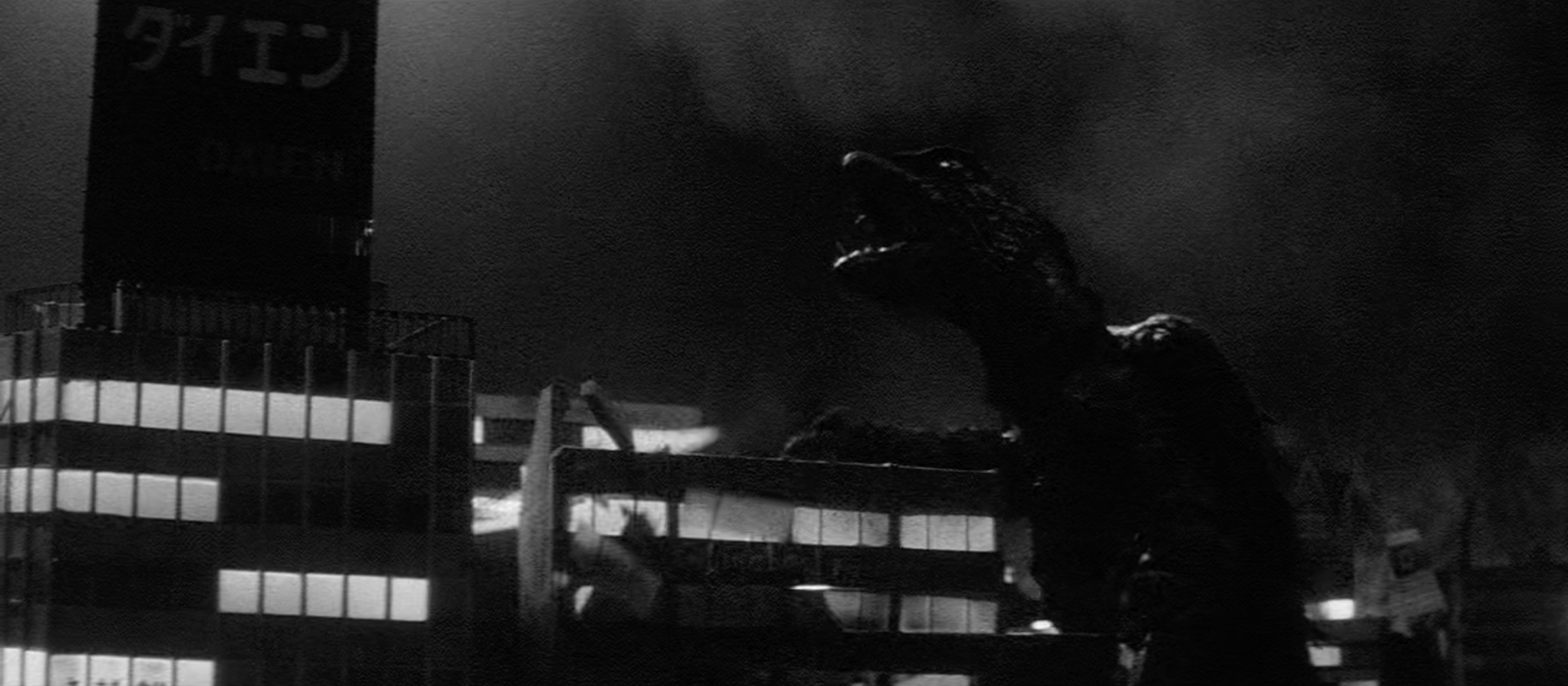
The special effects don’t reach the level of Eiji Tsuburaya but they’re not terrible. Daiei Studios didn’t have the same tradition of visual effects, and the budget was lower than what Toho would lavish on even a mid-budget Godzilla film. Special effects director Yonesaburo Tsukiji manages some good work with what he was given, such as the model planes and ship during the Arctic opening, Gamera’s destruction of a geothermal power plant (“a benefit to all”), and the animation for Gamera in flight. The black-and-white photography comes in handy, since it smooths over the model and optical effects. The weakest section is the obligatory attack on Tokyo, where the limited model work cannot hold up to Toho’s standards. (This is also the point where everybody needs to stop listening to Toshiro’s pleas about Gamera’s beneficial nature.)
Gamera has an awkward, almost silly design for the headliner of what’s supposed to be a serious monster film. Once later installments moved into spaced-out territory, Gamera started to look better. Director Noriaki Yuasa took over the special effects with the following film and gave them their unique look.
Daikaiju Gamera has appeared under several titles in English. This was the only classic era Gamera film that received a first-run US theatrical release, retitled Gammera the Invincible with the extra “m” inserted to keep people from pronouncing the monster’s name as “GAH-mare-ah.” World Entertainment Corp. and Harris Associates, Inc. handled the release and North Americanization using footage of Albert Dekker and Brian Donlevy as US military officers. This version hasn’t seen a legitimate release since a pan-and-scan DVD from the early 2000s.
Gamera the Giant Monster was among the five Gamera films distributor Sandy Frank Entertainment purchased in the 1980s. Frank only had access to the Japanese version, not the American footage. He gave the film a cheap dub but kept it mostly intact, then released it to television with the simple title Gamera. When Mystery Science Theater 3000 picked up the rights to the Gamera movies, they purchased the Sandy Frank versions. This explains the absence of two films from the original MST3K line-up: Sandy Frank never obtained the rights to Gamera vs. Viras or Gamera vs. Jiger, and I don’t think anybody even considered Gamera: Super Monster or knew it existed. The recent MST3K seasons corrected this oversight by finally riffing Gamera vs. Jiger.
Gamera will be back, like it or not, in Gamera vs. Barugon (1966).
Rating: Poor
Next: Gamera vs. Barguon
 The Ultra Project