Directed by Harunosuke Nakagawa. Written by Masahiro Yamada. Airdate Feb. 6, 1966.
The Ultra series frequently mines fairy tales for story material. Eiji Tsuburaya loved the idea of entertaining children, so it makes sense that his work would go in this direction.
“Grow Up! Little Turtle” is the Ultra series’ first exploration of the fairy-tale realm. It’s Ultra Q’s manifesto that it will travel to whatever bizarre locations of the imagination it feels like, including outright children’s fantasies. The show has had some weirdness before, but now all bets are off. To make that clear, the main cast only makes a short cameo, and the surf-rock main theme is replaced by a more buoyant musical piece. Ultra Q is fully embracing its anthology roots.
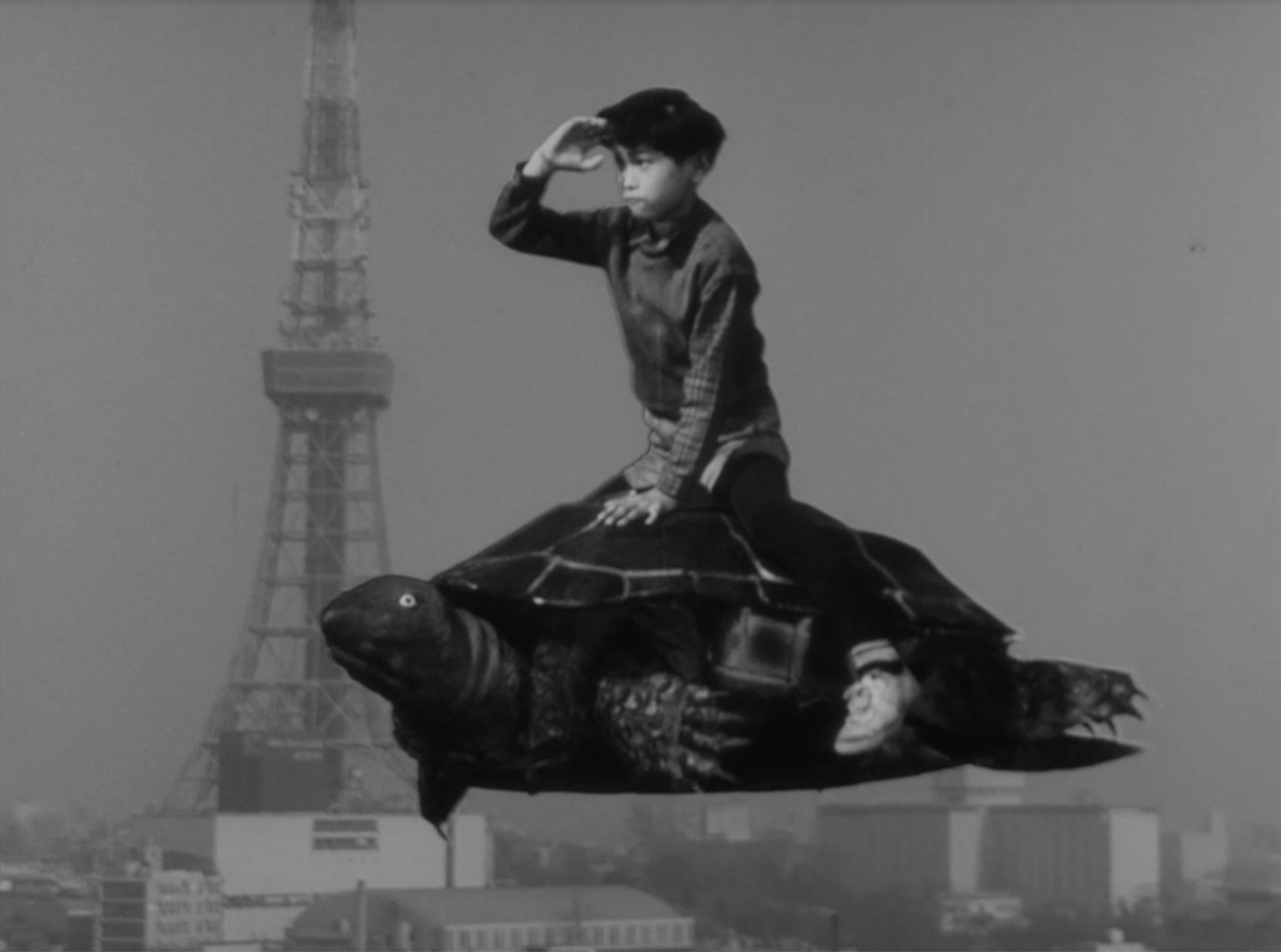
The script is based on the Japanese folklore story “Urashima Taro.” In the most common version of the tale, a fisherman named Taro rescues a turtle, and as a reward the turtle carries him on its back to the underwater Dragon Palace. Taro spends several days with the princess of the Dragon Palace before he returns to his village, where he discovers he has actually been gone for over a century. He chooses to open a jeweled box the princess gave him, even though she warned him never to open it. When he does, the years catch up with Taro and turn him into an old man. The story has similarities to Washington Irving’s “Rip Van Winkle” and other folklore tales from around the world. It was adapted in 1918 into the oldest known Japanese animated film, now lost.
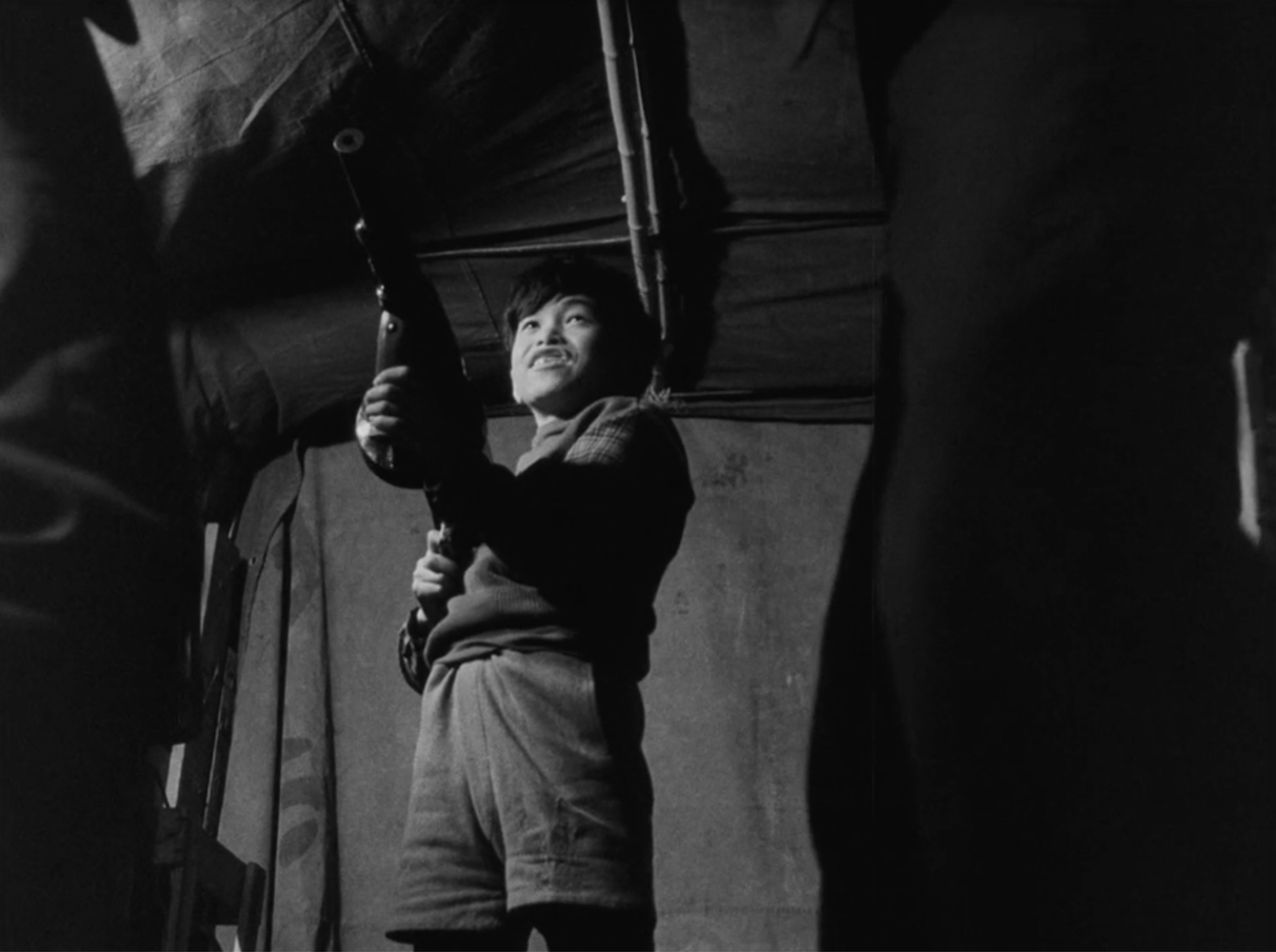
How does Ultra Q adapt this story? The creative team changes Taro into a child, then adds machine gun-toting bank robbers who kidnap the boy and his turtle. The action then switches to a “kid empowerment fantasy,” where the child gets the drop on the robbers because they’re actually complete idiots. (Not surprising considering one of them is played by comic actor Masanari Nihei, in the second of three Ultra Q roles before becoming a lead in Ultraman.) There’s a hilarious scene of Taro chasing the two doltish criminals through an amusement park with his stolen machine gun, screaming “Give me back my turtle!” while charming music plays. Folks, was this what you expected from “The Japanese Twilight Zone?”
(Aside: This won’t be the last time in the Ultra series that children will irresponsibly wield heavy weaponry.)
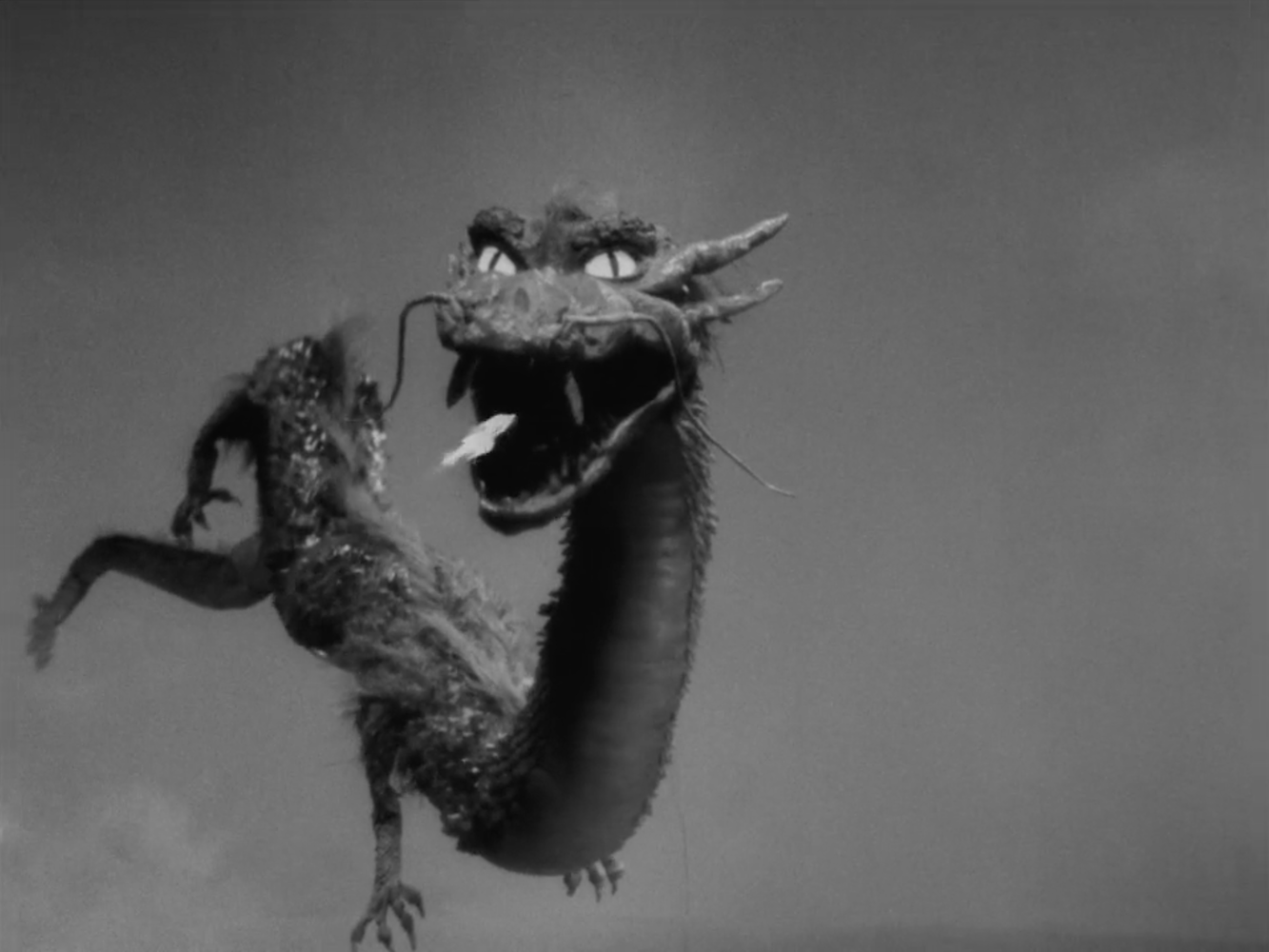
It’s almost halfway through the episode before anything supernatural occurs. Taro’s turtle inexplicably grows while the boy is down in a city storm drain with the two robbers. The fairy tale part kicks in, and it’s a faithful rendition … if you ignore that the turtle has a speedometer, the Dragon Princess rides a rocket, and Taro does a Looney Tunes gag with a pretend atomic bomb. A dragon pops up briefly, played by Manda from Atragon (1963). The coda makes a small pretense at a moral about why you shouldn’t lie, but the real moral is that inner lives of children can be utterly cracked.
Maybe it’s not a faithful rendition. It’s a faithful parody.
By the way, does this story of a kid and his affection for a big turtle make you think of another piece of Japanese media? Why yes, the original Gamera the Giant Monster came out the year before. It didn’t have a direct impact on “Grow Up! Little Turtle” because it was released to theaters in November of 1965 after production had almost wrapped on Ultra Q. Boys and pet turtles were just on people’s minds in mid-‘60s Japan, I guess. The turtle in this episode was retroactively named “Gameron,” however. Cute.
This episode blindsided me the first time I watched Ultra Q. I thought I understood what the show was going to be like based on the first five episodes. Then along comes a children’s fairy-tale comedy where the main cast hardly appears. Even based on my experience with Ultraman’s comedy outings and surreal detours, I wasn’t prepared for Ultra Q to swerve in such an eccentric direction. I wasn’t certain if I liked it.
Then, six episodes later, the epiphany happened with “Kanegon’s Cocoon” that solidified my understanding of not only Ultra Q, but the entire Ultra series. More on that when I get to it, but I’ll say here that my appreciation of “Grow Up! Little Turtle” has grown significantly within the context of the series. It’s funny, it’s fast-moving, it’s filled with bizarre surprises — all around, it’s pretty fantastic.
Rating: Great
Previous: Peguila Is Here!
Next: S.O.S. Mount Fuji
 The Ultra Project