
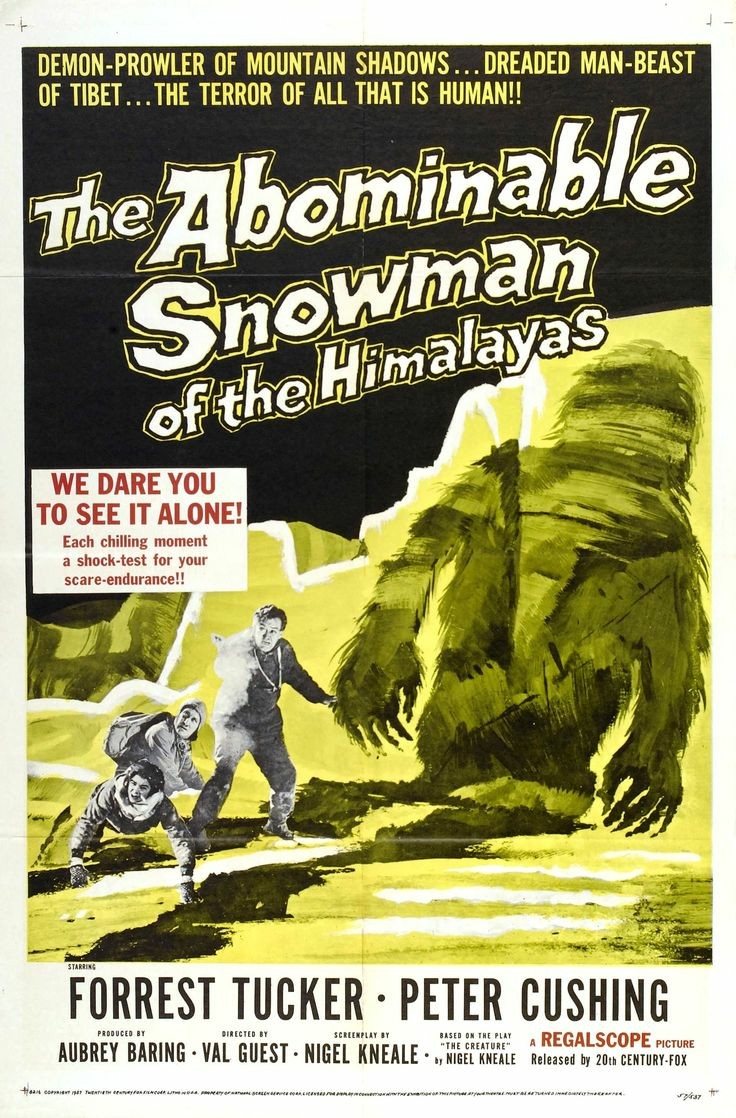
Directed by Val Guest. Written by Nigel Neale. Starring Peter Cushing, Forrest Tucker.
I’m inaugurating an occasional feature of reviews of monster movies outside the world of Japanese tokusatsu. Monsters are glorious, they live in cinemas all over the world, and I’ll take any excuse to talk about them. And my love for Hammer Films is as strong as my love for tokusatsu. In a different mood, I might have created a whole blog just about Hammer movies.
Reviewing the Ultra Q episode “Peguila Is Here!” inspired me to take another look at one of the snow-bound horror films of the 1950s that inspired it, a semi-obscure marvel from Hammer that did unusual things with the legend of the Yeti. It’s a film that needs more exposure because it’s a unique, almost ethereal science-fiction tale hidden behind what appears to be a rote B-movie monster flick.
Before Hammer discovered the lucrative field of colorful Gothic horror through the smash hits of The Curse of Frankenstein and Dracula (titled Horror of Dracula for US release), they had massive success with black-and-white science-fiction horror films. The most notable were the Quatermass movies based on the popular television serials by writer Nigel Kneale: The Quatermass Xperiment (1955) and Quatermass 2 (1957) — both of which influenced Eiji Tsuburaya and Ultra Q. Hammer also produced a Quatermass-alike, X the Unknown (1956), after Kneale refused to let them make an original Quatermass movie. In 1967, the studio completed adapting the Quatermass serials with the film version of Quatermass and the Pit, one of the finest films the studio ever made.
Although Kneale was vocally unhappy with the changes director Val Guest made to his Quatermass serials for the film versions, he was willing to partner with Guest to work on a third project based on another of his teleplays, The Creature, about a hunt for the Yeti in the Himalayas. The movie, titled The Abominable Snowman, completed production before the release of The Curse of Frankenstein, making it the last Hammer film produced before the bloody Eastmancolor explosion swept up the studio. It’s a restrained and cerebral movie much different from the lurid Gothics that would soon define the studio output. It also defies the expectations of contemporary audiences who think they know what they’ll get when they see “Abominable Snowman” in the title. Hammer at the time sold the horror category with advertisements: take a look at the hyperbole on the poster.
That ad copy may have gotten people in seats, but they were likely disappointed. The Abominable Snowman isn’t a “monster on the loose” flick, nor do I dare you to see it alone. If AIP had made this movie in the 1970s among the glut of Bigfoot flicks, it would’ve been a Jaws copycat with loads of blood. But here in the 1950s, we instead have a wilderness adventure with science-fiction overtones. The Abominable Snowman isn’t so much a monster movie as it is a Lost Race story. The title creature is rarely seen; only a hand and arm here and there — although it’s a frightening-looking hand — and a brief glimpse of the full body and face at the conclusion.

The Yetis are the film’s biggest surprise, and not just because we barely see them. In Kneale’s vision, the Yetis may be a parallel line of evolution with humanity and the great apes. Kneale puts this postulating in the mouth of Peter Cushing’s character, botanist Dr. John Rollason: “This creature may have an affinity for man, something in common with ourselves. Let’s remember that before we start shooting.” They turn out to have much more than an affinity with man. They may be vastly superior, and have mental abilities beyond what humans can understand.
The real danger is from the humans searching for the beast in the Himalayas, who are a greater threat to themselves than the Yeti is to them. Peter Cushing (reprising his part from The Creature) plays Rollason as a rational man willing to step outside of the boundaries of conventional science, a template for many of the Hammer characters he would play. Rollason tromps off with an American-funded expedition into the mountains of Nepal. But the expedition head, gruff American Tim Friend (Forrest Tucker), turns out to be, as Rollason puts it, “nothing more than a cheap fairground trickster.” The Yeti is Friend’s next prize — even if he has to invent the damn thing. Which he considers trying … using a snow monkey. I’m not making this up.
The production team headed by Hammer’s brilliant production designer Bernard Robinson does an excellent job mixing the studio sets of the mountains, shot at Pinewood studios, with actual climbing footage shot in Switzerland and the Pyrenees. The actors deserve a lot of credit for selling the sheer cold and exhaustion of the high mountains. Cushing nails his part, as usual. The idea that I would ever dislike a performance by Peter Cushing, my favorite actor, is bizarre.

Kneale’s script pays special attention to the Nepalese culture and its mysticism, adding an aura of spirituality to what might have been just another monster-hunt flick. Humphrey Searle’s echoing music contributes to the atmosphere and the images of the mountains, many of which look inspired by Nicholas Roerich’s famous Tibetan paintings. The matte painting of the exterior of the Tibetan monastery might as well be a black-and-white version of a Roerich painting.
As much as I like The Abominable Snowman, I can’t imagine it getting wide appreciation or emerging from its icy nook within the Hammer filmography. It staunchly refuses to do the ordinary things the average audience expects of it. Fifty minutes pass before the Yetis have any direct impact on the expedition. That length may not hold many viewers today. I find the movie haunting and enthralling, in particular the transcendent ending, but I’m afraid too many will dismiss it as boring. Director Val Guest had similar thoughts: “No one was expecting films from Hammer that said anything but this one did […] audiences didn’t want that sort of thing from Hammer.”
Toho released their own Yeti film in 1965, Half Human (known in Japanese as “Beastman Snowman”), directed by Ishiro Honda with effects by Eiji Tsuburaya. This might have put the idea of a snowbound horror story in Tsuburaya’s mind, leading to “Peguila Is Here!” and possibly the Ultraman episode “Phantom of the Snow Mountains.” Half Human has almost gone missing completely because of objections to its portrayal of the native Ainu people. Toho has yet to release it in any home video format. It’s the only Ishiro Honda-Eiji Tsuburaya joint venture I haven’t seen.
Related to home video: The Abominable Snowman was trimmed by five minutes for its US release. When Shout! Factory prepared their Blu-ray release of the film, the licensor sent them only the edited US version. To present the most complete version, they added the missing scenes using upscaled standard definition footage. Not an ideal situation, but it seems the complete version of The Abominable Snowman is currently missing … or the licensor just didn’t feel like digging it up. That matches the dismissive attitude this gem of early Hammer lore still receives.
Rating: Great

 The Ultra Project