
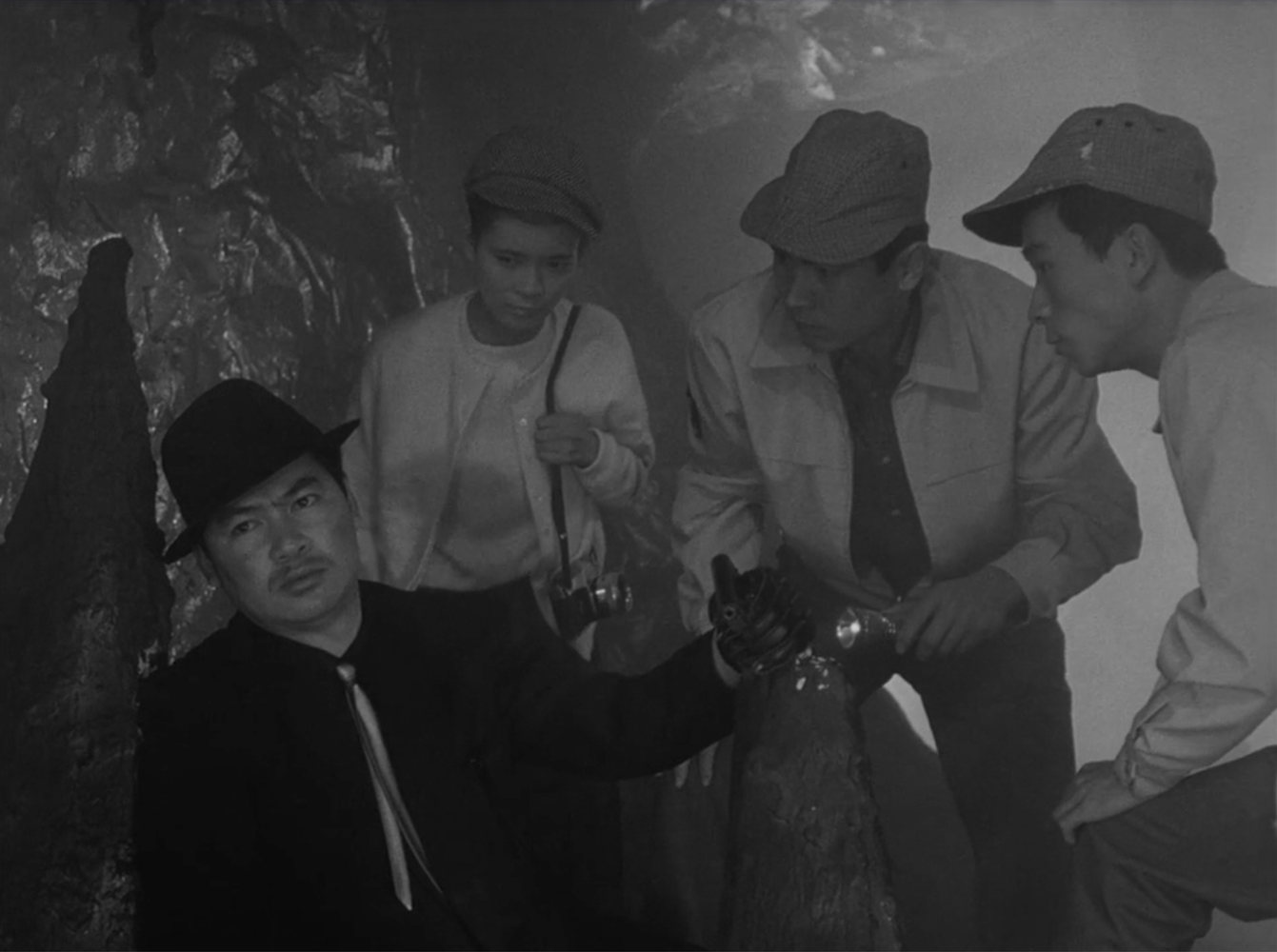
Directed by Hajime Tsuburaya. Written by Tetsuo Kinjo. Airdate Jan. 16, 1966.
We have the Ultra series’ first alien creature, a monster Martian slug, which is also the first fully original kaiju design seen on the show. Resident scientific genius Professor Ichinotani (Ureo Egawa) makes his debut. There’s a freaky theme about humanity intruding where we’re not wanted. And Jun gets into a fistfight with a thief dressed up to audition for a Yakuza gangster flick. Best episode so far!
Something I’m discovering as I write these reviews is that it’s tricky to discuss Ultra Q’s development when viewing the show in broadcast order because the episodes weren’t aired in anything close to production order. I could say that “The Gift From Space” shows Tsuburaya Pro finding its footing and stretching out in stranger directions after two traditional monster outings — except “The Gift From Space” was produced before either of those episodes. Any linear development is an illusion in viewers’ heads. The writers and crew already had confidence when tackling strange, moody stories.
The main trio of Jun, Ippei, and Yuriko take on more central protagonist roles, getting involved in the major sequences and working closely with Professor Ichinotani. Jun and Yuri put the story in motion in the opening when they make a discovery while flying over the ocean: a capsule from a rocket that crashed onto the Martian surface years ago. That the Earth has sent vessels to Mars seems to indicate that the show is taking place in the future, although it might simply be an alternate present, which was often the case with Toho science-fiction films.
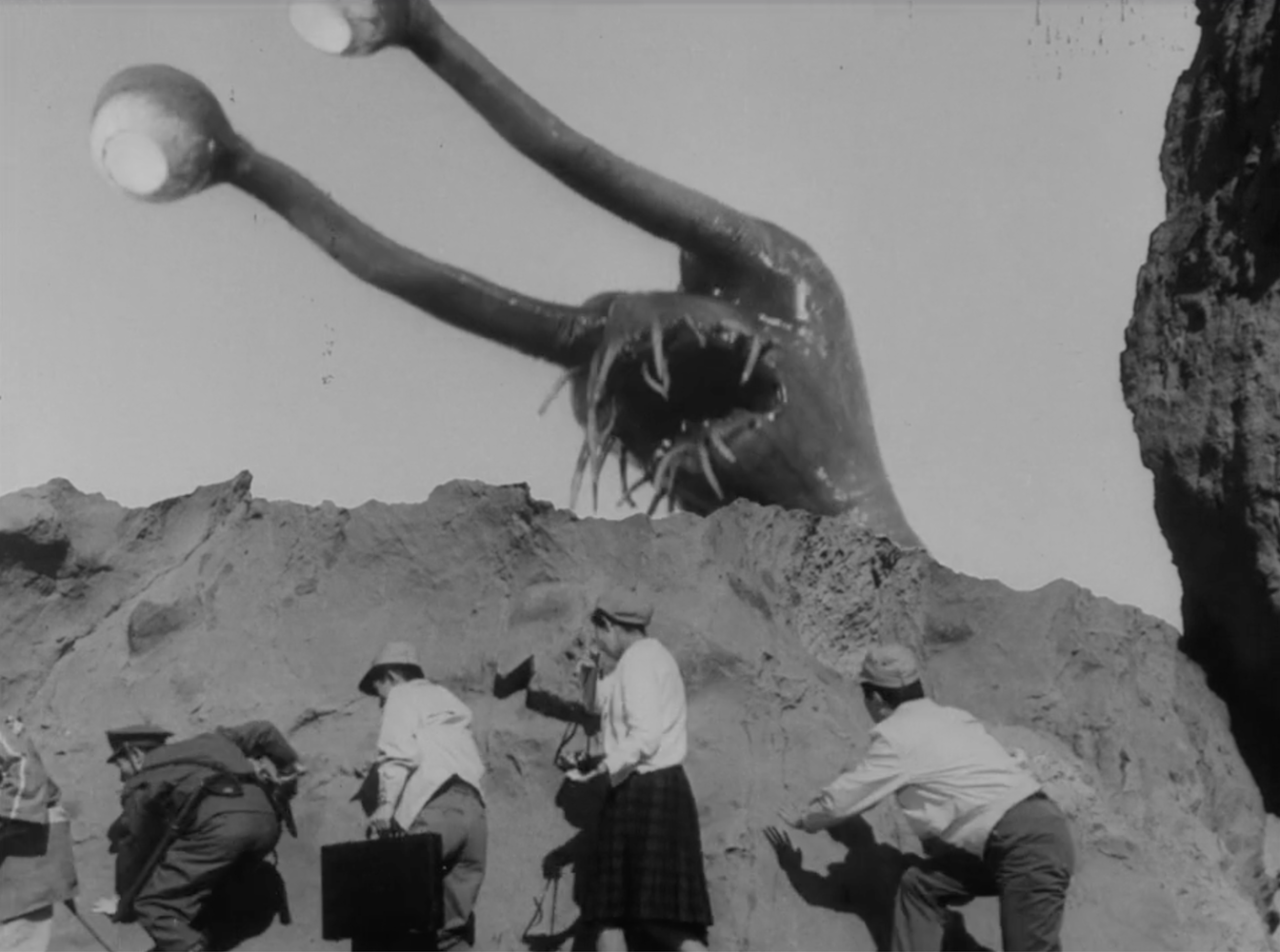
The returning Mars capsule contains golden spheres, and no one can figure out what message they might carry. A possible friendly greeting from the Martian? Or something more sinister? A thief steals the spheres from a safe, then forces Jun to fly him to a remote island. This is where we get the fistfight, which goes on longer than you’d expect. The thief joins a compatriot in a cave, where they find out the mystery sphere is actually an egg that enlarges and hatches Namegon, a bizarre giant slug creature. Namegon immediately kills the two criminals, thus answering the question about whether this embassy from Mars was meant as a friendly gesture or not.
During a Defense Agency meeting where the military and scientists debate the meaning of the gold spheres, Chief Sakamoto warns that “Optimism is dangerous.” The episode appears to support this view with its message that extraterrestrials do not want humans poking around in the stars. It’s the first Ultra episode with an alien, and the alien brings this warning: “Here be dragons, and we’re the dragons and we’ll damn well end you if you step off your planet.” The Ultra franchise has themes of hope for the future of humanity, but it also has a pessimistic view about what the rest of the galaxy’s inhabitants feel about humanity.
“The Gift From Space” is close to the tone of an Outer Limits episode. Namegon isn’t a standard rampaging kaiju but an eerie entity whose mere existence and what it means is a greater threat than what it can do. A mystery aura hangs over everything and the weird finale refuses to deliver a straightforward wrap-up or clear answers. Instead, Kinjo’s script and Hajime Tsuburaya’s direction leave viewers with a sensation of unease. The ending could easily fit an anthology show where we never expect to see these characters or this setting again.
On a lighter note, there’s a suggestion Ippei has a crush on Yuriko. That’s cute but also a dead end because the show continues to hint at Yuriko and Jun hooking up. Yuriko’s boss Seki gets the episode’s best line: when a cowardly reporter asks for more information about the monster, Seki snaps, “Idiot, it’s a monster because it’s unknown.”
Our special guest star is Jun Tazaki as Chief Sakamoto. Tazaki appeared as military figures in numerous Ishiro Honda films and played the newspaper editor in Mothra vs. Godzilla. His best role is the captain of the super-submarine in Atragon (1963), where he delivers a nuanced, moving performance.
Rating: Good
Previous: Goro and Goro
Next: Mammoth Flower
 The Ultra Project