
Directed by Hajime Tsuburaya. Written by Tetsuo Kinjo. Airdate Jan. 7, 1966.
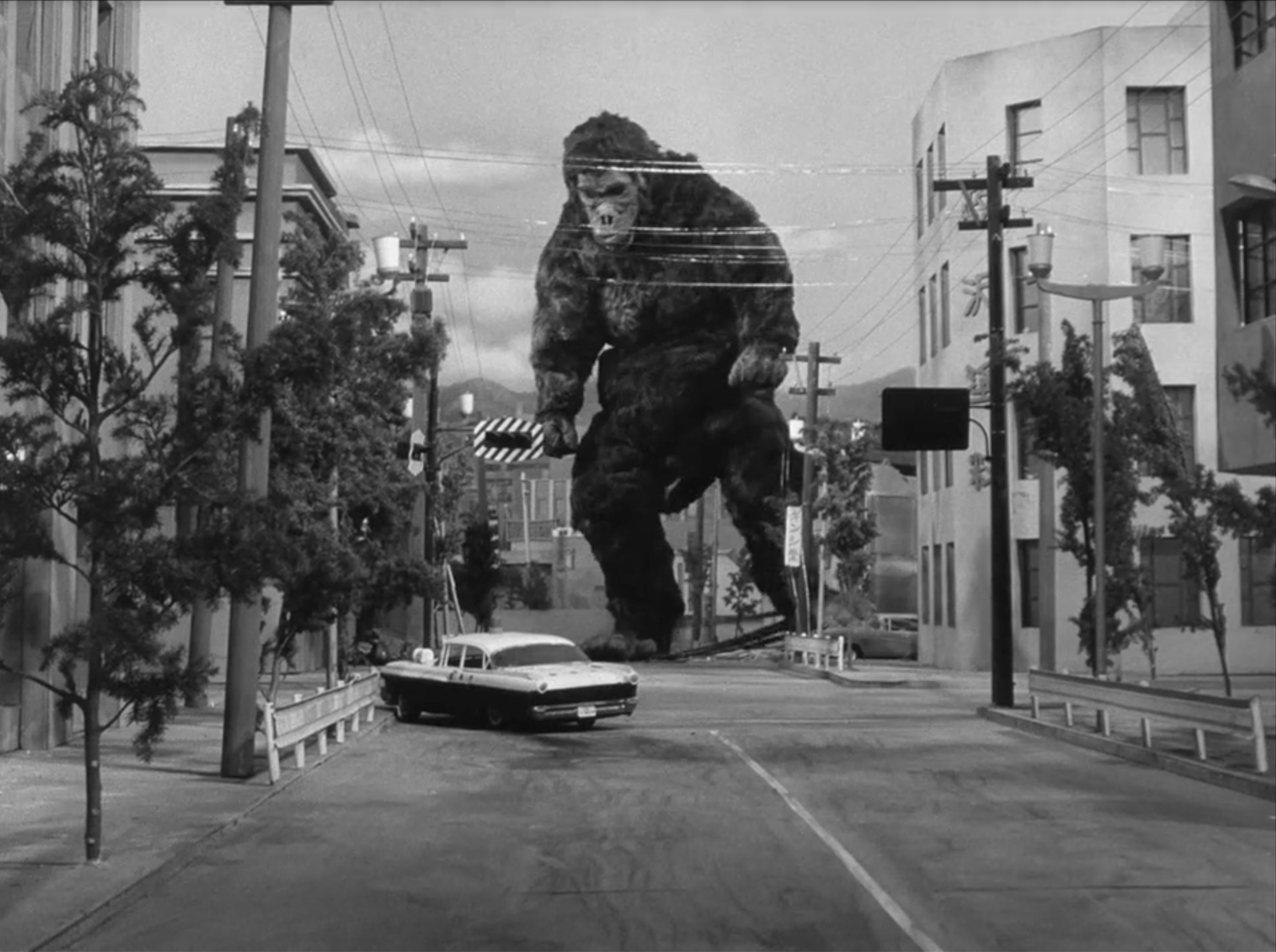
If you have Godzilla in disguise in the first episode of your monster TV show, why not have King Kong in disguise in the second? It must have made sense for the Tokyo Broadcasting Service, who picked “Goro and Goro” for Ultra Q’s second aired episode. The monster star, one of the two Goros of the title, is a slightly modified King Kong costume built for the movie King Kong vs. Godzilla (1962).
If “Defeat Gomess!” is a capsule of Toho monster movies, “Goro and Goro” is a capsule of earlier American monster movies. Experimental science accidentally enlarges an animal to titanic size, it goes on a rampage, and the military confronts it. It’s one of the simpler Ultra Q stories, and the show would get another crack at a similar plot with “Terror of the Sweet Honey,” although it would get a bit loonier. A giant mole is always loonier than a giant ape.
Tetsuo Kinjo’s script has specific Japanese reference points to liven up the conventional Hollywood B-movie story. The setting is Amagi Mountain, famous for its indigenous monkey population. The catalyst for the monkey’s growth to giant size is a potion made from Aoba walnuts that was originally developed to increase soldiers’ stamina during World War II. The episode doesn’t dwell on this, and considering what I know about Kinjo’s other scripts, I wonder if he’d planned to make this element more prominent.
Kinjo’s most important contribution to the standard story is the linchpin character of Goro (Kazuo Suzuki), a custodian at a forest research lab. Kinjo was drawn to outsider figures like Goro, a mute with a possible learning disability who’s bullied by villagers. Goro finds companionship with the Amagi monkeys, specifically the monkey named after him for whom he’s a “foster parent.” Kinjo took cues from the original King Kong in the bonding scenes between the two Goros. It’s no surprise that King Kong got into the Ultra series so early — it’s the movie that inspired Eiji Tsuburaya’s whole career.
Our trio of leads mostly play the part of observers. Yuri-kun shows up late with some info she gathered about another giant monkey she encountered in the South Seas, and Jun and Ippei make several helicopter trips to shuttle the other characters to the scenes of the action. Seki, Yuriko’s boss at the newspaper, gets a meaty part and does more to resolve the action than the series leads. Seki is always a welcome presence: actor Yoshifumi Tajima enlivens any scene he’s in.
Although there’s plenty to enjoy, what holds the episode back for me personally is Goro (the monkey, not the man). It’s the same problem I have with King Kong vs. Godzilla: Eiji Tsubaraya’s version of Kong looks sloppy. The costume lacks a strong build, its fur is matted and clumpy, and the face is elongated and goofy. Repurposed as a monkey with a tail and different ears improves the costume, but it still looks awkward and silly. I know, I know: many people think all Japanese giant monsters look awkward and silly. I don’t. Except in a few cases, and this is one.
At least the visual effects for Goro’s final rampage in the town are solid. Want to see a giant monkey smash stuff? Tsuburaya Pro has got you covered.
Two important names appear in the supporting cast. Yoshio Tsuchiya plays the head scientist in charge of the research facility at Mt. Amagi. Tsuchiya was a familiar face in Ishiro Honda’s films, noted for quirky parts in Battle in Outer Space and Invasion of Astro Monster. He was also a favorite of Akira Kurosawa’s, playing the lead villager in Seven Samurai. In a small part as a milk truck driver is comic actor Masanari Nihei, who’d go on to fame as Ide, one of the leads in Ultraman and arguably that show’s best character.
Rating: Average
Previous: Defeat Gomess!
Next: The Gift From Space
 The Ultra Project