
Ultra Q created the basic style of the Ultra series with its mixture of giant monsters and investigators of the strange and unusual, its medley of different story types that could swing from weird science and espionage to fairy tales and outright comedy. But the Ultra series wouldn’t have marched on as it did if the next show, Ultraman, didn’t add something essential for its future survival: a repeatable and appealing all-ages formula that brought in a central icon — a superhero.
If Ultraman never happened, Ultra Q would still be a fantastic show and had several revivals the same way The Twilight Zone had its own revivals. But Ultraman became a phenomenon that Tsuburaya Productions could repeat and use to build an infinite merchandising empire. Sometimes this formula would grow tired — inevitable when something continues for more than 50 years — but using the creativity of Ultra Q as its starting point, the adventure of the giant alien superheroes known as the Ultras would result in many excellent shows and spectacular episodes.
Ultraman is still one of the best of the Ultra shows, even as it occasionally stumbles in its early episodes as it figures out how to execute its new premise: a giant superhero working beside an official monster defense team equipped with futuristic gizmos and vehicles. The same Tsuburaya team that made Ultra Q a success put their creativity to the best use in a colorful science-fiction program that thrilled children and adults alike.

The Background
Development on Ultraman started in December 1965 before the first episode of Ultra Q aired. The Tokyo Broadcasting System sensed they had a smash success coming and wanted Tsuburaya Pro to strike fast with a new program to immediately follow Ultra Q. This new show would be in color to help international sales and feature giant monsters in every episode. Eiji Tsuburaya and writer Tetsuo Kinjo returned to an earlier pitch, Woo, about an alien visiting Earth, to create a new program with an alien superhero who aids humanity in the battle against the threat of giant monsters and hostile aliens.
Kinjo’s first pitch to TBS had a monster called Bemular as the hero: a winged and beaked creature standing on two legs. TBS worried Bemular was too “monstrous,” so Tsuburaya and Kinjo reworked the concept into a silver and red humanoid, originally called “Redman,” but eventually named “Ultraman” to tie the show to its predecessor. The series would feature a human member of the Science Special Search Party (SSSP or the Science Patrol) who merges with the alien Ultraman, allowing him to transform in times of need into the alien’s 40 meter-tall form using a special device called the beta capsule. It added a touch of Superman to the Ultra Q world and met TBS’s request of a monster-filled experience with each episode.
Tsuburaya blasted off into making the new show — although they didn’t have much time, as TBS wanted Ultraman to premiere right after the last of Ultra Q’s original 28 episodes finished airing in July 1966. Tohl Narita again worked as the main creature designer, and he refined Ultraman into his iconic Space Age appearance, a fantastic contrast to many of the kaiju Narita and Co. created as adversaries. A “color timer” was added to the costume late in pre-production to create a ticking-clock suspense element warning when Ultraman would run out of energy. Composer Kunio Miyauchi returned to create the famous “Song of Ultraman” with lyrics by Hajime Tusbaraya, a jazzy number with a children’s chorus that remains the best-remembered theme song of any Ultra show. (I prefer the English language lyrics and adult chorus performance from the dubbed version, as the children can sound a bit shrill.)
Production started in March 1966 while Ultra Q was scoring massive ratings with audiences. Even though Ultraman was the most expensive Japanese TV show ever produced, with episodes that cost three times those of Ultra Q, the production team still had to work around tight budgets and the insane time crunch to get the first episode ready for a July premiere. Ultraman was photographed in 16mm rather than 35mm to offset the switch to color, giving it a more grainy appearance (and which is much more noticeable today on Blu-ray releases, although it doesn’t hurt the show).
Tsuburaya Productions delivered the completed first episode of Ultraman, “Ultra Operation No. 1,” only four days before its July 17 airdate. TBS aired a hastily assembled live stage show, “The Birth of Ultraman,” to hype the show and give Tsuburaya Pro the extra days needed to make the deadline. The hype worked. Ultraman was an immediate hit that exceeded Ultra Q’s already impressive numbers. It averaged a 36.8% ratings share (the peak for Ultra Q) and peaked at a staggering 42.8% share.
The Cast
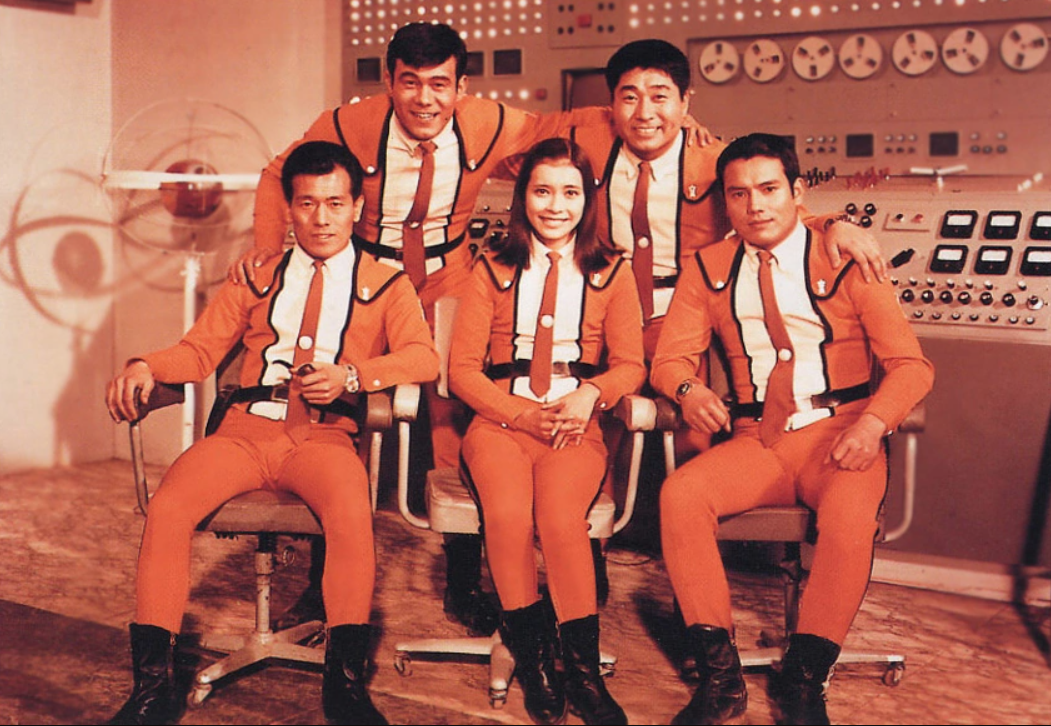
Early show concepts had a larger cast of characters in the Science Special Search Party, but it was honed down to a tight five. And what a great crew! The SSSP is rightly considered one of the more memorable defense teams in Ultra history, with standout characters who function as well together as the crew of the USS Enterprise. We wouldn’t have a defense team line-up this strong again until the Heisei Era, although most teams would follow the archetypes Ultraman established: tough guy, comic relief, stoic captain, the girl, etc.
Let’s meet the Science Patrol…
- Captain Toshio Muramatsu (Akiji Kobayashi): Calm, experienced, fatherly. Just what you want in a commander. A former astronaut who is cool under pressure, Muramatsu set the standard for future defense team commanders, although we wouldn’t see someone with his charm and charisma again until Captain Iruma in Ultraman Tiga.
- Daisuke Arashi (Sandayu Dokumamushi): Defense teams need hot-headed weapons specialists, and Arashi created the mold. He’s the top marksman in the Science Patrol and loves to wield his spider-shot rifle, the show’s signature weapon. He’s a tough guy and leans into the image, but he’s also rather lovable and a team player — although his suggestions are usually bad ideas.
- Mitsuhiro Ide (Mansanari Nihei): Rarely has a comic relief character succeeded so well. Ide, the Science Patrol’s chief inventor, is the heart of the human cast. It’s easy to dismiss his comic antics at first: he’s an extremely Japanese style of comedian with exaggerated facial expressions and theatrical cowering. Think Shaggy from Scooby-Doo. But Ide emerges as a strong figure who takes his job seriously, and he’s responsible for some of the show’s best moments. The late Mansanari Nihei’s performance is one of the most memorable of the Ultra series.
- Akiko Fuji (Hiroko Sakurai): Hiroko Sakurai is the one lead from Ultra Q who carried over to the new show, and I’m glad Tsuburaya picked her because she injects energy into a character that might have been relegated to generic “the girl one.” We’d see numerous examples of “the girl one” archetype in later shows, but Sakurai’s youthful zip makes Fuji the best character after Ide. If there were fan shippers in 1966, the Ide/Fuji ship would dominate.
- Shin Hayata (Susumu Kurobe): The team member who turns into Ultraman. And … there isn’t much more to say. One character had to end up as the least interesting member of the Science Patrol, and since Hayata gets to be the big superhero, his human side ends up less developed as a character.
Along with the regular cast are several recurring characters, such as young Isamu Hoshino (Akihide Tsuzawa), a boy who longs to join the science patrol. Hoshino vanishes after episode 25, “Mysterious Comet Tsuifon,” without explanation; the real-world reason was that actor Tsuzawa injured his leg. Akihiko Hirata, one of the stars of the original Godzilla and part of director Ishiro Honda’s ensemble, appears in several episodes as Dr. Iwamoto, science advisor to the SSSP and designer of their signature vehicle, the Jet VTOL.
For the part of Ultraman himself, stunt performer Bin Fururya filled out the silver and crimson suit. Furuya had played several Ultra Q monsters like Kemur and Ragon, and would later star as regular defense team member Amagi in Ultraseven.

Ultraman Rules!
Ultraman is one of the most successful television shows ever made. It has spawned over thirty-five spin-off shows and counting. It created Japan’s most famous superhero. It generated imitators and rip-offs. It is still adored around the world — and it deserves every bit of praise and love it receives.
Simply put, this show rules. It has colorful superhero thrills in a fabulous Space Age ‘60s design, episodes with horror and outrageous comedy, serious SF outings with social messages, unusual visuals that continue to get more inventive, and a cast of characters who leave lasting impressions. It’s a big love letter to fantasy and special effects, and like Superman and Star Trek, it leaves viewers with a sense of hope.
This was the first Ultra show I ever watched. I have dim recollections of seeing it as a young child when it still played in syndication on US television. According to my father, it was one of the first TV shows I watched regularly. As an adult, it was the first Ultra show I watched from start to finish, and that initial watch-through is what won me over to the whole series and made me want to seek out the other programs, in particular Ultra Q, which had its swirling logo (now in greens and blacks) attached to the start of each Ultraman episode. This logo was a way to remind Japanese viewers in 1966 that the new program was coming straight from the science-fantasy show they loved, even as it offered something different and bigger. For me, it was an invitation to go backwards and find out what this Ultra Q business was about. But I also went forward, and there was still so much Ultra to discover.
TBS wanted more Ultraman at the end of its 39 episode run (three blocks of 13 episodes), but Tsuburaya Productions was exhausted and wanted to take a break. They had ideas for a new program as a follow-up, but it would be six months of re-runs of Ultra Q and Ultraman before the word “Ultra” appeared on a new show…
Previous: Open Up!
Next: The Birth of Ultraman
 The Ultra Project